
TZM Molybdenum Alloy Plate and Sheet ASTM B386
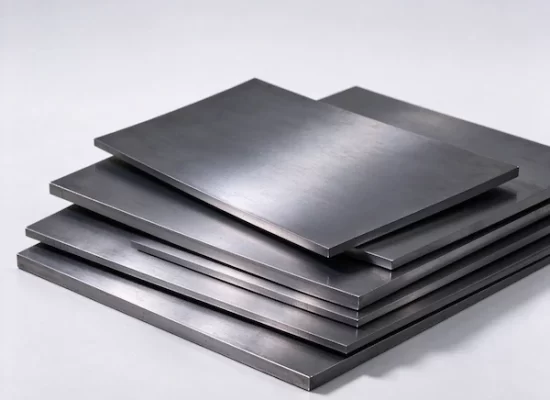
TZM molybdenum alloy plate and sheet are flat rolled refractory materials manufactured to ASTM B386 Type 36x from powder metallurgy or arc-cast titanium-zirconium-molybdenum alloy. Nominal composition is balance molybdenum, 0.40–0.55% Ti, 0.06–0.12% Zr, and 0.01–0.04% C (Mo-0.5Ti-0.08Zr-0.03C). We supply sheet from 0.1 mm to 3 mm and plate from 3 mm to 10 mm; thicker billets are available on request. Widths go up to 660 mm (26″) and lengths up to 2000 mm (80″), with material offered in stress-relieved, annealed or as-rolled condition. Available surface finishes include ground, as-rolled (milled), chemically cleaned, or pickled. TZM sheet and plate serve as standard flat refractory stock for vacuum furnace heat shields and hearth plates, rocket nozzle and thrust chamber liners, semiconductor sputtering targets and backing plates, X-ray tube components, glass melting forehearth and feeder hardware, aluminum die-casting and extrusion die inserts, isothermal forging dies, high-temperature fixtures, and sapphire crystal growth furnace parts. Every order ships with an MTC containing chemistry, density, room and high-temperature tensile/yield data, hardness, grain size, flatness and dimensional inspection results.
We are a direct bulk manufacturer supplying cut-to-size plate, sheet, foil, plus custom-machined parts to customer drawings, with mill-direct pricing and global delivery.
Technical Specifications
| Property | Value |
|---|---|
| Standard | ASTM B386 (Type 36x) |
| Density | 10.2 g/cm³ |
| Melting point | 2620°C |
| Recrystallization temperature | ~1250 – 1400°C |
| Service temperature | 1000 – 1700°C (vacuum / reducing atmosphere) |
| UTS at RT (annealed) | 700 – 900 MPa |
| UTS at 1300°C | ~250 – 350 MPa (≈2× pure Mo) |
| Elongation | 10 – 20% |
| Hardness | HV 220–280 |
| Thermal conductivity | ~130 – 140 W/(m·K) |
| Coefficient of thermal expansion | ~5.5 × 10⁻⁶ /K |
| Flatness (ground plate) | ≤ 1.5 mm/m |
What Is TZM Molybdenum Alloy Plate? Composition & Standard
TZM plate/sheet is the flat-rolled product form of titanium-zirconium-molybdenum, the most common molybdenum-based high-temperature alloy. It is governed by ASTM B386 (Standard Specification for Molybdenum and Molybdenum Alloy Plate, Sheet, Foil, and Coil).
Chemical Composition (wt%)
| Element | Ti | Zr | C | O | Mo |
|---|---|---|---|---|---|
| Content | 0.40 – 0.55 | 0.06 – 0.12 | 0.01 – 0.04 | ≤0.03 | Balance |
Plate & Sheet Dimensions
| Parameter | Specification |
|---|---|
| Forms | Foil, sheet, plate, coil |
| Thickness | 0.1 – 3 mm (sheet/foil); 3 – 10 mm (plate); thicker up to 75 mm on request |
| Max width | 660 mm (26″) |
| Max length | 2000 mm (80″); cut-to-size |
| Temper | Stress-relieved; annealed; as-rolled |
| Surface | Ground; as-rolled/milled; chemically cleaned; pickled |
| Flatness | ≤1.5 mm/m (ground plate) |
| Standard | ASTM B386 |
| Inspection | Chemistry, density, tensile (RT + elevated temp), hardness, grain size, ultrasonic, flatness, dimensional |
ASTM B386 Molybdenum Alloy Plate/Sheet/Foil — Full Grade Comparison
ASTM B386 covers molybdenum and molybdenum alloy plate, sheet, strip, foil, and ribbon under a unified Type 36x designation system — ranging from unalloyed vacuum-arc and powder-metallurgy molybdenum (Types 360/361/365) through the high-strength TZM grades (Types 363 and 364, Mo-0.5Ti-0.1Zr) to the Mo-30W refractory alloy (Type 366). Whether you need economical pure molybdenum furnace sheet, the ~2× strength of TZM at 1300°C, deep-drawing low-carbon Mo, or glass-melting Mo-W stock, the correct Type below defines chemistry, melting route, and service temperature. We supply every Type in sheet, plate, and foil with mill test certificates and custom dimensions.
| ASTM B386 Type | Material Class | Manufacturing Route | Nominal Composition | C (wt%) | Density (g/cm³) | Melting Point (°C) | Recrystallization Temp (°C) | Typical Applications |
|---|---|---|---|---|---|---|---|---|
| Type 360 | Unalloyed Mo | Vacuum Arc-Cast (VAR) | Mo ≥99.95% | ≤0.030 | 10.2 | 2620 | ~1000 | General-purpose Mo plate, furnace heat shields, glass melting |
| Type 361 | Unalloyed Mo | Powder Metallurgy (P/M) | Mo ≥99.95% | ≤0.010 | 10.2 | 2620 | ~1000 | P/M Mo sheet, sputtering targets, electronic components |
| Type 363 | TZM Alloy | Vacuum Arc-Cast (VAR) | Mo-0.5Ti-0.1Zr-0.02C | 0.010–0.030 | 10.2 | 2620 | ~1250–1400 | Rocket nozzles, die-casting inserts, isothermal forging |
| Type 364 | TZM Alloy | Powder Metallurgy (P/M) | Mo-0.5Ti-0.1Zr-0.02C | 0.010–0.040 | 10.2 | 2620 | ~1250–1400 | Vacuum furnace heating elements, X-ray target bases, semiconductor |
| Type 365 | Unalloyed Low-Carbon Mo | Vacuum Arc-Cast | Mo ≥99.95%, low C | ≤0.010 | 10.2 | 2620 | ~1000 | Deep-drawn Mo parts (cups, boxes), highest formability |
| Type 366 | Molybdenum-Tungsten | Vacuum Arc-Cast | Mo-30W | ≤0.030 | ~11.9 | ~2750 | ~1200 | Glass-melting electrodes, molten glass / zinc-resistant hardware |
Molybdenum Alloy TZM Application
- Vacuum & high-temperature furnaces: Heat shields, hearth plates, support rails, furnace furniture, annealing/sintering boats, fixtures for HIP and sintering.
- Aerospace & defense: Rocket nozzle throat and extension liners, thrust chamber components, missile leading edges, gas valve and pipe components.
- Semiconductor & display: Sputtering targets (TZM target discs), backing plates, ion-implantation hardware, thin-film deposition components.
- X-ray & medical: Rotating-anode target base bodies, X-ray tube components.
- Glass industry: Glass-melting forehearth and feeder bowls, glass forming tools, handlers for optical glass.
- Hot-work tooling: Aluminum die-casting die inserts, extrusion dies, isothermal forging dies, hot-press platens.
- Sapphire & crystal growth: Sapphire growth furnace heaters and heat-exchange components.
- Nuclear: Reactor internals, sheath materials, valves.
Frequently Asked Questions
Q: What is TZM plate used for?
A: TZM plate/sheet is used in vacuum furnace heat shields and hearth plates, rocket nozzle liners, semiconductor sputtering targets and backing plates, X-ray anode components, glass-melting hardware, aluminum die-casting and extrusion die inserts, and sapphire crystal growth furnaces.
Q: What thicknesses are available?
A: Sheet/foil from 0.1 mm to 3 mm, plate from 3 mm to 10 mm, width up to 660 mm, length up to 2000 mm. Thicker plate/billet on request.
Q: What standard does TZM plate meet?
A: ASTM B386 (Molybdenum and Molybdenum Alloy Plate, Sheet, Foil, and Coil). Bar/rod is covered by ASTM B387.
Q: How does TZM compare to pure molybdenum plate?
A: TZM has a higher recrystallization temperature and roughly twice the strength of pure Mo at 1300°C. It is the default choice for structural high-temperature service; pure Mo plate is used mainly where conductivity or cost dominates.