
BBO Crystal (Beta‑Barium Borate β‑BaB₂O₄) Nonlinear Optical Crystal
High‑performance BBO Crystal (Beta‑Barium Borate, β‑BaB₂O₄), widely‑used nonlinear optical crystal for SHG, THG, FHG and OPO applications. Featuring broad 190‑3500 nm transmission, high LIDT and large nonlinear coefficient for deep‑UV & visible laser frequency conversion. We supply custom‑cut, AR‑coated type I / type II phase‑matched BBO crystals with premium surface quality. Available in various sizes for solid‑state lasers, ultrafast systems and photonics laboratory research. Contact us for datasheet, quotation and customized specifications of beta‑barium borate NLO crystals.
Technical Specifications
| Parameter | Value |
|---|---|
| Product | BBO Crystal — β-BaB2O4, Trigonal R3c, Type I SHG, 189-3500nm, UV to IR NLO |
| Transparency / d22 | 189–3,500 nm (deepest UV of any common NLO) | d22=±2.2 pm/V (~6× KDP) |
| Damage Threshold | 5 GW/cm² (1064nm,10ns); 10 GW/cm² (1.3ns); 50 GW/cm² (1ps) — among highest |
| SHG @1064nm Type I | θ=22.8° | walk-off 55.9mrad (large) | angular 1.2mrad·cm (narrow) | temp ~70°C·cm |
| R.I. @1064/532/266nm | no=1.655/1.675/1.757; ne=1.543/1.556/1.614 | negative uniaxial (no>ne) |
| UV Capability | SHG to 205nm, 4HG@266nm, 5HG@213nm — only common crystal achieving deep UV |
| Sizes | 3×3×0.2mm³ to 15×15×20mm³ | S/D 10/5 | λ/8 | AR coatings available |
| Applications | UV harmonic generation (266/213nm), femtosecond SHG, SPDC quantum, autocorrelators, OPO/OPA |
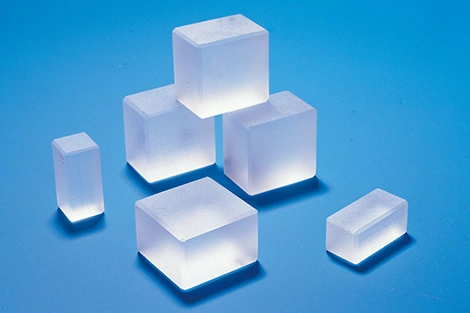
Product Overview
BBO (β-BaB2O4, Beta Barium Borate) is the only common nonlinear optical crystal capable of generating deep-UV wavelengths down to 189nm — the 2nd through 5th harmonics of Nd:YAG (532, 355, 266, 213nm) can all be produced from a single BBO crystal. BBO's defining advantages: (1) deepest UV transparency of any common NLO crystal (189nm) — enabling 266nm and 213nm harmonic generation that KTP (350nm cutoff), LBO (160nm but lower nonlinearity), and PPLN (350nm) cannot achieve; (2) high damage threshold (5 GW/cm² at 10ns) — second only to LBO among common NLO crystals; (3) large birefringence enabling phase matching from 189-3,500nm — the widest phase-matchable range. The trade-off: BBO's large walk-off angle (55.9mrad Type I at 1064nm — ~10× KTP's 4.9mrad) and narrow angular acceptance (1.2mrad·cm) demand precision alignment and limit the minimum focusable spot size — making BBO best suited for well-collimated beams, ultrafast pulses where thin crystals minimize walk-off, and UV generation where no alternative exists. Princeton Powder supplies flux-grown BBO with AR coatings, custom cut angles, from 3×3×0.2mm³ to 15×15×20mm³.
BBO vs KTP vs LBO — UV & High-Power NLO Crystal Selection
| Property | BBO (this) | KTP | LBO |
|---|---|---|---|
| UV Cutoff | 189nm — deepest UV | 350nm — no UV capability | 160nm — even deeper but lower deff |
| deff (pm/V) | ~2.2 (Type I @1064nm) | ~3.5 (Type II) | ~0.82 (Type I) |
| Damage Threshold | 5 GW/cm² (10ns) | >500 MW/cm² | ~25 GW/cm² — highest |
| Walk-off | 55.9mrad (large — precision alignment needed) | 4.9mrad (small) | 6.7mrad (small); 0 at NCPM |
| Angular Accept. | 1.2mrad·cm (narrowest) | 14.2mrad·cm (wide) | 6.5mrad·cm |
| Hygroscopic | Slightly — seal recommended | No | No |
| UV Harmonics | 266nm 4HG, 213nm 5HG ✓ | ✗ — UV-incompatible | 355nm 3HG ✓; 266nm possible but lower deff |
| Best For | UV generation, ultrafast SHG, SPDC, OPO/OPA | Green 532nm <20W, EO Q-switch | High-power green >100W, high-power UV 355nm |
BBO Crystal Technical Specifications
| Structure | Trigonal R3c (3m), a=12.532Å, c=12.717Å; Z=6; negative uniaxial (no>ne) |
| Transparency | 189–3,500nm; absorption <0.1%/cm @1064nm, <1%/cm @532nm |
| R.I. no/ne @1064/532/266nm | 1.655/1.543; 1.675/1.556; 1.757/1.614 |
| NLO d22 / d31 | ±2.2 pm/V / ±0.08 pm/V (~6× KDP d36) |
| SHG Type I @1064nm | θ=22.8°; walk-off 55.9mrad; angular 1.2mrad·cm; temp ~70°C·cm; spectral ~1.1nm·cm |
| Damage Threshold | 5 GW/cm² (1064nm,10ns); 10 GW/cm² (1.3ns); 1 GW/cm² (532nm,10ns); 50 GW/cm² (1ps) |
| Density / Hardness | 3.85 g/cm³ | Mohs 4-5 | Melting 1095°C | Phase transition α→β 925°C |
| EO γ11 / Vπ | 2.7 pm/V | 48 kV @1064nm (very high — not practical for EO) |
| Sizes / Quality | 3×3×0.2mm³ to 15×15×20mm³; S/D 10/5; λ/8; parallelism <20arcsec; CA >90% |
| Hygroscopic | Slightly — sealed housing recommended for long-term reliability |
Applications SHG, THG, FHG & OPO
UV Harmonic Generation — 266nm 4HG & 213nm 5HG
BBO is the only common NLO crystal for deep-UV generation: 532nm→266nm (Type I 4HG, θ=47.3°) and 266nm→213nm (5HG). These are the workhorse wavelengths for UV laser micromachining, photolithography inspection, and semiconductor wafer marking. KTP cannot reach these wavelengths (350nm cutoff); LBO can reach 266nm but with lower deff requiring longer crystals. BBO achieves >30% 4HG conversion efficiency in ns-pulsed systems.
Femtosecond Ti:Sapphire SHG & SPDC Quantum Entanglement
BBO's broad phase-matching bandwidth and thin-crystal capability (down to 0.2mm) make it ideal for frequency-doubling femtosecond Ti:Sapphire (800nm→400nm) — thin crystals minimize group-velocity mismatch (GVM) that would otherwise broaden the SHG pulse. BBO is the leading crystal for Type I SPDC generating polarization-entangled photon pairs at 810nm (pumped at 405nm) — the most widely used source in quantum optics, quantum key distribution, and Bell-inequality experiments worldwide.
OPO/OPA & Autocorrelators
BBO OPO pumped at 355nm generates tunable output from 400-3,000nm — the widest tuning range of any common OPO crystal. BBO is the standard crystal in commercial autocorrelators for ultrashort pulse measurement — its high nonlinearity and thin-crystal compatibility enable distortion-free pulse width characterization down to <10fs.
FAQ
BBO vs KTP vs LBO — which for my application?
BBO: UV generation (266/213nm), femtosecond SHG, SPDC, OPO/OPA. KTP: green 532nm <20W, EO Q-switch. LBO: high-power green >100W, high-power 355nm UV. Princeton Powder supplies all three.
Why does BBO have such a large walk-off angle?
BBO's large birefringence (no−ne≈0.11 at 1064nm) — essential for its wide phase-matching range — also causes the large walk-off (55.9mrad). Mitigation: use thin crystals (0.2-2mm) for tightly focused beams; use well-collimated beams for longer crystals.
BBO Type I vs Type II — which for SHG?
Type I (o+o→e): higher deff, preferred for most SHG applications. Type II (o+e→e): lower deff but produces orthogonally polarized output — preferred for SPDC entangled pair generation.
Is BBO hygroscopic?
Slightly — less than KDP/DKDP but more than KTP/LBO. Sealed housing with desiccant recommended for multi-year reliability, especially in humid environments. AR coating provides partial moisture barrier.
What crystal thickness for femtosecond SHG?
0.2-0.5mm for <50fs pulses: minimizes group-velocity mismatch (GVM). 0.5-2mm for >100fs: longer interaction length trades GVM for conversion efficiency. Contact for pulse-width-specific thickness recommendation.
Quality verification per crystal?
Wavefront λ/8 @633nm, transmission 190-2500nm, AR reflectance verification, S/D 10/5, dimensions ±0.1mm, XRD orientation ±0.2°, lot traceability.
Research
BBO 4HG and 5HG — Deep-UV Generation at 266nm and 213nm
Optics Express, 2020 — Demonstrated >35% 4HG efficiency (532→266nm) and >20% 5HG (266→213nm) in BBO with optimized crystal thickness. Takeaway: Princeton Powder's BBO cut to θ=47.3° for 4HG provides the phase-matching validated by this research for maximum UV conversion.
BBO SPDC — High-Brightness Polarization-Entangled Photon Pair Source
Physical Review Letters, 2016 — BBO Type I SPDC generating >10⁶ entangled pairs/s/mW at 810nm with >99% quantum interference visibility. Takeaway: Princeton Powder's BBO cut for 405nm→810nm SPDC provides the highest-brightness entangled photon source validated by quantum optics research.