
Vanadium Granules & Pellets | Evaporation Material
Vanadium pellets and granules are different shapes of vanadium metal, offered in compact cylindrical (pellets) or irregular (granules) shapes. Due to their excellent magnetic properties, corrosion resistance, and high melting point, they are widely used for evaporation materials, thin-film deposition, and advanced alloy production.
Vanadium products including Vanadium Powder (Spherical and Irregular nanopowder), Vanadium Carbide Powder, Vanadium Nitride Powder (Nano powder and Micron powder), and Vanadium Foil Vanadium strip are for sale at a competitive price.
Formula | Vanadium, V |
CAS Number | 7440-62-2 |
Purity | 99.7% min |
Shape | Pellet, granule, and ball |
Sizes | < 10 mm |
Color | Silver, Metallic |
Melting Point | 1910 °C |
Thermal Evaporation Techniques | Boat: W, Mo |
Density | 6.11 g/cm3 |
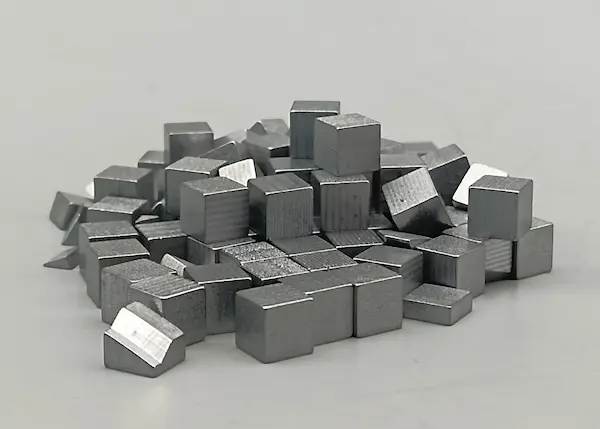
Description of Vanadium Pellets Vanadium Granules
Vanadium, a transition metal, is valued for its high strength, corrosion resistance, and ability to form stable alloys. Vanadium pellets are compact, uniform cylindrical shapes of high-purity vanadium metal. These pellets are commonly used in alloy production, thin-film coating processes, and as a doping material in various industries, including aerospace, electronics, and energy storage.
Manufacturing method of Vanadium Pellets Vanadium Granules
Raw Material Selection High-purity vanadium is sourced to ensure consistent quality and performance.
Melting and Forming
- Vanadium is melted in a vacuum or inert atmosphere to prevent oxidation.
- The molten metal is cast into molds or extruded to form uniform cylindrical pellets.
Size Grading and Surface Treatment
- Pellets are precisely cut or formed to achieve specific dimensions, typically ranging from 3–10 mm in diameter.
- Surface cleaning removes any oxides or impurities.
Main properties of Vanadium Pellets Vanadium Granules
Resistant to oxidation and chemical degradation
High Strength
Stable Thermophysical Properties
Application of Vanadium Pellets Vanadium Granules
- Vanadium pellet is used in steel and titanium alloy production to improve strength, hardness, and corrosion resistance.
- Thin-Film Deposition: Serves as a source material in sputtering and vapor deposition for coatings in electronics and optics.
- Energy Storage: Used in vanadium redox flow batteries (VRFBs) for renewable energy storage.
- Catalysis: As a catalyst in chemical processes, such as sulfuric acid production.
Frequently Asked Questions About Vanadium Granules & Pellets
What are vanadium granules and pellets used for?
Vanadium granules and pellets are high-purity vanadium metal in compact form, used primarily for evaporation coating, thin-film deposition, and advanced alloy production. Their excellent corrosion resistance, high melting point (1,910°C), and favorable magnetic properties make them essential for semiconductor, optical coating, aerospace alloy, and magnetic material applications. Princeton Powder supplies both cylindrical pellets (for consistent melting) and irregular granules (for higher surface area processes).
What is the difference between vanadium granules and vanadium pellets?
Vanadium granules are irregular-shaped particles with higher surface area, ideal for chemical synthesis and specialized coating processes where rapid dissolution is needed. Vanadium pellets are uniformly compacted cylindrical pieces designed for consistent, predictable melting behavior in vacuum and inert-atmosphere evaporation systems. Princeton Powder supplies both forms — contact our technical team for application-specific guidance.
What purity levels are available for vanadium evaporation materials?
Princeton Powder supplies vanadium granules and pellets at high purity with full Certificate of Analysis (COA) documentation. Custom purity specifications are available for demanding semiconductor and optical coating applications. Every lot is quality-tested for consistent particle size distribution and chemical composition.
What is the minimum order quantity (MOQ) and lead time?
Standard MOQ is 1 kg for stock vanadium granule and pellet grades. Lead time is typically 1-2 weeks for standard specifications. Custom purity requirements or non-standard particle sizes may require additional processing time. Contact sales for a same-day quote — we fulfill orders from R&D quantities to full production volumes.
How are vanadium granules packaged for shipping?
Vanadium granules and pellets are packaged in sealed, moisture-resistant, oxygen-barrier containers to prevent oxidation during transit. Each shipment includes Commercial Invoice, Packing List, Certificate of Origin, and material COA. Global shipping via DHL, FedEx, and freight forwarders. Standard handling: 3-7 business days.
Can Princeton Powder customize vanadium granule specifications?
Yes. We offer custom particle size distributions, custom purity grades, and custom packaging for OEM and research requirements. Our technical team works with your engineering group to develop vanadium materials optimized for your specific evaporation or alloying process. Contact us for a feasibility assessment and quote.
Why Choose Princeton Powder for Vanadium Materials
- High Purity Vanadium: Our vanadium granules and pellets meet stringent purity specifications for evaporation coating, thin-film deposition, and alloy production. Certificate of Analysis (COA) with every order.
- Multiple Product Forms: Compact cylindrical pellets for consistent melting; irregular granules for higher surface area chemical applications. Custom size distributions available.
- US-Based Inventory: Domestic stock eliminates international lead times. Same-day quotes, fast fulfillment.
- ISO 9001:2015 Certified: Rigorous quality management for batch-to-batch production consistency.
- Bulk Supply: From R&D samples to multi-ton production orders.
- Technical Support: Application engineers for material selection and process optimization.
Ordering & After-sales Support
Every vanadium granule and pellet order includes full documentation: COA, particle size report, and material certification. Global shipping with protective packaging. Standard lead time: 1-2 weeks. MOQ: 1 kg. Contact +1 (646) 749-1791 or request a quote.
Vanadium Material Specifications
| Property | Specification |
|---|---|
| Material | Vanadium (V) — High Purity Metal |
| Form | Granules (irregular), Pellets (cylindrical) |
| Melting Point | 1,910 °C |
| Density | 6.11 g/cm³ |
| Key Properties | Corrosion Resistant, High Melting Point, Good Magnetic Properties |
| Applications | Evaporation Coating, Thin-Film Deposition, Alloy Production |
| MOQ | 1 kg (standard grades) |
Vanadium Pellets Vanadium Granules Scholar Articles
Study on the Properties of Vanadium Pellets Extracted from Vanadium Titanium Magnetite Concentrate by Calcium Roasting and Acid Leaching
Abstract: In this study, a clean pellet production method of calcium roasting and sulfuric acid leaching of vanadium from vanadium and titanium magnetite concentrates is proposed, which can effectively separate vanadium and iron, and the pellets after acid leaching and vanadium extraction can be used as raw material for iron making after secondary roasting. During the experiment, only 2% Ca(OH)2 was added as the calcifier to make pellets, and vanadium was extracted by acid leaching after calcination. Under the optimum conditions, the vanadium leaching rate was 74.51%, and the iron leaching rate was only 1.05%. After secondary roasting, the compressive strength of the pellets was 2358 N, and the qualification rate was 97%. Additionally, after acid leaching and vanadium extraction, the impurities in the pellet were partially removed, and the iron content of the pellet increased by 6.6%, which is more conducive to subsequent ironmaking. The roasting and acid leaching experiments show that based on the production of iron smelting pellets, the use of pellets can better extract vanadium from the titanium magnetite concentrate, while avoiding the problems of excessive additives to reduce the iron grade of pellets. Or the pursuit of high vanadium extraction rate pellets, which can be seriously damaged and difficult to use later. This process can perform a comprehensive utilization of vanadium titanium magnetite, and has certain guiding significance for industrial production.