
Pyrroloquinoline Quinone (PQQ) Powder — 99% Purity Mitochondrial Biogenesis Coenzyme
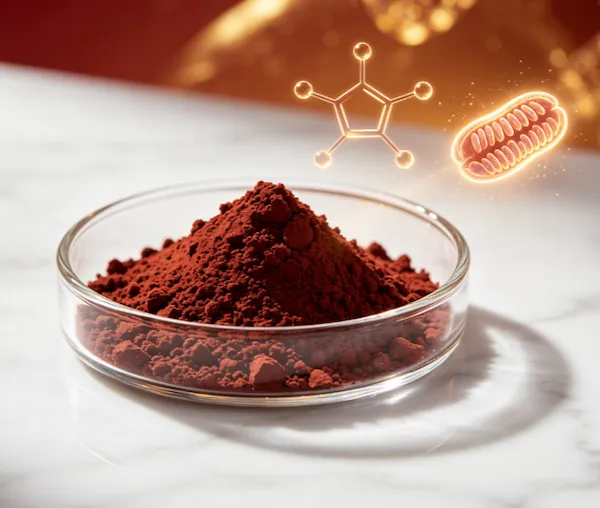
Pyrroloquinoline quinone (PQQ, CAS 72909-34-3) is a redox-active ortho-quinone coenzyme and vitamin-like accessory factor, naturally produced by bacterial fermentation, with a molecular weight of 330.21 Da and a characteristic deep red-brown crystalline appearance. PQQ’s defining biological action is the activation of **PGC-1α** (peroxisome proliferator-activated receptor-gamma coactivator 1-alpha), the master regulator of mitochondrial biogenesis, which upregulates NRF-1, NRF-2, and TFAM to stimulate the growth of new, functional mitochondria — increasing cellular ATP production, improving metabolic efficiency, and reducing mitochondrial reactive oxygen species (mtROS). As a catalytic antioxidant, PQQ participates in repeated redox cycling, providing sustained free-radical neutralization far beyond stoichiometric antioxidants like vitamin C. In skincare, topical PQQ supports fibroblast energy for collagen synthesis, reduces photodamage, and strengthens antioxidant defense; in nutraceuticals, PQQ supports mitochondrial energy, cognitive function, cardiovascular health, and healthy aging. Our PQQ powder is manufactured via fermentation to ≥99% purity (HPLC-verified), available as free acid or disodium salt, in cosmetic, nutraceutical, and research grades. As a leading bulk PQQ manufacturer and supplier, we provide full CoA documentation, custom grades, and competitive pricing for skincare brands, supplement companies, and research labs worldwide.
| Parameter | Specification |
|---|---|
| INCI / Common Name | Pyrroloquinoline Quinone (PQQ) |
| Other Names | Methoxatin, Coenzyme PQQ, PQQ Coenzyme, PQQ Disodium Salt |
| CAS Number (Free Acid) | 72909-34-3 |
| CAS Number (Disodium Salt) | 122628-50-8 |
| Chemical Formula | C₁₄H₆N₂O₈ (free acid); C₁₄H₄N₂Na₂O₈ (disodium salt) |
| Molecular Weight | 330.21 g/mol (free acid); 374.17 g/mol (disodium salt) |
| Appearance | Deep red-brown to dark red crystalline powder |
| Odor | Characteristic or odorless |
| Purity (HPLC) | ≥ 99.0% (high-purity grade ≥ 99.5%, ultra-high ≥ 99.8%) |
| Identification (UV) | A233/A259 = 0.90 ± 0.09; A322/A259 = 0.56 ± 0.03 |
| Identification (HPLC) | Retention time matches reference standard |
| Loss on Drying | ≤ 9.0% (free acid); ≤ 5.0% (disodium salt) |
| pH (1% solution) | 2.5 – 3.5 (free acid); 6.0 – 8.0 (disodium salt) |
| Isoelectric Point (pI) | 2.75 |
| Melting Point | ~250°C (decomposition) |
| Solubility | Free acid: slightly soluble in water (≥ 5 mg/mL); Disodium salt: freely soluble in water (≥ 50 mg/mL); soluble in ethanol/methanol; insoluble in oils |
| Bulk Density | 300 – 500 kg/m³ |
| Particle Size | D50 = 50 – 200 μm (customizable; micronized grade D50 < 20 μm available for enhanced solubility) |
| Residual Solvents | ≤ 0.5% (ethanol, methanol) |
| Heavy Metals | ≤ 10 ppm (Pb, As, Hg, Cd) |
| Total Plate Count | ≤ 100 CFU/g (nutraceutical/cosmetic grade); sterile grade available |
| Yeast & Mold | ≤ 10 CFU/g |
What Is PQQ? Pyrroloquinoline Quinone
Pyrroloquinoline quinone (PQQ), also known as methoxatin or coenzyme PQQ, is a redox-active ortho-quinone compound with the chemical formula C₁₄H₆N₂O₈ and a molecular weight of 330.21 Da (free acid). It was first discovered in 1979 as a cofactor for bacterial dehydrogenases and was later found to be present in all plant and animal tissues, as well as in human breast milk — leading researchers to classify it as a vitamin-like accessory factor essential for mammalian health.
Chemical structure & physical properties:
- PQQ consists of a pyrrole ring fused to a quinoline ring with two ortho-quinone carbonyl groups and a carboxylic acid side chain
- Appearance: Deep red-brown to dark red crystalline powder (a distinctive visual characteristic — PQQ is NOT white)
- Melting point: ~250°C (decomposition)
- Isoelectric point (pI): 2.75
- Solubility: Slightly soluble in water as free acid; freely soluble as disodium salt; soluble in ethanol and methanol; insoluble in oils and lipids
- UV absorbance: Characteristic peaks at 259 nm (primary), with diagnostic ratios A233/A259 = 0.90 ± 0.09 and A322/A259 = 0.56 ± 0.03 used for identity verification
PQQ Free Acid and PQQ Disodium Salt
Two commercial forms:
1. PQQ Free Acid (CAS 72909-34-3): The native acidic form, slightly water-soluble, deeper red color, preferred for solid-dose nutraceuticals (capsules, tablets) and research applications.
2. PQQ Disodium Salt (CAS 122628-50-8): The sodium salt form, highly water-soluble, lighter red color, preferred for aqueous skincare formulations, drinkable supplements, and sublingual powders.
We supply both forms and can recommend the optimal form based on your product application and formulation requirements.
Applications — Nutraceutical, Skincare & Research
- Skincare: Enhanced transdermal delivery, reduced visible color (liposomes mask the red color), improved stability, higher effective concentration in the dermis.
- Supplements: Improved oral bioavailability (liposomes protect PQQ from digestive degradation), targeted cellular delivery.
| Product Type | Recommended Usage | Key Benefit |
|---|---|---|
| Nutraceutical — capsules/tablets | 10 – 20 mg/serving (free acid or disodium salt) | Mitochondrial energy, cognitive support, cardiovascular health, healthy aging |
| Nutraceutical — drinkable powders/liquids | 10 – 20 mg/serving (disodium salt for solubility) | Mitochondrial energy, hydration, metabolic support |
| Sublingual powders/sprays | 5 – 10 mg/dose (micronized disodium salt) | Rapid absorption, immediate energy support, cognitive focus |
| Nootropic / brain health stacks | 10 – 20 mg/serving | Neuroprotection, memory, attention, BDNF/NGF support |
| Sports nutrition / pre-workout | 10 – 20 mg/serving | Mitochondrial biogenesis, exercise endurance, recovery, ATP production |
| Anti-aging / longevity supplements | 10 – 20 mg/serving | PGC-1α activation, sirtuin support, mitochondrial health, longevity pathways |
| Skincare — anti-aging serums | 0.01% – 0.5% (disodium salt or liposomal) | Fibroblast energy for collagen synthesis, antioxidant, photodamage repair, radiance |
| Skincare — eye creams | 0.01% – 0.2% | Fine line reduction, improved microcirculation, antioxidant, de-puffing |
| Skincare — brightening/radiance serums | 0.01% – 0.3% | Reduced oxidative stress, even skin tone, mitochondrial glow, antioxidant defense |
| Post-procedure recovery products | 0.01% – 0.2% | Accelerated recovery after lasers/peels/microneedling, reduced inflammation, barrier support |
| Body firming lotions | 0.01% – 0.1% | Mitochondrial energy support, improved skin firmness, reduced crepey texture |
| Scalp & hair care serums | 0.01% – 0.2% | Follicle mitochondrial energy support, antioxidant, healthy hair environment |
| Research — cell culture reagent | Per protocol (10 nM – 10 μM typical) | Mitochondrial biogenesis studies, PGC-1α research, antioxidant assays, neuroprotection |
| Research — enzyme substrate/cofactor | Per protocol | Bacterial dehydrogenase cofactor, redox enzyme studies, mitochondrial respiration assays |
| IV therapy / injectable (medical only) | Per clinical protocol (requires GMP grade) | Systemic mitochondrial support, energy, cognitive recovery (medical use only) |
Frequently Asked Questions (FAQ)
Q: What is the difference between PQQ free acid and PQQ disodium salt? Which should I use?
A: PQQ free acid (CAS 72909-34-3) is the native acidic form — it is slightly soluble in water (≥5 mg/mL), has a deeper red color, and is lower cost. PQQ disodium salt (CAS 122628-50-8) is the sodium salt form — it is freely soluble in water (≥50 mg/mL), has a lighter red color, and is slightly higher cost. Recommendation: Use free acid for capsules, tablets, and solid-dose supplements where water solubility is not critical. Use disodium salt for aqueous skincare serums, drinkable supplements, sublingual powders, and any formulation requiring high water solubility. For liposomal formulations, either form can be used. We can help you select the optimal form based on your product format and formulation pH.
Q: What is the difference between PQQ, CoQ10, and NAD+? Which is best for my product?
A: All three are mitochondrial support compounds, but they work through different mechanisms:
- PQQ: Stimulates mitochondrial biogenesis (growth of NEW mitochondria) via PGC-1α activation. Also a catalytic antioxidant. Best for: increasing mitochondrial quantity, long-term mitochondrial health, anti-aging/longevity, cognitive support.
- CoQ10 (Ubiquinone/Ubiquinol): Supports energy production in EXISTING mitochondria as an essential electron carrier in the electron transport chain (Complex III). Also a lipid-soluble antioxidant. Best for: immediate energy support, cardiovascular health, statin users (statins reduce CoQ10), migraine prevention.
- NAD+ / NMN / NR: Provides the essential coenzyme for mitochondrial energy metabolism (NAD+ is the primary electron carrier for glycolysis, Krebs cycle, and oxidative phosphorylation). Also a substrate for sirtuins and PARPs. Best for: comprehensive metabolic support, sirtuin activation, DNA repair, anti-aging. Recommendation by product type:
- Mitochondrial energy / anti-fatigue supplement: PQQ + CoQ10 (the classic duo — biogenesis + energy production)
- Premium anti-aging / longevity supplement: PQQ + NAD+ / NMN + Resveratrol (biogenesis + coenzyme + sirtuin activation)
- Cardiovascular health: CoQ10 + PQQ
- Cognitive / brain health: PQQ + NAD+ / NMN + Omega-3
- Skincare anti-aging serum: PQQ (liposomal) + Peptides + HA (mitochondrial energy + collagen signaling + hydration)
- We supply all three and can help you design an optimal mitochondrial blend for your target market and budget.