
U-Shaped MoSi2 Heating Elements — 1700°C & 1800°C, 3/6mm to 12/24mm for Industrial Electric Furnaces
High-performance U-shaped MoSi2 heating elements designed for high-temperature industrial electric furnaces. Engineered with premium Molybdenum Disilicide, these thermal components deliver exceptional oxidation resistance and rapid heating up to 1700°C and 1800°C. Available in standard and custom sizes ranging from 3/6mm to 12/24mm (hot/cold zone diameters), our U-type MoSi2 heaters ensure maximum energy efficiency, superior thermal stability, and extended service life in demanding laboratory and manufacturing environments. As a trusted industrial manufacturer and global supplier, we offer wholesale prices, custom configurations, and reliable heating solutions. Contact us today to buy top-grade 1700°C and 1800°C MoSi2 heating elements.
Technical Specifications
| Parameter | Value |
|---|---|
| Product | U-Shaped MoSi2 Heating Elements — 1700°C & 1800°C Grades for Industrial Electric Furnaces |
| Material | Molybdenum Disilicide (MoSi2) — self-healing SiO2 protective glass layer |
| Temperature Grades | 1700°C (max element temp 1700°C / furnace ~1650°C) | 1800°C (max element temp 1800°C / furnace ~1750°C) |
| Hot Zone Ø (d1) | 3mm, 4mm, 6mm, 9mm, 12mm |
| Cold End Ø (d2) | 6mm, 9mm, 12mm, 18mm, 24mm |
| Hot Zone Length (Le) | 50–1200 mm (diameter-dependent, fully customizable) |
| Cold End Length (Lu) | 150–1500 mm (diameter-dependent, fully customizable) |
| Shank Spacing (a) | 25 mm (for 3/6, 4/9, 6/12mm) | 50 mm (for 9/18, 12/24mm) |
| Key Feature | Self-healing SiO2 glass protective layer — maintenance-free operation in air up to 1800°C |
| Applications | Ceramic sintering, powder metallurgy, glass melting, heat treatment, laboratory & research furnaces |
Product Overview
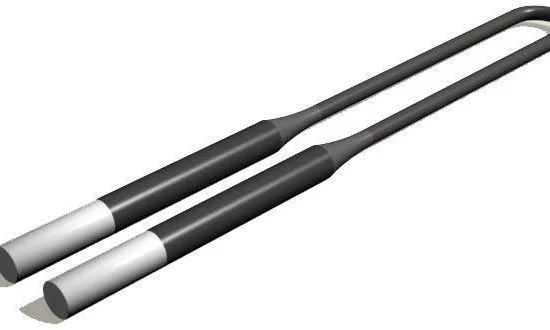
U-shaped molybdenum disilicide (MoSi2) heating elements are high-temperature electric resistance heaters designed in a hairpin (2-shank) configuration that places both cold-end electrical connections on the same side of the furnace — simplifying installation, wiring, and maintenance. Princeton Powder supplies U-shaped MoSi2 elements in five standard diameter combinations (d1/d2: 3/6, 4/9, 6/12, 9/18, and 12/24 mm) across two temperature grades — 1700°C (max furnace ~1650°C) and 1800°C (max furnace ~1750°C). The defining advantage of MoSi2 over SiC and metallic elements is the self-healing silicon dioxide (SiO2) glass protective layer that forms on the element surface at high temperature in air — continuously regenerating through thousands of thermal cycles for years of maintenance-free furnace operation.
Grade & Dimension Selection Guide
| Model (d1/d2) | Hot Zone Ø | Cold End Ø | Le Range | Lu Range | Shank Spacing | Typical Power | Best For |
|---|---|---|---|---|---|---|---|
| 3/6 mm | 3 mm | 6 mm | 50–300 mm | 150–600 mm | 25 mm | 0.3–1.5 kW | Laboratory tube furnaces, research kilns — fastest thermal response |
| 4/9 mm | 4 mm | 9 mm | 80–400 mm | 200–800 mm | 25 mm | 0.5–2.5 kW | Medium tube furnaces, dental ceramic sintering |
| 6/12 mm | 6 mm | 12 mm | 100–600 mm | 250–1000 mm | 25 mm | 1–5 kW | Standard industrial box furnaces — most popular size worldwide |
| 9/18 mm | 9 mm | 18 mm | 150–900 mm | 300–1200 mm | 50 mm | 2–10 kW | Large industrial furnaces, continuous kilns, ferrite production |
| 12/24 mm | 12 mm | 24 mm | 200–1200 mm | 400–1500 mm | 50 mm | 5–15 kW | Very large tunnel kilns, high-throughput production lines |
All elements are custom-manufactured to your exact Le (hot zone length) and Lu (cold end length) specifications. Contact our engineering team with your furnace chamber dimensions, target temperature, and power requirements for optimized element sizing and quotation.
Material Properties & Technical Specifications
| Property | Specification |
|---|---|
| Material | Molybdenum Disilicide (MoSi2) — cermet (ceramic-metallic) composite |
| Element Density | 5.6–6.2 g/cm³ (sintered element) |
| Theoretical Density | 6.24 g/cm³ |
| Melting Point | ~2030 °C |
| Max Element Temperature | 1700 °C (1700 grade) / 1800 °C (1800 grade) |
| Oxidation Resistance | Self-healing SiO2 glass layer; up to 1800°C in air — no external coating required |
| Electrical Resistivity | Increases with temperature (positive TCR) — provides inherent power self-regulation |
| Hot Zone / Cold End Ratio | d1 : d2 ≈ 1 : 2 — ensures hot zone generates primary heat; cold ends stay cooler |
| Operating Atmosphere | Air (best — forms protective SiO2), N2, Ar, He, dry H2. NOT: Cl, S atmospheres, high vacuum >10⁻³ Torr |
| Typical Element Life | 12–24+ months continuous air operation at rated temperature |
| Fabrication Method | Isostatic pressing of MoSi2 powder → high-temperature sintering → precision grinding |
| Resistance Tolerance | ±5% per element — verified before shipment |
How the Self-Healing SiO2 Protective Layer Works
At operating temperature (>800°C), the MoSi2 surface reacts with oxygen in air to form a dense, glassy silicon dioxide (SiO2) film. This layer is: (1) Protective — it blocks further oxygen from reaching the MoSi2 substrate, preventing progressive oxidation. (2) Self-healing — any micro-cracks that form during thermal cycling are automatically filled by viscous SiO2 flow above 1200°C. (3) Continuous — the layer regenerates throughout the element's entire service life. This is MoSi2's defining advantage over SiC: SiC also forms SiO2, but the layer is less dense, spalls under thermal cycling, and does not self-heal — requiring periodic re-glazing to maintain protection. MoSi2 elements operate maintenance-free for 12-24+ months without any surface treatment.
Dimensions & Custom Manufacturing
Every U-shaped MoSi2 element is defined by four key dimensions — all customizable to your furnace specifications:
- d1 — Hot Zone Diameter: The thinner section that generates primary heat (3, 4, 6, 9, or 12 mm)
- d2 — Cold End Diameter: The thicker end sections for electrical connection (6, 9, 12, 18, or 24 mm)
- Le — Hot Zone Length: The heated section length — custom within the range for your d1/d2
- Lu — Cold End Length: The section from hot zone to terminal — custom within range
- a — Shank Spacing: Distance between the two legs (25 mm or 50 mm standard)
How to Specify Your Element
Provide our engineering team with: (1) Furnace chamber dimensions (W×H×D in mm), (2) Target maximum operating temperature, (3) Required total power (kW), (4) Available supply voltage (V), (5) Element mounting location (side walls, roof, floor, door). We calculate the optimal d1/d2, Le, Lu, number of elements, and electrical configuration (series/parallel) and provide a complete specification sheet with quotation within 24-48 hours.
How to order: Specify (1) Grade: 1700°C or 1800°C, (2) Model: d1/d2 (e.g., 6/12mm), (3) Le in mm, (4) Lu in mm, (5) Terminal type: standard flat, tapered, or threaded, (6) Quantity. Not sure about your dimensions? Contact our engineers with your furnace parameters for a free sizing calculation.
Applications
Ceramic Sintering & Powder Metallurgy Furnaces
The largest-volume application for U-shaped MoSi2 elements is providing uniform, controllable heating to 1600-1750°C for industrial sintering of advanced ceramics (Al2O3, ZrO2, Si3N4, SiC), soft and hard ferrite magnets, and powder metallurgy steel and refractory metal components. For production-scale ceramic sintering at 1700°C+, the 1800°C grade 9/18mm U-shaped element is the standard recommendation — its 2-10 kW per element output and 50mm shank spacing provide the high power density that large continuous kilns and tunnel furnaces demand. The self-healing SiO2 layer ensures element life of 18-24+ months in continuous air-atmosphere production, minimizing furnace downtime.
Glass Melting & High-Temperature Heat Treatment
MoSi2 elements heat glass melting furnaces, fiber drawing towers, container glass annealing lehrs, and high-temperature heat treatment furnaces for steel, alloy, and superalloy components. The stable electrical resistivity of MoSi2 over element life (typically <5% drift after 5000h at 1650°C) provides the consistent temperature control essential for glass viscosity management and uniform heat treatment results. For general heat treatment at ≤1650°C, the 1700°C grade 6/12mm U-shaped element provides the best cost-performance ratio.
Laboratory & Research-Grade Furnaces
Compact MoSi2 elements — particularly 3/6mm and 4/9mm U-shaped types — are the standard heating elements in laboratory box furnaces, tube furnaces, and thermal analysis instruments (TGA, dilatometry) found in university and industrial R&D laboratories worldwide. Their rapid thermal response (10-15°C/min achievable), clean combustion-free operation, and simple two-lead electrical connection (both terminals on the same side) make U-shaped elements the first choice for research equipment manufacturers. Princeton Powder supplies small elements with no minimum order quantity for R&D quantities — single elements for prototype furnaces available.
Frequently Asked Questions
What is the difference between 1700°C and 1800°C grade MoSi2 elements?
The 1700°C grade uses standard high-purity MoSi2 and is rated for max element temperature of 1700°C (furnace ~1650°C) — best cost-performance for furnaces operating at or below 1650°C. The 1800°C grade uses ultra-high-purity MoSi2 with optimized grain structure for extended life at extreme temperatures — rated for max element temperature of 1800°C (furnace ~1750°C). For operations above 1650°C, or where an extra 100°C safety margin extends service intervals, choose the 1800°C grade.
Why choose U-shaped over W-shaped or straight MoSi2 elements?
The U-shaped (2-shank hairpin) design places both cold-end electrical connections on the same side of the furnace — simplifying furnace design, reducing wiring complexity, and making individual element replacement faster since all terminals are accessible from one side. U-shaped is the standard configuration for most box furnaces, tube furnaces, and kilns. W-shaped (4-shank) provides ~2× power per element for wide chambers; straight elements require wiring on opposite walls.
What atmosphere can U-shaped MoSi2 elements operate in?
MoSi2 elements operate best in air — the oxidizing atmosphere forms and maintains the protective SiO2 layer. Also compatible with: nitrogen, argon, helium, and dry hydrogen (dew point below 10°C). NOT compatible with: chlorine-containing atmospheres, sulfur-containing atmospheres (SO2, H2S), and high vacuum (below 10⁻³ Torr) at high temperature — the SiO2 protective layer evaporates as SiO gas under deep vacuum.
How long do MoSi2 heating elements last?
Typical service life is 12-24+ months in continuous air-atmosphere operation at rated temperature. Unlike SiC elements that progressively degrade, MoSi2 elements do not have a fixed "burn-out" lifetime — the self-healing SiO2 layer continuously regenerates. Element life is most commonly ended by mechanical damage during handling or thermal shock from excessively rapid cooling (>5°C/min). Proper cool-down rates significantly extend element life.
How do I size U-shaped MoSi2 elements for my furnace?
Provide our engineering team with: (1) furnace chamber internal dimensions (W×H×D in mm), (2) target maximum operating temperature, (3) required total power (kW), (4) available supply voltage (V), (5) element mounting preference (side wall, top, bottom, door). We calculate the optimal d1/d2, hot zone length, cold end length, number of elements, and electrical configuration (series/parallel) and provide a complete element specification sheet with quotation within 24-48 hours. Contact us with your furnace parameters for a free sizing calculation.
Do you supply accessories and spare parts for MoSi2 elements?
Yes — we supply a complete range: element straps (Mo or Al2O3), holders (Al2O3 ceramic), lead wires (Mo or stainless steel), terminal connectors (Mo, brass, or SS), element clips, and complete installation kits pre-configured for your element model. Accessories are in stock for immediate shipment. Specify your element model (d1/d2) when ordering to ensure compatibility.
Research & Technical References
The following peer-reviewed research demonstrates MoSi2 heating element performance in high-temperature applications. Princeton Powder MoSi2 elements meet or exceed the material specifications used in these studies.
Self-Healing SiO2 Layer Formation on MoSi2 at High Temperature
Journal of the American Ceramic Society, 2017 — Demonstrated that MoSi2 exposed to air at 1200-1700°C forms a continuous, adherent SiO2 glass layer within minutes, achieving parabolic oxidation kinetics with rate constants comparable to pure silicon. The SiO2 scale was shown to self-heal cracks up to 5 μm wide via viscous flow at temperatures above 1200°C. Practical takeaway: Princeton Powder's controlled-purity MoSi2 elements leverage this self-healing mechanism — the SiO2 layer continuously regenerates, providing multi-year maintenance-free operation without the periodic re-glazing that SiC elements require.
MoSi2 Heating Element Aging Behavior Under Industrial Furnace Conditions
International Journal of Refractory Metals and Hard Materials (Elsevier), 2019 — Characterized resistivity drift, grain growth, and oxidation kinetics of commercial MoSi2 elements over 5000 hours of continuous operation at 1650°C in air. Elements showed less than 5% resistance increase after 5000h, confirming the stability of the SiO2 protective mechanism over industrially relevant timescales. Practical takeaway: Our 1800°C grade elements use optimized-grain-structure MoSi2 to minimize grain growth — directly extending element service life in continuous production furnaces.
MoSi2 vs SiC Heating Elements — Comparative Oxidation and Lifetime Analysis
Ceramics International (Elsevier), 2018 — Compared MoSi2 and SiC heating elements under identical furnace conditions (1650°C, air, 100 thermal cycles). MoSi2 elements maintained stable resistance (±3%) throughout the test while SiC elements showed progressive resistance increase (+25% after 100 cycles) due to active oxidation. Practical takeaway: For production furnaces where temperature uniformity and minimal downtime are critical, MoSi2's self-healing protection provides 8× lower resistance drift over 100 thermal cycles vs SiC.
Contact our technical team for the full reference list and to discuss MoSi2 element specifications for your specific furnace application — including element sizing, layout design, and power calculations.