
Copper Tripeptide-1 (GHK-Cu) — Collagen-Stimulating Signal Peptide for Skin Regeneration
opper Tripeptide-1 (INCI), also known as GHK-Cu or copper peptide, is a naturally occurring copper-binding tripeptide with the sequence Glycyl-L-Histidyl-L-Lysine (GHK) chelated to a copper (II) ion in a 1:1 molar ratio, with molecular formula C₁₄H₂₂CuN₆O₄ and a molecular weight of approximately 402 Da (CAS 89030-95-5 for the copper complex; CAS 49557-75-7 for the free GHK peptide).
GHK-Cu is a signal peptide — it does not merely provide copper as a nutrient but acts as a biological signal molecule that binds to cell surface receptors and activates gene expression pathways responsible for tissue regeneration, remodeling, and repair. GHK-Cu benefits include wound healing acceleration, potent antioxidant activity, anti-inflammatory effects, photodamage repair, skin thickening and firming, and hair growth promotion. As a leading bulk copper peptide supplier, we provide full CoA documentation, custom purities and concentrations, and competitive pricing for premium skincare brands, hair care formulators, and cosmetic contract manufacturers worldwide.
Technical Specifications
| Parameter | Specification |
|---|---|
| INCI Name | Copper Tripeptide-1 |
| Common Names | GHK-Cu, Copper Peptide, Glycyl-Histidyl-Lysine Copper, Prezatide Copper |
| CAS Number | 89030-95-5 (GHK-Cu); 49557-75-7 (GHK free) |
| Sequence | Gly-His-Lys (GHK) + Cu²⁺ (1:1) |
| Molecular Formula | C₁₄H₂₂CuN₆O₄ |
| Molecular Weight | ~401–404 Da |
| Purity (HPLC) | ≥ 98% |
| Identity | LC-MS, UV-Vis (λmax 610–630 nm), copper assay |
| Appearance | Deep blue to blue-violet crystalline powder |
| Copper Content | ~15–16% (theoretical 15.8%) |
| Solubility | Freely soluble in water; insoluble in oils/ethanol |
| pH Stability | 5.0 – 7.0 (optimal); avoid pH >7.5 (copper precipitation) and <4.0 |
| Temperature | Add at ≤40°C; avoid prolonged heat >60°C |
| Light Sensitivity | Moderate — use amber/opaque packaging |
| Recommended Usage (pure powder) | 0.01 – 0.1% in final formulation |
| Recommended Usage (2000 ppm solution) | 2.5 – 10% (delivering 50–200 ppm active); optimal 5% |
| Grade Options | Cosmetic grade, Research grade, High-purity ≥98% |
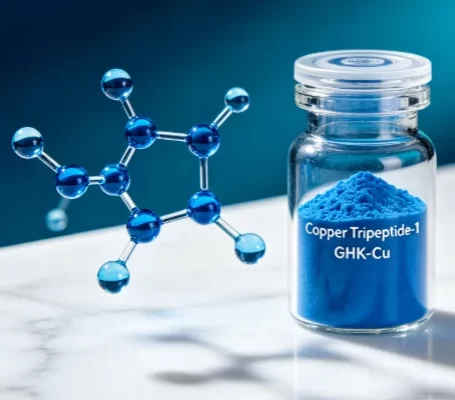
What Is Copper Tripeptide-1 (GHK-Cu)?
Copper Tripeptide-1 is the copper (II) complex of the tripeptide Gly-His-Lys (GHK) — a naturally occurring human peptide discovered by Dr. Loren Pickart in 1973.
Chemical & physical properties:
- Sequence: Gly-His-Lys (GHK) + Cu²⁺ (1:1 molar ratio)
- CAS: 89030-95-5 (GHK-Cu complex); 49557-75-7 (GHK free peptide)
- Molecular formula: C₁₄H₂₂CuN₆O₄
- Molecular weight: ~401–404 Da (varies by hydration state)
- Appearance: Deep blue to blue-violet crystalline powder
- Solubility: Freely soluble in water; slightly soluble in glycerin; insoluble in oils and ethanol
- pH stability: Stable at pH 5.0–7.0; copper may precipitate at pH >7.5 (form insoluble copper hydroxide); avoid pH <4.0 (peptide degradation)
- Purity: ≥98% (HPLC), confirmed by LC-MS and UV-Vis
Copper coordination structure: The Cu²⁺ ion binds to GHK via:
- The imidazole nitrogen of the histidine residue
- The deprotonated amide nitrogens of the peptide backbone
- The terminal amino group of glycine This forms a stable, square-planar coordination complex that gives GHK-Cu its characteristic blue color and biological activity. The copper is tightly bound but bioavailable — it can be transferred to copper-dependent enzymes (e.g., SOD, lysyl oxidase) in cells.
Natural occurrence & age-related decline:
- GHK is naturally present in human plasma, saliva, and urine
- This age-related decline parallels the decline in skin collagen, elasticity, and wound healing capacity — providing the rationale for topical GHK-Cu supplementation in anti-aging skincare
GHK-Cu Benefits
- Wound Healing & Tissue Regeneration
- Antioxidant Activity
- Anti-Inflammatory Effects
- Hair Growth Promotion
- Photodamage Repair & Skin Rejuvenation
- Anti-aging serums (collagen stimulation, wrinkle reduction, firming)
- Eye creams & eye serums
Frequently Asked Questions Copper Tripeptide-1 (GHK-Cu)
What is the CAS number of Copper Tripeptide-1?
- GHK-Cu (copper complex): CAS 89030-95-5
- GHK (free peptide, without copper): CAS 49557-75-7
When sourcing, confirm whether you are purchasing the copper-chelated complex (89030-95-5, blue, active form) or the free peptide (49557-75-7, white, requires separate copper chelation). Our product is the fully chelated GHK-Cu complex (CAS 89030-95-5).
Is GHK-Cu the same as copper peptide? Are there other copper peptides?
“Copper peptide” is a general term that can refer to any peptide-copper complex. GHK-Cu (Copper Tripeptide-1) is by far the most widely used and well-studied copper peptide in cosmetics. Other less common copper peptides include:
- Copper Lysinate / Copper PCA — copper-amino acid complexes, simpler, less studied
- Copper Peptide (various) — generic term, always confirm the specific peptide sequence
When a product says “copper peptide” without specifying GHK-Cu, ask for the exact INCI name and sequence. Our product is specifically Copper Tripeptide-1 = GHK-Cu, the original copper peptide.
What are the skin benefits of GHK-Cu?
- Wrinkle reduction — increased collagen fills fine lines and wrinkles from within
- Skin firming & lifting — rebuilt dermal matrix improves elasticity and structural support
- Skin thickening & density — increased dermal collagen and GAGs (measurable by ultrasound)
- Photodamage repair — inhibits UV-induced MMP activation and collagen degradation
- Wound healing & post-procedure recovery — accelerates healing after lasers, peels, microneedling
- Redness & irritation relief — anti-inflammatory, suitable for sensitive and rosacea-prone skin
- Antioxidant protection — scavenges ROS, protects against pollution and UV oxidative stress
- Hair growth — stimulates follicles, reduces shedding (in hair serums/scalp treatments)
- Improved skin tone & radiance — reduced oxidative damage and pigmentation