
WNiCu Tungsten Heavy Alloy Sheet & Plate — ASTM B777
WNiCu, or tungsten‑nickel‑copper heavy alloy, is a liquid-phase sintered tungsten composite. It is made of 90–95 wt% sintered tungsten grains bonded by a ductile nickel-copper binder matrix. This alloy family follows ASTM B777 Non‑Magnetic Classes 1 through 3, equivalent to AMS 7727E Type 1–3 and remains the most widely adopted non-magnetic tungsten heavy alloy for aerospace, defense, medical and satellite projects.
We supply non-magnetic WNiCu heavy alloy as sheet, plate, foil/strip, plus custom-machined parts to customer drawings. As a direct bulk manufacturer, we provide full MTC documentation with magnetic permeability, density and mechanical test results for every order.
– Class 1 (90W-NiCu): 90% tungsten, 6% nickel, 4% copper
– Class 2 (93W-NiCu): 93% tungsten, 4.9% nickel, 2.1% copper
– Class 3 (95W-NiCu): 95% tungsten, 3.5% nickel, 1.5% copper
Technical Specifications
| Category | Item | Specification |
|---|---|---|
| Composition | Tungsten (W), wt% | 95.0 ± 1.0 |
| Nickel (Ni), wt% | ~3.5 | |
| Copper (Cu), wt% | ~1.5 | |
| Ni:Cu ratio | 7:3 | |
| Impurities (each, max) | ≤ 0.05 | |
| Classification | ASTM B777 Class | Class 3 |
| Equivalent spec | AMS 7727E Type 3 | |
| Density | g/cm³ | 17.75 – 18.35 |
| lb/in³ | ~0.65 | |
| Magnetic | Permeability (μ) | ≤ 1.05 |
| Mechanical | Min. UTS (MPa / ksi) | ≥ 680 / 100 |
| Typical UTS (MPa) | 720 – 900 | |
| Min. 0.2% YS (MPa) | ~650 | |
| Hardness (HRC) | 27 – 30 | |
| Elongation (%) | 5 – 15 | |
| Physical | Thermal conductivity (W/m·K) | ~160 |
| CTE (10⁻⁶/K) | ~5.5 | |
| Dimensions | Sheet thickness | 0.5 – 3 mm |
| Plate thickness | 3 – 50 mm | |
| Foil/strip thickness | 0.05 – 2.0 mm | |
| Max width | 350 mm | |
| Max length | 600 mm (cut-to-size) |
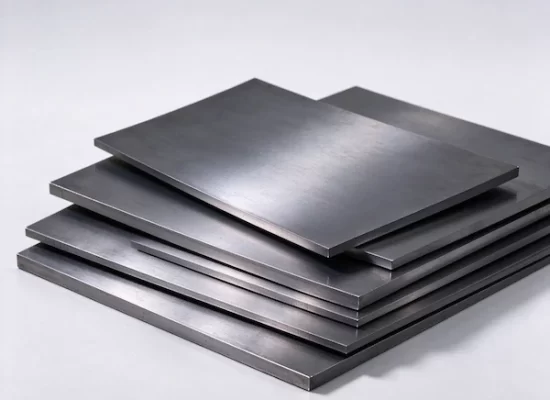
What is WNiCu Tungsten Heavy Alloy?
WNiCu non-magnetic tungsten heavy alloy (WHA) sheet and plate are magnetically clean flat-rolled materials. We produce sintered tungsten‑nickel‑copper composite to ASTM B777 Non-Magnetic, matching AMS 7727E Type 1–3 specifications. This alloy series includes three grades: 90W-NiCu (Class 1), 93W-NiCu (Class 2), and 95W-NiCu (Class 3).
Its standout trait is non-magnetic performance. The nickel-copper binder replaces iron used in magnetic W-Ni-Fe tungsten heavy alloys, so the material stays non-ferromagnetic. This makes WNiCu the preferred option for parts installed close to gyroscopes, accelerometers, IMUs, magnetometers, and MRI equipment, where magnetic disturbance cannot be tolerated. Available as sheet and plate in sintered, rolled and vacuum stress-relieved condition.
WNiCu Non-Magnetic Tungsten Heavy Alloy — Technical Specification Chart
Our WNiCu non-magnetic tungsten heavy alloy sheet and plate covers the full ASTM B777 non-magnetic grade family — Class 1 (90W-NiCu), Class 2 (93W-NiCu), and Class 3 (95W-NiCu) — equivalent to AMS 7727E Type 1–3. Sheet is supplied 0.5–3 mm, plate 3–50 mm, width up to 350 mm, length up to 600 mm. Choose 90W-NiCu for maximum ductility or 95W-NiCu for maximum density with magnetic cleanliness.
| Category | Item | 90W-NiCu | 93W-NiCu | 95W-NiCu |
|---|---|---|---|---|
| Composition | Tungsten (W), wt% | 90.0 ±1.0 | 93.0 ±1.0 | 95.0 ±1.0 |
| Nickel (Ni), wt% | ~6.0 | ~4.0 | ~3.5 | |
| Copper (Cu), wt% | ~4.0 | ~3.0 | ~1.5 | |
| Ni:Cu ratio | 6:4 | 4:3 | 7:3 | |
| Impurities (each, max) | ≤0.05 | ≤0.05 | ≤0.05 | |
| Classification | ASTM B777 Class | Class 1 (Non-Mag) | Class 2 (Non-Mag) | Class 3 (Non-Mag) |
| Equivalent spec | AMS 7727E Type 1 | AMS 7727E Type 2 | AMS 7727E Type 3 | |
| Density | g/cm³ | 16.85–17.30 | 17.15–17.85 | 17.75–18.35 |
| lb/in³ | 0.61 | 0.63 | 0.65 | |
| Magnetic | Permeability (μ) | 1.05 (ASTM B193) | ≤ 1.05 | ≤ 1.05 |
| Mechanical | Min. UTS (MPa / ksi) | ≥675 / 100 | ≥650 / 95 | ≥680 / 100 |
| Typical UTS (MPa) | 675–850 | 700–900 | 720–900 | |
| Min. 0.2% YS (MPa) | ≥600 | ~620 | ~650 | |
| Hardness (HRC) | 24–26 | 25–27 | 27–30 | |
| Elongation (%) | 20–33 | 10–25 | 5–15 | |
| Physical | Thermal conductivity (W/m·K) | ~150 | ~155 | ~160 |
| CTE (10⁻⁶/K) | ~6.5 | ~6.0 | ~5.5 | |
| Dimensions | Sheet thickness | 0.5 – 3 mm | 0.5 – 3 mm | 0.5 – 3 mm |
| Plate thickness | 3 – 50 mm | 3 – 50 mm | 3 – 50 mm | |
| Foil/strip thickness | 0.05 – 2.0 mm | 0.05 – 2.0 mm | 0.05 – 2.0 mm | |
| Max width | 350 mm | 350 mm | 350 mm | |
| Max length | 600 mm (cut-to-size) | 600 mm | 600 mm | |
| Temper & Surface | Supply condition | Sintered → rolled → vacuum stress-relieved | same | same |
| Surface finish | As-rolled; ground; polished | same | same | |
| Flatness (ground) | ≤1.5 mm/m | ≤1.5 mm/m | ≤1.5 mm/m |
WNiCu (tungsten-nickel-copper) heavy alloy application
WNiCu non-magnetic tungsten heavy alloy is selected for magnetically sensitive high-density applications, including balance weights and inertial masses for gyroscopes and IMUs, magnetic-clean counterweights for satellites and spacecraft, MRI-compatible components and non-magnetic CT/LINAC collimators for medical radiation hardware, precision balance weights for scientific metrology instruments, magnetic-free guidance parts for defense systems, balance masses for rotating machinery with magnetic bearings and position sensors, and downhole counterweights for oil & gas magnetometer survey tools, where magnetic interference must be fully avoided.
Frequently Asked Questions
Q: Is WNiCu truly non-magnetic?
A: Yes. Per ASTM B777 / ASTM B193, magnetic permeability is μ ≤ 1.05 — effectively non-ferromagnetic. We test every lot and report the measured value on the MTC.
Q: Why is WNiCu non-magnetic while WNiFe is magnetic?
A: The binder differs. W-Ni-Fe contains iron (ferromagnetic). W-Ni-Cu replaces iron with copper, producing a non-ferromagnetic binder.
Q: Which grade should I choose?
A: 90W-NiCu for maximum ductility; 95W-NiCu for maximum density with magnetic cleanliness.