
Gas-Atomized Spherical Tungsten Powder
High purity Tungsten Metal Spherical Powder, also know as UNS R07000 Tungsten Plasma-Spheroidized Powder, is widely used for additive manufacturing/3D printing applications. Tungsten Spheres is for sale at a competitive price.
Princeton Powder is a leading supplier of Tantalum Carbide refractory ceramic powder. Tantalum powders including Tantalum Nanoparticles, Tantalum Tungsten gas atomized powder, and Tantalum Disilicide powder are for sale in bulk.
Spherical Tungsten W Powder
Formula | Tungsten W |
Synonyms | spherical Tungsten particles, spherical Tungsten powders, Tungsten Powder, Tungsten thermal spray powder, Tungsten gas atomized powder |
Appearance | Black Powder |
Particle Size | 15-53 um, 45-105 um, can be customized upon request |
Melting Point | 3410 °C |
Density | 19.3 g/cm 3 |
Apparent Density | >9.5 g/cm3 |
Tap Density | >11.5 g/cm3 |
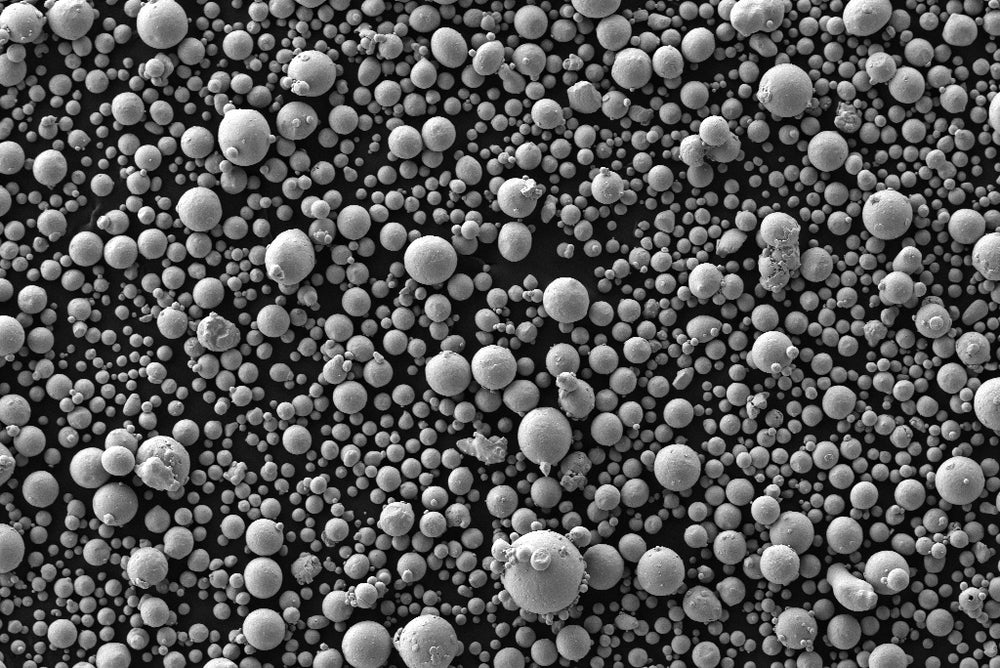
Description of Spherical Tungsten Powder
Spherical tungsten powder consists of uniformly round particles, produced primarily through atomization methods. It is known for its high density, melting point, and hardness, along with excellent thermal and electrical conductivity. This powder is used in high-performance applications such as high-density alloys, radiation shielding, and precision components in aerospace and defense. Its spherical shape enhances flowability and uniformity, making it suitable for advanced manufacturing processes. The powder is typically made by atomizing molten tungsten with high-pressure gas or water.
Princeton Powder is a leading supplier of Spherical tungsten powder. We have a range of spherical powder products and possess extensive expertise in additive manufacturing (3D printing) industry. Tungsten powder is for sale in the USA.
Chemical Composition of Spherical Tungsten Powder
Chemical Composition | |||||
Element | Value(%) | Test Method | Element | Value(%) | Test Method |
W | ≥99.95 | — | Sn | <0.001 | ICP-AES |
Al | <0.001 | ICP-AES | Mo | <0.001 | ICP-AES |
Si | <0.002 | ICP-AES | Cu | <0.001 | ICP-AES |
Ni | <0.001 | ICP-AES | Fe | <0.005 | ICP-AES |
Gas Impurities | |||||
Element | Value(%) | Test Standard | Element | Value(%) | Test Standard |
C | ≤0.005 | GB/T 4324-2012 | O | ≤0.02 | GB/T 4324-2012 |
N | ≤0.003 | GB/T 4324-2012 | P | ≤0.002 | GB/T 4324-2012 |
Density(g/cm³) | Hall Flow Rate(s/50g) | |||
Apparent Density | Tap Density | Test Standard | Value | Test Standard |
≥10.0 | ≥12.0 | GB/T 1479-1984 GB/T 5162-2006 | ≤6.5 | GB/T 1482-2010 |
Tungsten Powder Particle Size distribution
0-15μm, 15-53μm, 45-105μm, 45-150μm. (Various particle sizes can be customized)

Applications
High-Density Components: Used in aerospace, automotive, and defense industries for producing high-density components like counterweights and shielding materials. Its high density and strength make it ideal for applications requiring significant mass in a compact form.
Radiation Shielding: Employed in radiation shielding materials to protect against X-rays and gamma rays in medical and nuclear industries. Tungsten’s high density provides effective shielding.
Tooling and Cutting Tools: Used in manufacturing high-performance tooling and cutting tools, such as drills and inserts, due to its hardness and wear resistance.
3D Printing: In additive manufacturing, tungsten powder is utilized to print parts that require high density, hardness, and thermal stability. This includes custom aerospace components, high-density penetrators, and precision parts.
Electrical Contacts and Components: Applied in electrical contacts and components where high melting points and good conductivity are required.
Spherical Tungsten powder Reference
Properties evolution of additive manufacture used tungsten powders prepared by radio frequency induction plasma
- In this study, radio frequency induction plasma was adopted to improve tungsten powder properties to meet the requirements of additive manufacturing process. After plasma spheroidization process operated, tungsten particles changed from irregular shape to uniform spherical shape. The average size and oxygen content of raw tungsten powders were both decreased, meanwhile, the laser absorption coefficient was increased by plasma spheroidization process. Furthermore, a series of tests were carried out for raw and spherical tungsten powders to investigate the influence of plasma spheroidization process on powder flowability evolution. The results displayed that, plasma spheroidized powders had a better comprehensive flowability, such as basic flow property, aerated flow property, compressibility, permeability and shear property, comparing to raw tungsten powders. In conclusion, plasma spheroidized tungsten powders met demands of additive manufacturing process very well.
Spherical Tungsten powder FAQ
What are the Production Methods of Spherical Tungsten Powder?
Plasma Atomization: Tungsten wire is melted in a plasma torch and atomized into spherical droplets.
Chemical Vapor Deposition (CVD): Tungsten hexafluoride (WF₆) is reduced to form pure spherical particles.
Radio Frequency (RF) Plasma Spheroidization: Irregular powders are melted into spheres via RF plasma.
What are the Advantages Plasma Spheroidization Tungsten Powder of Over Irregular Tungsten Powder
Better Packing Density: Spherical particles improve sintering and final part density.
Superior Flowability: Enhances consistency in 3D printing and molding processes.
Reduced Porosity: Critical for applications requiring structural integrity.
What are the Applications
Additive Manufacturing: Used in laser powder bed fusion (LPBF) to print high-density tungsten parts (e.g., aerospace components).