
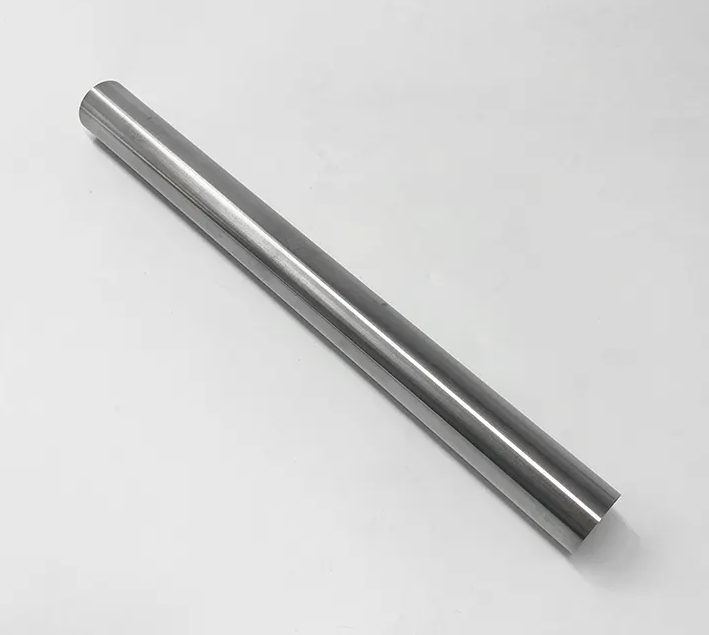
High Purity Tantalum Bars & Rods - ASTM B365 Compliant
Princeton Powder is a leading supplier of tantalum rods and bars in the United States, providing materials that comply with ASTM B365 standards for quality and performance. Our tantalum rods and bars are available in various diameters, making them ideal for a wide range of applications, including aerospace, medical devices, and chemical processing. Utilizing advanced manufacturing techniques such as hot rolling and annealing, we enhance the mechanical properties and ensure high purity of our products. Committed to excellence, we deliver tantalum rods and bars that meet the stringent requirements of our customers across diverse industries.
Tantalum Bar & Rod Product Specifications
Material | Tantalum Rod, Ta Bar |
CAS Number | 7440-25-7 |
Standard | ASTM B365, ASTM F560 (Medical Grade) |
Grade | R05200, R05400, R05252 (Ta2.5W), R05255 (Ta10W), R05240 (Ta40Nb) |
| Density | 16.65 g/cm3 |
Melting Point | 3020 ℃ |
Diameter | >0.125″ diameter x L, customized |
Form | Annealed |
Surface Treatment | Pickling or Polishing |
Related Products:
Pure Niobium Wire (Spool and Coil Wire)
Thermal spray molybdenum wire ASTM B386
Tantalum Wire (Straight Wire, Spooled and Coiled Wire)
Titanium Wire, Rod, Bar & Tube (ASTM B348, AMS 4911)
Molybdenum rhenium wire, Mo-Re41.5%, Mo-Re47.5%
Molybdenum Lanthanum Wire (MoLa)
Unalloyed Tantalum Bars (R05200, R05400)
Princeton Powder supplies high purity unalloyed tantalum bars meeting ASTM B365 standards. Our R05200 tantalum bars are produced via electron-beam or vacuum-arc melting, offering exceptional purity levels of 99.9% or higher. The R05400 grade, manufactured through powder-metallurgy consolidation, provides superior density and mechanical properties for demanding applications. Both grades exhibit excellent corrosion resistance, high melting point (2996°C), and biocompatibility for medical applications.
Unalloyed Tantalum Bars (R05200, R05400)
For enhanced strength and high-temperature performance, we offer tantalum alloy rods including R05252 (Ta-2.5W), R05255 (Ta-10W), and R05240 (Ta-40Nb). These tantalum alloy products combine the corrosion resistance of pure tantalum with improved mechanical properties. Ta-2.5W and Ta-10W alloys provide increased strength at elevated temperatures, ideal for aerospace components. Ta-40Nb offers improved formability while maintaining excellent corrosion resistance for chemical processing equipment.
Medical Grade Tantalum (ASTM F560)
Our medical grade tantalum meets ASTM F560 standards for surgical implant applications. With purity levels exceeding 99.95%, this biocompatible tantalum material is suitable for orthopedic implants, pacemaker leads, dental applications, and surgical instruments. The material’s radiopacity makes it ideal for medical imaging applications, while its corrosion resistance ensures long-term stability in physiological environments.
Chemical Compositions of Pure Tantalum and Ta alloy Rod/Bar
Grade | Chemical Composition (≤%) | |||||||||||
Ta | Fe | Si | Ni | W | Mo | Ti | Nb | O | C | H | N | |
Ta1 | Bal. | 0.005 | 0.005 | 0.002 | 0.01 | 0.01 | 0.002 | 0.03 | 0.015 | 0.01 | 0.0015 | 0.01 |
Ta2 | Bal. | 0.03 | 0.02 | 0.005 | 0.04 | 0.03 | 0.005 | 0.1 | 0.02 | 0.01 | 0.0015 | 0.01 |
TaNb3 | Bal. | 0.03 | 0.03 | 0.005 | 0.04 | 0.03 | 0.005 | <3.5 | 0.02 | 0.01 | 0.0015 | 0.01 |
TaNb20 | Bal. | 0.03 | 0.03 | 0.005 | 0.04 | 0.03 | 0.005 | 17.0-23.0 | 0.02 | 0.01 | 0.0015 | 0.01 |
Ta2.5W | Bal. | 0.005 | 0.005 | 0.002 | 3.0 | 0.01 | 0.002 | 0.04 | 0.015 | 0.01 | 0.0015 | 0.01 |
Ta10W | Bal. | 0.005 | 0.005 | 0.002 | 11 | 0.01 | 0.002 | 0.04 | 0.015 | 0.01 | 0.0015 | 0.01 |
Physical Properties of Tantalum Rod and Bar
| Product condition | Tensile strength (MPa) | Elongation, % |
| Annealed | 300~600 | 10~30 |
| Half annealed | >600~1000 | <5 |
Unannealed | >1000 | <5 |
Custom Tantalum Bar Sizes & Dimensions
Princeton Powder offers tantalum bar diameters from 3mm (0.125″) to 200mm (8″), with standard tantalum rod diameters including 6mm, 12mm, 25mm, 50mm, and 100mm. Custom tantalum bar diameters outside this range can be produced upon request, with tight tolerance control ensuring dimensional accuracy for precision applications.
Standard tantalum rod lengths up to 2000mm (79″) are available from stock, with custom cutting services to your specified lengths. For specialized applications, we can produce continuous lengths or cut-to-size components. Our tantalum bar length customization ensures minimal waste and optimal material utilization for your project requirements.
Various surface finishes are available for tantalum rods and bars, including:
- Polished finish: Mirror-like surface for aesthetic and low-friction applications
- Ground finish: Precision ground surfaces for dimensional accuracy
- Machined finish: Custom machined surfaces for specific interface requirements
- As-drawn finish: Standard mill finish for general applications
Applications by Industry
Aerospace & Defense Applications
Tantalum bars and rods are essential for aerospace applications requiring exceptional high-temperature performance and corrosion resistance. Our tantalum materials are used in rocket nozzle components, jet engine parts, heat shields, and structural elements in supersonic aircraft. The material’s ability to withstand extreme temperatures (up to 3000°C) makes it ideal for propulsion systems and thermal protection applications in defense and space exploration.
Medical & Surgical Implants
Tantalum bars and rods are essential for aerospace applications requiring exceptional high-temperature performance and corrosion resistance. Our tantalum materials are used in rocket nozzle components, jet engine parts, heat shields, and structural elements in supersonic aircraft. The material’s ability to withstand extreme temperatures (up to 3000°C) makes it ideal for propulsion systems and thermal protection applications in defense and space exploration.
Chemical Processing Equipment
In chemical processing industries, tantalum rods provide unmatched corrosion resistance to aggressive media including acids, chlorides, and reactive chemicals. Our tantalum bars are used in heat exchangers, reactor vessels, piping systems, and protective linings for equipment handling sulfuric acid, hydrochloric acid, and other corrosive substances at elevated temperatures and pressures.
Chemical Processing Equipment
Tantalum’s high dielectric constant and stability make it indispensable for electronics applications. Our tantalum materials are used in capacitor manufacturing, sputtering targets for thin-film deposition, semiconductor processing equipment, and high-temperature sensors. The material’s consistent electrical properties ensure reliable performance in critical electronic components across consumer electronics, telecommunications, and industrial control systems.