
Cross-linked Sodium Hyaluronate Powder EP Pharmaceutical Supplier Cross-linked hyrluronic Acid Powder
Cross-linked sodium hyaluronate powder is a pharmaceutical-grade hydrogel raw material produced by covalently crosslinking high-molecular-weight sodium hyaluronate with 1,4-butanediol diglycidyl ether (BDDE) — followed by controlled particle sizing, purification, and lyophilization into a sterile, free-flowing powder. Unlike non-crosslinked HA, which is rapidly degraded by hyaluronidase within days, the crosslinked three-dimensional network resists enzymatic breakdown, providing sustained in vivo residence and tunable mechanical support for soft tissue augmentation. Our product is manufactured under strict GMP conditions, complies with the European Pharmacopoeia (EP) monograph for sodium hyaluronate. With customizable particle size, crosslinking degree, swelling ratio, and elastic modulus, our cross-linked HA powder is the ideal API for dermal fillers, intra-articular viscosupplementation, drug delivery carriers, and anti-adhesion barriers. As a leading bulk crosslinked hyaluronic acid supplier, we provide full regulatory documentation, custom formulation development, and competitive pricing for medical device and pharmaceutical companies worldwide.
Technical Specifications
| Parameter | Medical Grade (Injectable) | Cosmetic Grade (Topical) |
|---|---|---|
| INCI Name | Polydeoxyribonucleotide | Sodium DNA |
| CAS Number | 100403-24-5 | 100403-24-5 |
| Appearance | White to off-white powder | White to off-white powder |
| Purity (HPLC/UV) | ≥ 99.0% | ≥ 98.0% |
| Molecular Weight | 50–650 kDa (PDRN) / >1,500 kDa (PN) | 50–1,500 kDa |
| pH (1% solution) | 6.5 – 7.5 | 6.0 – 8.0 |
| Loss on Drying | ≤ 10.0% | ≤ 10.0% |
| Protein Residue | ≤ 0.1% | ≤ 0.5% |
| Endotoxin (LAL) | ≤ 0.03 EU/mg | ≤ 0.5 EU/mg |
| Bioburden | ≤ 10 CFU/g | ≤ 100 CFU/g |
| Sterility | Sterile (gamma-irradiated or aseptic) | Non-sterile (preservative-compatible) |
| Heavy Metals | ≤ 10 ppm | ≤ 20 ppm |
| Residual Solvent | ≤ 0.5% | ≤ 1.0% |
| Intended Use | Injectable skin boosters, wound care, hair restoration, medical devices | Topical serums, creams, masks, essences |
What Is Cross-linked Sodium Hyaluronate Powder?
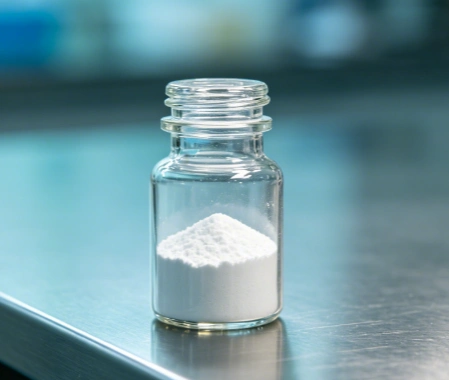
Cross-linked sodium hyaluronate powder (also called crosslinked HA powder, CL-HA, or HA hydrogel microspheres) is a pharmaceutical-grade active pharmaceutical ingredient (API) and medical device raw material consisting of lyophilized, covalently crosslinked hyaluronic acid hydrogel particles.
The chemistry: Native sodium hyaluronate is a linear polysaccharide with a molecular weight of 500 kDa to over 4,000 kDa. In its native form, it is rapidly degraded by hyaluronidase enzymes in the body within hours to days. To extend its residence time and create mechanical support, HA is chemically crosslinked using bifunctional crosslinking agents that form covalent bonds between adjacent HA chains, creating a three-dimensional hydrogel network.
Crosslinked HA powder Pharmaceutical Applications
Aesthetic Medicine — Dermal Fillers
- Soft tissue augmentation: The primary application. Reconstituted crosslinked HA is injected into the dermis or subcutaneous tissue to correct facial volume loss, wrinkles, folds, and contours.
- Product types:
- Fine line / superficial fillers: Small particle size (100–300 μm), lower G’ (~100–300 Pa), for periorbital lines, forehead lines, lip vermilion border.
- Mid-depth fillers: Medium particle (300–600 μm), medium G’ (~300–800 Pa), for nasolabial folds, marionette lines, cheek augmentation, lip augmentation.
- Deep / volumizing fillers: Large particle (600–1000 μm), high G’ (~800–3,000 Pa), for jawline definition, chin augmentation, cheek volumizing, temple augmentation, facial contouring.
- Lip fillers: Soft, elastic formulations with medium particle size and medium G’ for natural lip movement and feel.
- Non-surgical rhinoplasty: High G’, cohesive gel for structural support.
- Typical formulation: 20–26 mg/mL crosslinked HA in sterile phosphate-buffered saline, with lidocaine (0.3%) for pain management in many products. Supplied in pre-filled syringes (0.5 mL, 1.0 mL, 1.5 mL, 2.0 mL).
Orthopedics — Viscosupplementation
- Intra-articular injection for osteoarthritis: Crosslinked HA (often higher MW and moderate crosslinking) is injected into the knee, hip, shoulder, or ankle joint to restore synovial fluid viscosity, reduce pain, and improve joint mobility.
- Advantages over non-crosslinked HA: Longer intra-articular residence (6–12 months vs. 1–2 days for native HA), fewer injections required (1–3 vs. 5 weekly injections), better pain relief.
- Typical formulation: 10–20 mg/mL crosslinked HA in sterile saline, supplied in 2–3 mL pre-filled syringes for single intra-articular injection.
Drug Delivery & Controlled Release
- Crosslinked HA hydrogel as a drug depot: The porous hydrogel network can be loaded with therapeutic agents (proteins, peptides, small molecules, cells) for sustained release over days to months.
- Applications: Post-surgical pain management (local anesthetics), ophthalmic drug delivery, oncology (local chemotherapy), hormone therapy, vaccine adjuvants.
- Release kinetics controlled by: Crosslinking degree (higher = slower release), particle size, drug loading, and HA degradation rate.
Anti-Adhesion Barriers
- Post-surgical adhesion prevention: Crosslinked HA hydrogel is applied as a film or gel between surgically traumatized tissues (abdominal, pelvic, orthopedic, cardiac) to prevent the formation of fibrous adhesions during healing.
- Mechanism: The HA hydrogel acts as a physical barrier during the critical 5–7 day post-surgical period when adhesions form, then is gradually biodegraded.
- Typical formulation: Crosslinked HA powder reconstituted to a sprayable gel or film-forming solution.
Ophthalmology — Viscoelastic Agents
- Surgical viscoelastics (OVDs): Crosslinked HA (high MW, moderate crosslinking) is used in cataract surgery, refractive surgery (LASIK, SMILE), and corneal transplantation to maintain anterior chamber depth, protect corneal endothelium, and manipulate tissues.
- Advantages: High viscosity and elasticity, excellent biocompatibility, easy removal at end of procedure.
Other Medical Applications
- Wound care: Crosslinked HA hydrogel dressings for chronic wounds, burns, and surgical wounds.
- Cell therapy carrier: Hydrogel microspheres for cell encapsulation and transplantation (e.g., chondrocytes for cartilage repair, pancreatic islets for diabetes).
- Tissue engineering scaffolds: Crosslinked HA as a 3D matrix for cartilage, bone, and skin tissue engineering.
- Vocal fold augmentation: Injection of crosslinked HA for vocal fold paralysis or atrophy.
Frequently Asked Questions Crosslinked Hyaluronic Acid Powder
Q: What is the difference between cross-linked HA and regular (non-crosslinked) HA?
A: Regular sodium hyaluronate is a linear, non-crosslinked polysaccharide that is rapidly degraded by hyaluronidase enzymes in the body within hours to days. It provides lubrication and temporary hydration but no long-term volume or structural support. Cross-linked HA is chemically modified with a crosslinker (most commonly BDDE) to form a three-dimensional covalent network that resists enzymatic degradation. This extends in vivo residence to 6–18 months and creates mechanical support for soft tissue augmentation. Cross-linked HA is the active ingredient in dermal fillers and long-acting viscosupplements; non-crosslinked HA is used in short-acting joint injections, eye drops, and topical skincare.
Q: What is the difference between monophasic and biphasic fillers?
A: Monophasic fillers (e.g., Juvederm®) consist of a homogeneous, cohesive crosslinked HA gel with no distinct particles. They are smooth, easy to inject, and produce a natural, soft result. They are typically manufactured by crosslinking HA in a uniform gel, then homogenizing to a cohesive consistency. Biphasic fillers (e.g., Restylane®) consist of discrete crosslinked HA particles suspended in a non-crosslinked HA solution. The particles provide structure and longevity, while the non-crosslinked HA solution provides lubrication and ease of injection. Biphasic fillers tend to be firmer and longer-lasting but may have a slightly different injection feel. Our cross-linked HA powder can be used for both: for monophasic, reconstitute and homogenize to a cohesive gel; for biphasic, reconstitute the particles and suspend in non-crosslinked HA solution.