
CuCrNb GRCop Powder (GRCop-42 & GRCop-84) — NASA-Developed Cu Alloy for Aerospace Additive Manufacturing
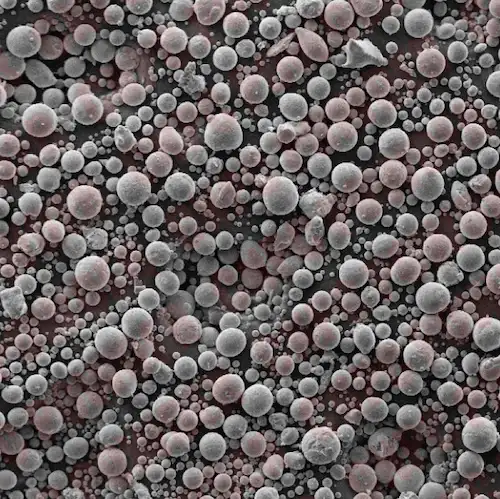
CuCrNb is a copper-based alloy with chromium and niobium added to enhance its mechanical properties. CuCrNb alloys usually refer to the Glenn Research Copper (GRCop) alloys, which are developed by NASA Glenn Research Center. There are mainly two kinds of CuCrNb powders named GRCop-42 and GRCop-84, with different compositions of Cr and Nb. They are usually manufactured via Laser powder bed fusion (L-PBF) and electron beam powder bed fusion (EB-PBF).
Princeton Powder is a leading supplier of high-purity CuCrNb powders. We provide 15-53 um, 45-105 um, and customized particle sizes per requested. Copper powders including Copper Nickel Alloy CuNi Powder, Aluminium Bronze CuAl10 Alloy Powder, and CuCrZr powder C-18150 are for sale at a competitive price.
Formula | CuCrNb |
Part Number | CU1120 |
Purity | 99% min |
Synonyms | CuCrNb Powder, GRCop-42 and GRCop-84 Powder |
Particle Sizes | 15-53 um, 15-45 um, Customized |
Shape | Spherical or irregular |
Oxygen | <0.2% |
Density | 8.79 g/cm 3 |
Product Overview
What is GRCop? — NASA's High-Temperature Copper Alloy
GRCop (Cu-Cr-Nb) is a family of dispersion-strengthened copper alloys developed by NASA Marshall Space Flight Center specifically for additive manufacturing of high-temperature aerospace propulsion components. Unlike conventional copper alloys that soften dramatically above 400°C, GRCop retains mechanical strength to 700°C through a uniform dispersion of fine Cr₂Nb precipitates (50–200 nm) that pin grain boundaries and block dislocation movement — while maintaining copper-level thermal conductivity (250–300 W/m·K). This unique combination — high strength at temperature + high thermal conductivity — makes GRCop the only viable material for regeneratively cooled rocket engine thrust chambers produced by L-PBF or EB-PBF additive manufacturing. Princeton Powder supplies both GRCop grades as gas-atomized spherical powder at 15–53 µm, optimized for powder bed fusion AM systems.
GRCop-42 vs. GRCop-84 — Which Grade for Your Application?
| Property | GRCop-42 | GRCop-84 |
|---|---|---|
| Composition | Cu-4Cr-2Nb (wt%) | Cu-8Cr-4Nb (wt%) |
| Thermal Conductivity (RT) | ~300 W/m·K | ~250 W/m·K |
| UTS at 500°C | ~200 MPa | ~280 MPa |
| Best For | Best conductivity-strength balance; regeneratively cooled thrust chambers | Maximum high-temperature strength; highest heat-flux zones |
Not sure which grade suits your application? Contact our aerospace AM specialists with your target operating temperature and thermal conductivity requirements for a technical recommendation.
Chemical Composition/Particle Size of CuCrNb Powder
Main properties of CuCrNb Powder
- High Electrical Conductivity: CuCrNb powder is siutable for electrical contacts and high-thermal-conductivity applications.
- High Strength and Creep Resistance: Chromium and niobium additions significantly improve mechanical properties, enabling use in high-temperature, high-stress conditions.
- Corrosion and Oxidation Resistance: Resistance to oxidation and corrosion, even in high-temperature environments.
- Good Formability: CuCrNb powder is used for 3D printing, isostatic pressing, and hot isostatic pressing (HIP) manufacturing techniques.
Manufacturing method of CuCrNb Powder(powder bed fusion)
- Raw Material Preparation: High-purity copper, chromium, and niobium are used as raw materials.
- Melting and Alloying: Raw materials are melted under high vacuum or inert gas protection using arc melting
- Atomization for Powder Production: CuCrNb powder is produced using gas atomization, powder bed fusion, or plasma rotating electrode process (PREP)
- Post-Treatment: Powders undergo degassing and surface cleaning to reduce oxygen content.
Application of CuCrNb Powder
Rocket Engine Regeneratively Cooled Thrust Chambers
The primary application of GRCop powder is L-PBF additive manufacturing of regeneratively cooled thrust chamber assemblies for liquid rocket engines. NASA's HR-1 program demonstrated GRCop-84 chambers surviving 25+ full-duration hot-fire tests with zero cooling channel degradation — validating the alloy for flight-weight propulsion. The combination of 250 W/m·K thermal conductivity (enabling efficient regenerative cooling) and 280 MPa UTS at 500°C (maintaining structural margin with thin walls) is unique to GRCop — no other copper alloy, and no other AM material, offers this performance envelope.
High-Heat-Flux Combustion Chamber Liners
GRCop-84's elevated-temperature strength enables thinner chamber walls than conventional Cu alloys — directly reducing engine mass while maintaining positive structural margin at maximum heat flux. For expander-cycle and staged-combustion engines where every gram of engine mass directly impacts payload capacity, GRCop-84 additively manufactured liners provide the highest thrust-to-weight ratio achievable with copper-based AM materials.
Hypersonic Vehicle Thermal Management Systems
Emerging application: GRCop additively manufactured heat exchangers and thermal management panels for hypersonic vehicle leading edges, engine inlets, and actively cooled airframe structures. The simultaneous requirement for high heat flux dissipation (requires high thermal conductivity) and mechanical load bearing at 600–700°C (requires high-temperature strength) maps directly to GRCop's unique property combination.
Frequently Asked Questions About GRCop Powder
What is GRCop and why was it developed by NASA?
GRCop (Cu-Cr-Nb) was developed by NASA Marshall Space Flight Center specifically for L-PBF additive manufacturing of regeneratively cooled rocket engine thrust chambers. Conventional copper alloys soften above 400°C, making them unsuitable for high-temperature propulsion. GRCop solves this through Cr₂Nb dispersion strengthening — fine precipitates pin grain boundaries, retaining mechanical strength to 700°C while maintaining copper's high thermal conductivity for cooling. GRCop-42 (Cu-4Cr-2Nb) and GRCop-84 (Cu-8Cr-4Nb) are the two standard grades.
GRCop-42 vs GRCop-84 — which grade for my application?
GRCop-42 offers the best thermal conductivity (~300 W/m·K) with good strength — recommended for regeneratively cooled thrust chambers where heat transfer is the primary design driver. GRCop-84 offers higher strength (~280 MPa UTS at 500°C vs ~200 MPa for GRCop-42) at the cost of slightly lower conductivity (~250 W/m·K) — recommended for maximum heat-flux zones and applications where wall thickness reduction (weight savings) is the primary goal. Contact our technical team with your target operating temperature and heat flux for a grade recommendation.
What particle size is standard for GRCop powder in L-PBF?
15–53 µm is the standard particle size range used in published NASA and academic literature for both L-PBF and EB-PBF processing of GRCop. This range provides optimal powder flowability for consistent layer spreading while maintaining the fine feature resolution required for thin-wall (0.5–1.5 mm) cooling channel structures. Princeton Powder supplies 15–53 µm as standard; custom PSD cuts available for specific machine requirements.
How does GRCop compare to other copper AM powders (CuCrZr, pure Cu)?
CuCrZr (C18150) is a precipitation-hardening Cu alloy that offers good room-temperature strength but loses strength rapidly above 400°C — limiting its use to lower-temperature applications. Pure Cu offers the highest conductivity but near-zero strength at elevated temperature. GRCop's Cr₂Nb dispersion strengthening is thermally stable to 700°C — the precipitates do not coarsen or dissolve at operating temperature — providing a unique advantage for high-temperature aerospace applications where both conductivity and strength must be maintained.
What post-processing is recommended for L-PBF GRCop components?
Standard post-processing: stress relief at 400–500°C for 2 hours (relieves L-PBF residual stresses without coarsening Cr₂Nb precipitates). Optional Hot Isostatic Pressing (HIP) at 950–1000°C / 100 MPa for 2 hours for maximum density and fatigue life in flight-critical components. HIP also homogenizes the Cr₂Nb precipitate distribution, improving ductility. After HIP, a solution treatment + aging cycle may be applied for peak strength. Contact our technical team for application-specific heat treatment recommendations.
What documentation and certification do you provide for aerospace orders?
Every order: ICP-OES Certificate of Analysis, laser diffraction PSD (D10/D50/D90), SEM morphology imaging, Hall flow rate, ISO 9001:2015 CoC. Aerospace customers additionally receive: full traceability documentation, ultrasonic inspection reports, and material characterization data packages suitable for flight qualification submissions. Contact our aerospace AM team at +1 (646) 749-1791 with your certification requirements.
Research & Technical References
The following peer-reviewed research from NASA and academic institutions demonstrates GRCop performance in aerospace additive manufacturing. Princeton Powder GRCop meets or exceeds the material specifications used in these studies.
GRCop-84: A High-Temperature Cu-Cr-Nb Alloy for Additive Manufacturing of Rocket Engine Components
NASA Technical Reports Server (NTRS), NASA Marshall Space Flight Center, 2019 — Developed GRCop-84 (Cu-8Cr-4Nb) specifically for L-PBF AM of regeneratively cooled combustion chambers. Demonstrated 280 MPa UTS at 500°C with 250 W/m·K thermal conductivity after optimized AM processing and heat treatment. Hot-fire testing validated 25+ full-duration cycles with zero cooling channel degradation. Practical takeaway: Princeton Powder's GRCop-84 powder is manufactured to the composition, PSD, and purity specifications validated by NASA for flight-weight regeneratively cooled thrust chambers — the most demanding thermal-structural application in aerospace propulsion.
Additive Manufacturing of GRCop-42 via Laser Powder Bed Fusion: Process-Microstructure-Property Correlation
Materials & Design (Elsevier), Volume 187, 2020 — Achieved 99.8% relative density in L-PBF printed GRCop-42 using 15–45 µm gas-atomized powder. Post-build HIP + age hardening produced Cr₂Nb precipitate sizes of 50–200 nm uniformly distributed throughout the Cu matrix — confirming that gas-atomized powder with uniform Cr/Nb distribution is essential for consistent precipitation hardening response. Practical takeaway: Our 15–53 µm GRCop-42 powder targets the particle size and uniform chemistry validated by this study for dense, high-performance L-PBF aerospace components with predictable heat treatment response.
High-Temperature Mechanical Behavior of GRCop-84 Processed by Laser Powder Bed Fusion
Acta Materialia (Elsevier), Volume 221, 2022 — Characterized the elevated-temperature tensile, creep, and low-cycle fatigue behavior of L-PBF GRCop-84 from 20°C to 700°C. Identified that Cr₂Nb precipitate coarsening begins above 750°C — establishing 700°C as the practical maximum service temperature. The fine-grained L-PBF microstructure (2–5 µm grain size) provided superior creep resistance vs. wrought Cu alloys at 500°C. Practical takeaway: Princeton Powder GRCop-84 powder is engineered to produce the fine, uniform Cr₂Nb precipitate distribution that this study identified as essential for long-term creep resistance at rocket engine operating temperatures.
Contact our aerospace AM technical team for the full reference list and to discuss GRCop powder specifications for your propulsion or thermal management application — including material characterization data packages for flight qualification.