
KTaO3 Substrates - Single Crystal Potassium Tantalate Wafer
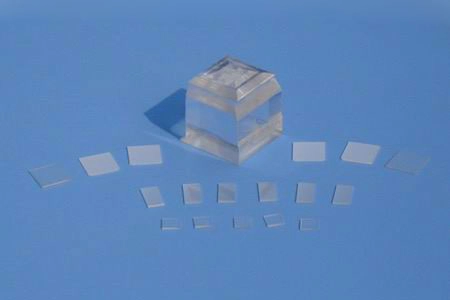
High-purity Potassium Tantalate (KTaO3) single crystal substrates offer an ideal perovskite cubic structure with a lattice constant of a = 0.3989 nm. Engineered specifically for advanced thin-film epitaxy, KTaO3 serves as an exceptional lattice-matched substrate for high-temperature superconductors, ferroelectric films, and non-linear optical devices. Its low dielectric loss, superior optical clarity, and structural stability make it indispensable in quantum materials research and high-frequency microwave applications.We supply custom KTaO3 wafers in standard (100), (110), and (111) crystal orientations with single or double-sided atomic-level polishing (Ra < 0.5 nm). Available in standard dimensions or customized specifications, our substrates guarantee low defect density and high batch-to-batch consistency. Contact our technical sales team for custom sizing, orientation tolerances, and bulk pricing.
Technical Specifications
| Parameter | Value |
|---|---|
| Product | KTaO3 — Potassium Tantalate Single Crystal, Cubic Perovskite, Space Group Pm3m |
| Lattice Constant | a = 3.989 Å — excellent match to YBCO (a~3.89Å) and perovskite oxides |
| Density / Melting Pt | 7.015 g/cm³ | ~1,500°C (incongruent) |
| Dielectric Constant | ε ~300 — quantum paraelectric (remains cubic to 0K) |
| Transmission / R.I. | 380–4,000 nm | n=2.226 @633nm; 2.152 @1539nm |
| Key Feature | Hosts 2DEG with Rashba SOC αR=0.26 eV·Å (~5× SrTiO3) at oxide interfaces |
| Standard Orientations | (100), (110), (111) ±0.5° |
| Primary Applications | Complex oxide epitaxy (YBCO, STO, LAO), 2DEG spintronics, diamond heteroepitaxy buffer, high-k dielectric research |
Product Overview
KTaO3 (Potassium Tantalate) is a cubic perovskite single crystal that is quantum paraelectric — it remains cubic and paraelectric down to 0K, never undergoing a ferroelectric phase transition. With a lattice constant a=3.989Å (excellent match to YBCO a~3.89Å), high dielectric constant ε~300, and epi-ready CMP surface (Ra<0.5nm), KTaO3 is a premier substrate for complex oxide epitaxy. Its defining research application: KTaO3 hosts a 2DEG at its interface with LaAlO3 or EuO, exhibiting Rashba spin-orbit coupling αR=0.26 eV·Å — ~5× larger than the benchmark SrTiO3/LaAlO3 system — making it the leading platform for oxide spintronics and topological superconductivity. Princeton Powder supplies (100), (110), and (111) orientations, SSP/DSP, AFM-verified epi-ready.
KTaO3 vs SrTiO3 — Which Perovskite Substrate?
| Property | KTaO3 (this product) | SrTiO3 | Advantage |
|---|---|---|---|
| Lattice a | 3.989Å — better YBCO match (~0.4%) | 3.905Å — standard perovskite | KTaO3 for YBCO epitaxy |
| Phase Stability | Cubic to 0K — no phase transitions | Cubic→Tetragonal at ~110K | KTaO3 — domain-free at all T |
| Rashba SOC αR | 0.26 eV·Å (~5× STO) | ~0.05 eV·Å | KTaO3 for spintronics |
| Cost / Availability | More expensive, specialized | Lower cost, widely available, Nb-doped conductive | STO for general epitaxy |
| Best For | YBCO epitaxy, 2DEG spintronics, quantum paraelectric stability | General perovskite epitaxy, 2DEG benchmark, conductive substrates | Application-dependent |
Technical Specifications
| Parameter | Specification |
|---|---|
| Crystal Structure | Cubic perovskite, Pm3m, a=3.989Å |
| Density | 7.015 g/cm³ |
| Melting Point | ~1,500°C (incongruent) |
| Mohs Hardness | 6 |
| Dielectric ε | ~300 (quantum paraelectric) |
| R.I. @633nm / 1539nm | 2.226 / 2.152 |
| Transmission | 380–4,000 nm |
| Thermal Conductivity | 0.17 W/m·K @300K |
| Orientations | (100), (110), (111) ±0.5° |
| Sizes | 5×5, 10×5, 10×10mm²; thickness 0.5mm ±0.05mm |
| Polish | SSP/DSP; CMP epi-ready Ra<0.5nm (AFM verified) |
Applications
Complex Oxide Epitaxy — YBCO, STO, LAO
KTaO3's a=3.989Å provides the best commercial-substrate lattice match to YBCO (~0.4% mismatch). Its paraelectric stability to 0K eliminates domain formation during low-temperature measurements — critical for HTS device research.
2D Electron Gas & Spin-Orbitronics
KTaO3-based 2DEGs exhibit the strongest Rashba SOC of any oxide interface (αR=0.26 eV·Å) — enabling gate-tunable spin precession and potential topological superconductivity in KTaO3/EuO heterostructures.
Diamond Heteroepitaxy Buffer
KTaO3's lattice match (~3% mismatch) with Ir buffer layers enables diamond heteroepitaxy for quantum sensing and power electronics substrates.
Why Choose Princeton Powder KTaO3
- Quantum Paraelectric — No Phase Transitions: Stays cubic to 0K — eliminating all substrate domain formation concerns during low-T epitaxy and measurements.
- 5× Stronger Rashba SOC than STO: αR=0.26 eV·Å — the leading platform for oxide spintronics and topological superconductivity.
- Best YBCO Lattice Match: a=3.989Å vs YBCO a~3.89Å (~0.4% mismatch) — enables highest-Jc HTS thin films.
- CMP Epi-Ready Ra<0.5nm: AFM roughness report with every substrate.
Frequently Asked Questions About KTaO3 Single Crystal Substrate
KTaO3 vs SrTiO3 — which?
KTaO3: better YBCO match, 5× Rashba SOC, no phase transitions. STO: cheaper, Nb-doped conductive, widely available. Princeton Powder supplies both.
What is "quantum paraelectric"?
KTaO3 would become ferroelectric at negative temperature (~−30K), but quantum zero-point fluctuations prevent the transition — it stays cubic and paraelectric to absolute zero with an extremely high, temperature-stable ε~300.
Potassium volatility at high temperature?
At >773K, K can segregate to surface. Recommend ≤700°C for prolonged anneals; rapid heating to growth temperature minimizes K loss during epitaxy.
Research & References
Rashba Spin-Orbit Coupling in KTaO3 2DEGs
Nature Physics, 2022 — Demonstrated KTaO3 2DEG Rashba αR=0.26 eV·Å — 5× larger than STO benchmark. Practical takeaway: Princeton Powder KTaO3 substrates enable the oxide spintronics device research validated by this study.