
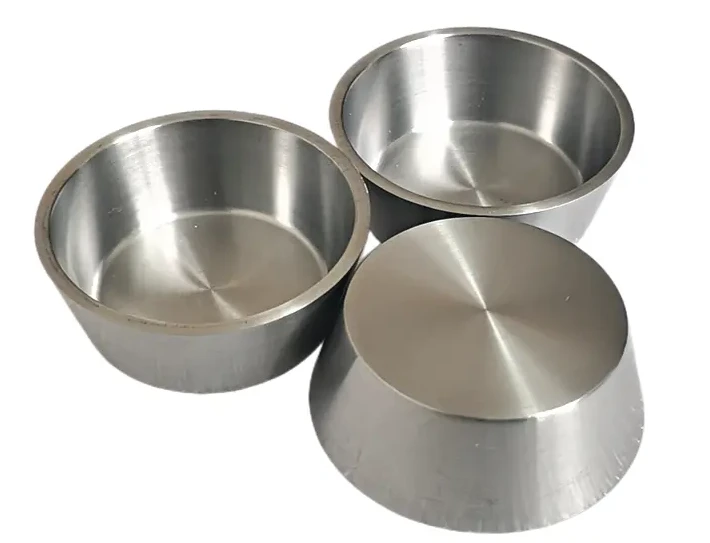
High Purity Molybdenum (Mo) Crucible — Forged & Welded, 99.95% Purity
Princeton Powder is a leading supplier of high-purity refractory Molybdenum (Mo) crucibles. Molybdenum crucibles are known for their high melting point, excellent thermal conductivity, and resistance to chemical corrosion. Based on the production methods, our molybdenum (Mo) crucibles can be classified into Forged Molybdenum Crucibles and Welded Molybdenum Crucibles. Based on the shape of the crucibles, we provide Cylindrical Crucibles, Conical Crucibles, Rectangular or Square Crucibles, Round-Bottom Crucibles, and Custom-shaped Crucibles.
We provide a wide range of crucibles including Niobium Crucible, Tungsten Crucible, Tantalum Crucible, and Zirconium Crucible. Our Molybdenum (Mo) crucible is for sale at a competitive price in the United States, Canada, and Europe.
Material | Molybdenum Crucible, Mo |
CAS Number | 7439-98-7 |
Purity | 99.95% min |
Standard | ASTM B387 |
| Density | 10.2 g/cm3 |
Melting Point | 2623 C |
Shape | Straight Wall, Cylindrical, Rectangular or Square, Custom-shaped |
Dimensions | 10-500mm OD x 10-600mm L |
Manufacturing Process | Forged, welding |
| Working conditions | rapidly oxidizes at temperatures above 760 C |
Description of Molybdenum (Mo) crucible
Molybdenum (Mo) crucibles are high-purity (99.95% min), high-temperature containers engineered for demanding thermal processing applications up to 2,000°C in vacuum or inert atmosphere. Princeton Powder supplies forged molybdenum crucibles (superior grain structure, higher density, better thermal uniformity) and welded molybdenum crucibles (larger available diameters, cost-effective for less demanding thermal profiles) — both available in cylindrical, straight wall, and rectangular/square configurations.
Forged vs. Welded Mo Crucibles — Which One Do You Need?
| Property | Forged Crucible | Welded Crucible |
|---|---|---|
| Grain Structure | Fine, equiaxed — uniform thermal expansion | Weld zone has different grain size vs base metal |
| Max Diameter | Limited by forge capacity (~200 mm) | Larger diameters possible (300+ mm) |
| Thermal Uniformity | Excellent — uniform wall thickness | Good — minor variation at weld seam |
| Cost | Higher — more material waste in forging | Lower — efficient sheet material usage |
| Best For | Sapphire crystal growth, critical thermal processes | General furnace, evaporation boats, non-critical applications |
Chemical Composition of Molybdenum (Mo) crucible
| Element | Purity: 99.95% |
|---|---|
| C | 0.01 wt%, max |
| Fe | 0.01 wt%, max |
| Ni | 0.005 wt%, max |
| Si | 0.01 wt%, max |
| Mo | Bal |
Stock Dimensions of Molybdenum Crucible
Mo Straight Wall Crucibles:
Item Number | Capacity | OD | H | WT |
Mo-5ml | 5 | 25 | 17 | 2 |
Mo-10ml | 10 | 30 | 21 | 2 |
Mo-15ml | 15 | 34 | 23 | 2 |
Mo-20ml | 20 | 37 | 26 | 2 |
Mo-25ml | 25 | 39 | 27 | 2 |
Mo-30ml | 30 | 42 | 29 | 2 |
Mo-35ml | 35 | 44 | 30 | 2 |
Mo-40ml | 40 | 45 | 32 | 2 |
Mo-45ml | 45 | 47 | 33 | 2 |
Mo-50ml | 50 | 49 | 34 | 2 |
Mo-55ml | 55 | 50 | 35 | 2 |
Mo-75ml | 75 | 55 | 39 | 2 |
Mo-80ml | 80 | 58 | 40 | 3 |
Mo-100ml | 100 | 62 | 43 | 3 |
Mo-250ml | 250 | 82 | 58 | 3 |
Mo-500ml | 500 | 102 | 72 | 3 |
Mo-1000ml | 1000 | 127 | 90 | 3 |
Application
Sapphire Crystal Growth (LED Manufacturing)
The highest-spec application for forged molybdenum crucibles — used to contain molten alumina (Al₂O₃) at 2,050°C during Kyropoulos and EFG sapphire crystal growth for LED substrates. Forged crucibles are preferred because their fine, uniform grain structure minimizes thermal gradient-induced distortion and ensures consistent heat transfer to the melt. Princeton Powder forged Mo crucibles are supplied with certified 99.95% purity and ultrasonic wall thickness verification — critical for LED manufacturers where crucible failure means complete batch loss.
High-Temperature Vacuum Furnace Components
Mo crucibles serve as charge carriers and heating zones in vacuum furnaces for sintering refractory metals, processing nuclear fuel pellets, and heat-treating aerospace alloys. Welded Mo crucibles are cost-effective for these applications where thermal uniformity requirements are less stringent than sapphire growth. Custom dimensions, flanges, and lid configurations available.
Frequently Asked Questions
What is the difference between forged and welded molybdenum crucibles?
Forged Mo crucibles are machined from a solid Mo billet that has been hot-worked under high pressure, producing fine, equiaxed grain structure with excellent thermal uniformity — ideal for critical processes like sapphire crystal growth. Welded Mo crucibles are fabricated from rolled Mo sheet bent and welded into cylindrical form — larger diameters are possible at lower cost. The weld zone has slightly different grain structure than the base metal, which matters in applications requiring extreme temperature uniformity.
What is the maximum operating temperature of a Mo crucible?
Molybdenum crucibles operate up to ~2,000°C in vacuum or inert atmosphere (argon, helium). In oxidizing atmosphere, Mo rapidly forms volatile MoO₃ above ~550°C — Mo crucibles must ALWAYS be used in vacuum or protective atmosphere. Melting point is 2,623°C, but practical maximum service temperature is ~2,000°C to maintain structural integrity.
What purity level do I need for sapphire crystal growth crucibles?
99.95% minimum purity is the industry standard for LED-grade sapphire crystal growth. Key impurities to control: tungsten (W), iron (Fe), and carbon (C) — even ppm-level contamination can cause crystal discoloration, reduced LED light output, and increased lattice defects. Princeton Powder supplies 99.95% certified Mo crucibles with full chemical analysis documentation.
What stock dimensions are available for Mo crucibles?
Our stock dimensions cover commonly used sizes — see the Stock Dimensions table. Custom outside diameter (OD), inside diameter (ID), wall thickness, and height are available within 3-4 weeks. Don't see your dimensions? Contact us with your OD/ID/Height/Wall Thickness requirements for a quotation.
How should Mo crucibles be stored and handled?
Store Mo crucibles in their original vacuum-sealed packaging in a dry environment. Molybdenum does not oxidize at room temperature, but surface contamination from handling (skin oils, dust) can cause localized hot spots during high-temperature operation. Handle with clean, lint-free gloves. Inspect for surface scratches or dents before installation — surface defects can propagate under thermal cycling.
Can you manufacture custom Mo crucible configurations?
Yes. Custom OD, ID, wall thickness, height, flange configurations, and lid designs available. We also manufacture Mo crucibles with: threaded lids, pour spouts, integral handles, stepped walls, and multi-diameter profiles. Submit your drawing or specifications for a feasibility assessment and quotation.
Research & Technical References
The following peer-reviewed research demonstrates molybdenum crucible performance in high-temperature applications. Princeton Powder Mo crucibles meet or exceed the material specifications used in these studies.
Molybdenum Crucible Performance in Kyropoulos Sapphire Crystal Growth
Journal of Crystal Growth (Elsevier), 2019 — Investigated the effect of Mo crucible grain structure on thermal gradient uniformity during Kyropoulos sapphire boule growth. Fine-grained forged Mo crucibles produced 22% lower radial thermal gradients vs. coarse-grained variants, directly improving boule crystallinity and reducing dislocation density in finished LED substrates. Practical takeaway: Princeton Powder's forged Mo crucibles with certified fine, equiaxed grain structure are engineered to deliver the thermal uniformity validated by this research for high-yield sapphire crystal production.
High-Temperature Mechanical Properties of Pure Molybdenum for Crucible Applications
International Journal of Refractory Metals and Hard Materials (Elsevier), 2020 — Characterized the tensile strength, creep behavior, and recrystallization kinetics of 99.95% pure Mo at 1,200-1,800°C under vacuum. Found that forged Mo retains ~65% of room-temperature yield strength at 1,600°C vs. ~45% for powder-metallurgy Mo, attributed to the finer, more stable grain structure of forged material. Practical takeaway: The 99.95% purity and forged microstructure of Princeton Powder Mo crucibles provide the elevated-temperature mechanical integrity documented in this study — critical for crucibles that must maintain dimensional stability through hundreds of thermal cycles in sapphire growth furnaces.
Contact our technical team for the full reference list and to discuss Mo crucible specifications for your specific high-temperature application.