
WMoTaNb High-Entropy Alloy (HEA) Spherical Powder
WMoTaNb High-Entropy Alloy (HEA) Spherical Powder is a refractory alloy composed of tungsten (W), molybdenum (Mo), tantalum (Ta), and niobium (Nb) in near-equiatomic proportions. It features a stable body-centered cubic (BCC) structure, with the outstanding melting point, strength, oxidation resistance, and thermal stability of its constituent elements.
Tungsten-Molybdenum-Tantalum-Niobium Alloy Powder’s high sphericity, narrow particle size distribution, and low oxygen content make it particularly well-suited for metal additive manufacturing, including Selective Laser Melting (SLM), Electron Beam Melting (EBM), and Directed Energy Deposition (DED).
Product Code | PW010 |
Product Name | WMoTaNb High-Entropy Alloy Powder Tungsten-Molybdenum-Tantalum-Niobium Alloy Powder, W-Mo-Ta-Nb Spherical Powder |
Appearance | Grey powder |
Morphology | Spherical |
| Composition (at%) | W: 25%, Mo: 25%, Ta: 25%, Nb: 25% |
Particle Size | 15–45 μm, 45–105 μm,0-15 um customized on request |
Production Method | Gas atomization Mechanical alloying Plasma spheroidization |
Density | 14.5–15.0 g/cm³ |
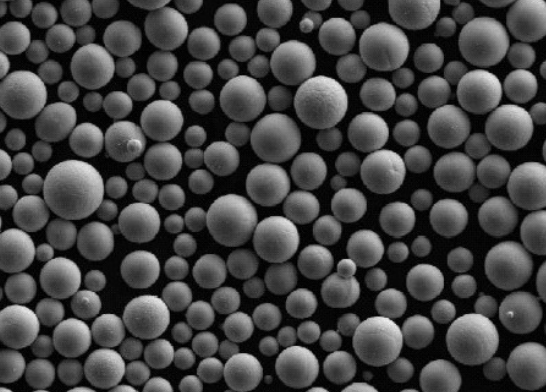
Description of W-Mo-Ta-Nb Spherical Powder
W-Mo-Ta-Nb Spherical High-Entropy Alloy (HEA) Powder is available in particle size distributions such as 0–45 μm, 0–53 μm, 15–45 μm, 15–53 μm, and 45–105 μm, this gas atomized spherical powder offers excellent flowability and packing density and can be customized to meet specific additive manufacturing or powder metallurgy requirements.
Key Features
- High-Melting-Point BCC Refractory HEA
- Ultra-High Temperature Strength and Creep Resistance
- Excellent Structural Stability Under Thermal Cycling
- Low Oxygen Content & High Purity
- High Sphericity (≥95%) for Powder Flowability
- Optimized for AM: SLM, EBM, DED, HIP, and SPS
WMoTaNb HEA Spherical Powder properties
Product | Purity (%) | O (%) | Sphericity | Apparent Density (g/cm3) | Tap Density (g/cm3) | Hall Flow Rate (s/50g) |
HM-(W-Mo-Ta-Nb) | >99.95 | <0.05 | >95.0 | ≥7.5 | ≥8.5 | ≤10.0 |
Particle Size | 0-45um,0-53um,15-45um, 15-53um, 45-105um, or customized. | |||||
WMoTaNb HEA Spherical Powder Application
- Spherical WMoTaNb HEA powder for Selective Laser Melting (SLM)
- Spherical WMoTaNb Powder Electron Beam Melting (EBM)
- Tungsten-Molybdenum-Tantalum-Niobium Alloy Powder for Directed Energy Deposition (DED)
- W-Mo-Ta-Nb Powder for Hot Isostatic Pressing (HIP)
- WMoTaNb powder Spark Plasma Sintering (SPS) process
- Spherical W-Mo-Ta-Nb Powder for Thermal spraying coating (plasma spray or HVOF)
WMoTaNb Powder Scholar Articles
Microstructure and wear property of WMoTaNb refractory high entropy alloy coating by laser cladding
Abstract: WMoTaNb refractory high entropy alloy (RHEA) coating was prepared successfully by laser cladding. The coating is a composite structure composed of BCC1 and BCC2 structural HEA with some tiny intermetallic compound (IMC). The surface EBSD results indicates that the BCC1 has a strong (0001) texture with the intensity of 63.96. BCC2 possesses higher content of solute atoms, such as Nb, Mo, Ta, W, than that in BCC1, resulting in the formation of higher KAM mean value in BCC2, which indicates BCC2 has greater stresses and strains than that of the BCC1.
FAQ WMoTaNb refractory high entropy alloy powder
What manufacturing processes is this WMoTaNb powder suitable for?
It is compatible with SLM, EBM, DED, HIP, spark plasma sintering (SPS), and powder metallurgy.
Can I get custom particle sizes or non-spherical WMoTaNb powder?
Yes, we provide tailored size distributions and morphology options depending on your application—nano to 150 μm ranges available.
Is this WMoTaNb HEA alloy corrosion or oxidation resistant?
Yes, especially in vacuum or inert atmospheres. However, WMoTaNb may oxidize in air at high temperatures unless coated or processed accordingly.
What’s the difference between WMoTaNb powder and other HEAs like CoCrFeNiMn powder?
WMoTaNb is a refractory BCC alloy designed for extreme temperatures (>2000°C), while CoCrFeNiMn is an FCC alloy optimized for ductility and corrosion resistance at lower temps.