
High Purity Indium Metal — Granules, Balls & Beads | Princeton Powder
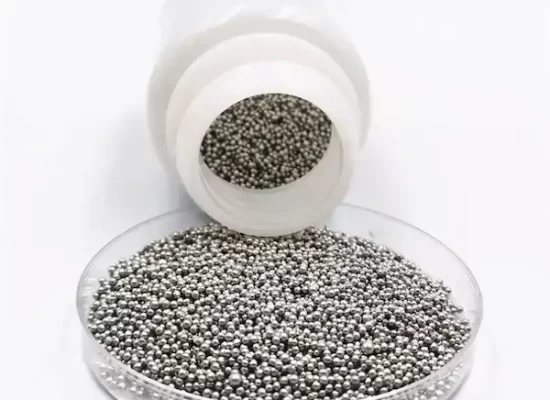
Indium Granules are small, irregularly shaped pieces of high-purity indium, ideal for alloying, plating, and chemical applications. Indium Pellets are uniform, cylindrical shapes of indium used in vapor deposition, thin-film applications, and precise material dosing. Indium Balls are spherical indium forms with excellent purity, thermal conductivity, and softness, widely used in soldering, thermal interfaces, and hermetic sealing.
Princeton Powder is a leading supplier of high-purity indium products.
Formula | Indium |
Part Number | IN2401 |
Purity | 99.99% min |
Shape | Pallet, Granule, ball |
Particle Sizes | 1-3 mm |
Melting point | 156.6 °C |
Boiling Point | 2072 °C |
Density | 7.29 g/cm 3 |
Product Overview
High purity indium metal (CAS 7440-74-6) is a soft, malleable post-transition metal with exceptional thermal conductivity (81.8 W/m·K), excellent wettability to glass and ceramics, and one of the lowest melting points of all metals at just 156.6°C. Princeton Powder supplies indium granules, indium balls, and indium beads in purity grades from 4N (99.99%) to 6N (99.9999%), manufactured to meet the stringent requirements of semiconductor, aerospace, medical, and optoelectronic applications.
Unlike many metal suppliers, we stock all three primary indium forms — irregular granules for alloying and plating, uniform pellets for vapor deposition and thin-film coating, and spherical balls/beads for soldering preforms and thermal interface materials. Custom sizes, custom purity specifications, and bulk packaging are available with full material traceability. Request a quote for your application requirements.
Indium Product Forms — Which One Do You Need?
Indium Granules (Irregular Shape)
Indium granules are small, irregularly shaped pieces of high-purity indium ideal for alloying (In-Sn, In-Ag, In-Bi solders), electroplating anode material, and chemical synthesis of indium compounds (In₂O₃, ITO, InP). The irregular shape provides high surface area for rapid dissolution. Available in 1-10 mm sizes.
Indium Pellets (Cylindrical)
Indium pellets are uniform, cylindrical compacts designed for thermal evaporation and electron-beam (e-beam) deposition of indium thin films. The consistent shape and mass ensure predictable evaporation rates and uniform film thickness. Widely used in PVD coating for semiconductor wafers and optical components. Custom diameters available.
Indium Balls & Beads (Spherical)
Indium balls and indium beads are precision spherical forms with excellent surface finish, used primarily for soldering preforms, thermal interface materials (TIM) in high-power electronics, and hermetic sealing of sensitive components. The spherical shape ensures consistent volume, precise dosing, and reliable compression in sealing applications. Diameters from 0.5 mm to 10 mm.
Main properties of Indium Granules, Indium Pellets, and Indium ball
- High Purity: Typically ≥99.99%, ensuring consistent performance in sensitive applications.
- Excellent Thermal & Electrical Conductivity: Ideal for heat dissipation and electrical connections.
- Softness & Malleability: Allows deformation without cracking, perfect for creating seals and joints.
- Low Melting Point: Facilitates use as solder for temperature-sensitive components.
Indium Technical Specifications
| Property | Value |
|---|---|
| CAS Number | 7440-74-6 |
| Available Purity | 4N (99.99%), 5N (99.999%), 6N (99.9999%) |
| Melting Point | 156.6 °C (313.9 °F) |
| Boiling Point | 2,072 °C (3,762 °F) |
| Density | 7.31 g/cm³ at 20 °C |
| Thermal Conductivity | 81.8 W/(m·K) |
| Electrical Resistivity | 8.37 μΩ·cm at 20 °C |
| Crystal Structure | Body-centered tetragonal |
| Available Forms | Granules (1-10 mm), Pellets (custom dia.), Balls/Beads (0.5-10 mm), Shot, Ingot |
| Packaging | Vacuum-sealed with argon backfill, moisture-resistant container |
Manufacturing method of Indium ball
Raw Material Selection
- High-purity indium ingots (≥99.99%) are sourced to ensure low impurity levels.
Melting and Forming
- Indium is melted under controlled conditions to prevent oxidation and ensure uniformity.
- A precision forming process, such as drop or rotary atomization, is used to create spherical indium balls of uniform size.
Size Grading
- Spheres are screened and classified to achieve tight tolerances in diameter, typically ranging from 0.5 mm to 10 mm or customized sizes.
Surface Treatment and Packaging
- Surface cleaning is performed to remove oxides and impurities.
- Packaged in vacuum-sealed or inert-gas-filled containers to preserve purity and prevent surface oxidation during storage.
Indium vs Alternative Thermal Interface & Sealing Materials
| Property | Indium | Thermal Paste | Solder (Sn-Pb) |
|---|---|---|---|
| Thermal Conductivity | 81.8 W/m·K | 3-8 W/m·K | ~50 W/m·K |
| Melting Point | 156.6 °C | N/A (paste) | 183 °C |
| Conformability | Excellent (self-annealing) | Excellent | Poor (rigid joint) |
| Reworkability | Easy (low-temp removal) | Easy (wipe clean) | Difficult (desolder required) |
| Vacuum Compatibility | Excellent | Poor (outgassing) | Moderate |
| Cryogenic Performance | Excellent (ductile to 4K) | Poor (cracks) | Poor (tin pest below 13°C) |
Bottom line: Indium is the only material that combines high thermal conductivity, extreme conformability, vacuum compatibility, and cryogenic ductility — making it irreplaceable for advanced thermal management and hermetic sealing applications.
Applications of High Purity Indium Metal
Soldering & Bonding
Indium balls and granules are the primary raw material for manufacturing indium-based solder alloys (In-Sn, In-Ag, In-Pb, In-Bi). Indium solders offer superior wetting to glass, ceramics, and metal oxides — surfaces that tin-based solders cannot bond to. Critical applications include hermetic sealing of infrared detectors, laser diodes, and aerospace sensors where a vacuum-tight, ductile seal is essential. Princeton Powder supplies indium in purity grades up to 6N for ultra-high-reliability solder applications.
Thermal Interface Materials (TIM)
Indium balls and beads are used as high-performance thermal interface materials between high-power semiconductor devices and heat sinks. Indium's thermal conductivity (81.8 W/m·K) combined with its extreme softness and conformability eliminates microscopic air gaps, achieving lower thermal resistance than conventional thermal pastes or pads. Widely used in CPU/GPU thermal management, IGBT modules, and RF power amplifiers.
Thin-Film Deposition (PVD)
Indium pellets serve as evaporation source material for physical vapor deposition (PVD) of indium thin films in semiconductor manufacturing. Indium films are used as transparent conductive oxides (ITO) in flat-panel displays, touch screens, and solar cells. Purity is critical — Princeton Powder's 5N and 6N indium ensures minimal trace element contamination in deposited films.
Alloying & Plating
Indium granules are widely used for master alloy production and electroplating anode material. Indium electroplating provides exceptional corrosion resistance and lubricity to bearing surfaces in aerospace and automotive applications. Indium alloy additions improve the corrosion resistance, strength, and wetting behavior of gold, silver, and copper alloys used in dental and jewelry applications.
Indium Purity Grade Selection Guide
| Grade | Purity | Typical Impurity Level | Recommended Applications |
|---|---|---|---|
| 4N | 99.99% | <100 ppm total | General soldering, alloying, electroplating anodes, chemical synthesis |
| 5N | 99.999% | <10 ppm total | Semiconductor packaging, PVD thin-film deposition, ITO target manufacturing, precision soldering |
| 6N | 99.9999% | <1 ppm total | Infrared detector sealing, superconducting electronics, MBE source material, ultra-high-vacuum applications |
Not sure which purity grade your application requires? Contact our technical team for a material recommendation based on your process parameters and performance requirements.
Why Choose Princeton Powder for Indium Metal
- 4N to 6N Purity Range: Stocking supplier of 99.99% (4N), 99.999% (5N), and 99.9999% (6N) indium — select the exact purity your application requires. Full COA with ICP-MS trace element analysis provided with every lot.
- All Three Product Forms in Stock: Granules, pellets, balls/beads, shot, and ingot — one supplier for all your indium requirements eliminates multi-vendor procurement complexity.
- Custom Size & Form Manufacturing: Custom granule sizes, pellet diameters, ball diameters, and packaging configurations for OEM and production-scale requirements.
- ISO 9001:2015 Certified Quality: Rigorous quality management ensures batch-to-batch consistency for production environments where material variability is unacceptable.
- US-Based Inventory & Fast Fulfillment: Domestic stock eliminates international lead times and customs uncertainty. Same-day quotes, standard 3-7 business day handling.
- Technical Application Support: Our materials engineers can advise on purity grade selection, form factor optimization, and process compatibility for your specific application.
Frequently Asked Questions About Indium Metal
What is the difference between indium granules, pellets, and balls?
Indium granules are irregular-shaped pieces ideal for alloying, plating, and chemical synthesis where high surface area aids dissolution. Indium pellets are uniform cylindrical compacts designed for consistent evaporation rates in PVD thin-film deposition. Indium balls/beads are precision spheres used for soldering preforms, thermal interface materials, and hermetic sealing where precise volume and compression characteristics matter. Princeton Powder supplies all three forms in 4N-6N purity.
What purity grades of indium are available and which one do I need?
Princeton Powder supplies indium in 4N (99.99%), 5N (99.999%), and 6N (99.9999%) purity. 4N is suitable for general soldering and alloying. 5N is recommended for semiconductor packaging and thin-film deposition. 6N is required for ultra-high-reliability applications like infrared detector sealing and superconducting electronics. Every lot includes ICP-MS trace element analysis so you can verify purity against your specification.
Why does indium have such a low melting point (156.6°C)?
Indium's low melting point is an intrinsic material property that makes it uniquely valuable for soldering, thermal interface, and sealing applications. At just 156.6°C, indium solder joints can be made at temperatures that don't damage heat-sensitive components. Its exceptional wetting to glass, ceramics, and oxides — combined with extreme ductility (it can be deformed indefinitely without work hardening) — makes indium the material of choice for cryogenic and vacuum seals that must remain hermetic through thermal cycling.
What is the minimum order quantity (MOQ) for indium metal?
Standard MOQ is 100 g for 5N and 6N purity grades, and 1 kg for 4N standard grades. Custom sizes, non-standard purity specifications, or specialized packaging may require higher MOQs. Contact our sales team for same-day quote — we fulfill orders from R&D sample quantities to full production volumes.
How should indium metal be stored to prevent oxidation?
Indium is relatively stable in air at room temperature and does not oxidize rapidly like alkali metals. However, for long-term storage of high-purity (5N/6N) indium, we recommend keeping the material in its original vacuum-sealed, argon-backfilled packaging. Once opened, store in a desiccator or inert atmosphere (nitrogen/argon) glovebox for maximum shelf life. Princeton Powder's standard packaging is designed for 12+ month shelf life when unopened.
Can you customize indium ball/granule sizes for specific applications?
Yes. Princeton Powder offers custom size distributions for indium granules (standard: 1-10 mm), balls/beads (standard: 0.5-10 mm diameter), and pellets (custom diameters). We can also produce custom binary/ternary indium alloy compositions (In-Sn, In-Ag, In-Bi, In-Pb) to your specification. Contact our engineering team with your requirements for a feasibility assessment and quotation.
Indium ball Scholar Articles
A simple and rapid method for preparing indium nanoparticles from bulk indium via ultrasound irradiation
Abstract: A simple and rapid process has been developed for the preparation of indium nanoparticles from bulk indium via ultrasound irradiation. Transmission electron microscopy (TEM) shows the as-prepared indium nanoparticles are appear to be close to a spherical shape. X-ray diffraction (XRD) pattern indicates that the samples are the tetragonal phase of indium with the same crystal structure as that of the bulk indium. It is confirmed by X-ray photoelectron spectrum (XPS) analysis that there is an indium oxide layer at the surface of the indium nanoparticles. The tribological property of indium nanoparticles as additives in oil is evaluated on a four-ball tester and shown that indium nanoparticles exhibit good performance in wears.