
Phenylboronic Acid-Modified Hyaluronic Acid Methacryloyl (HAMA-PBA) — Dual-Functional Smart Hydrogel Precursor
Phenylboronic acid-modified hyaluronic acid methacryloyl (abbreviated HAMA-PBA or HA-PBA-MA) is a dual-functionalized hyaluronic acid derivative that combines two powerful chemical functionalities on a single biopolymer backbone: methacryloyl (MA) groups for rapid UV/visible-light photocrosslinking into covalent hydrogel networks, and phenylboronic acid (PBA) groups that form reversible boronate ester bonds with cis-diol compounds, endowing the hydrogel with glucose-responsive, ROS-responsive, and pH-responsive behavior. Synthesized by first methacryloylating sodium hyaluronate (via methacrylic anhydride or glycidyl methacrylate) and then conjugating 3-aminophenylboronic acid through EDC/NHS amidation, HAMA-PBA enables the fabrication of stimuli-responsive smart hydrogels for diabetic wound healing, glucose-triggered insulin delivery, ROS-targeted drug release, 3D bioprinting, tissue engineering, and antibacterial wound dressings. With customizable methacryloyl degree of substitution (10–60%), PBA degree of substitution (5–30%), and molecular weight (50–500 kDa), our research-grade HAMA-PBA provides precise control over gelation kinetics, mechanical properties, and stimuli-responsiveness. As a specialized custom synthesis supplier for biomedical research, we provide full characterization, batch-specific CoA, and flexible quantities from 100 mg to 10 g for academic and industrial R&D labs worldwide.
Technical Specifications
| Parameter | Specification |
|---|---|
| Product Name | Phenylboronic Acid-Modified Hyaluronic Acid Methacryloyl |
| Abbreviations | HAMA-PBA, HA-PBA-MA, PBA-HAMA, Methacrylated HA-PBA |
| Appearance | White to off-white, fluffy powder or lyophilized cake |
| Purity | ≥ 95.0% (by 1H NMR and SEC) |
| HA Molecular Weight (starting) | 50 – 500 kDa (customizable; standard 100 kDa, 200 kDa) |
| Methacryloyl Degree of Substitution (DS_MA) | 10 – 60% (customizable; standard 20–40%) |
| PBA Degree of Substitution (DS_PBA) | 5 – 30% (customizable; standard 10–20%) |
| PBA Content | 0.5 – 3.0 mmol/g (calculated from DS_PBA) |
| Methacryloyl Content | 0.3 – 2.5 mmol/g (calculated from DS_MA) |
| pH (1% solution) | 6.0 – 8.0 |
| Loss on Drying | ≤ 10.0% |
| Solubility | Soluble in water, PBS, MES buffer, DMEM; slightly soluble in DMSO |
| Residual EDC/NHS | ≤ 0.1% |
| Residual APBA | ≤ 0.5% |
| Residual MA | ≤ 0.5% |
| Endotoxin | ≤ 0.5 EU/mg (research grade; ≤ 0.03 EU/mg GMP-grade available upon request) |
| Bioburden | ≤ 100 CFU/g |
| Heavy Metals | ≤ 20 ppm |
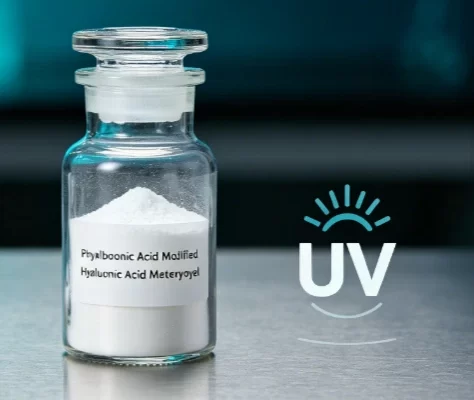
What Is HAMA-PBA? Dual-Functionalized HA for Smart Hydrogels
Phenylboronic acid-modified hyaluronic acid methacryloyl (HAMA-PBA, also called HA-PBA-MA or PBA-bearing methacrylated HA) is a double-functionalized hyaluronic acid derivative engineered to serve as a versatile precursor for stimuli-responsive (“smart”) hydrogels. It carries two distinct reactive groups on the HA backbone:
1. Methacryloyl (MA) groups — photocrosslinkable covalent network
- Methacrylate pendant groups (–OCOC(CH₃)=CH₂) attached to HA hydroxyl or carboxyl positions
- Under UV light (365 nm) or visible light (405 nm) in the presence of a photoinitiator (e.g., LAP, Irgacure 2959), the methacrylate double bonds undergo free-radical polymerization, forming a covalently crosslinked hydrogel network within 30–120 seconds
- This is the same chemistry used in methacrylated HA (MeHA/HAMA) and gelatin methacryloyl (GelMA) — the gold standard for photocrosslinkable bioprinting inks
- MA degree of substitution directly controls crosslink density, gel stiffness (G’), and degradation rate
2. Phenylboronic acid (PBA) groups — dynamic boronate ester stimuli-responsiveness
- Phenylboronic acid (–C₆H₄B(OH)₂) pendant groups, typically conjugated via 3-aminophenylboronic acid (APBA) through amide bonds to HA carboxyl groups
- PBA reversibly binds to cis-diol compounds (glucose, fructose, catechols, dopamine, glycoproteins) forming boronate ester bonds — a dynamic, reversible covalent interaction
HAMA-PBA Biomedical Research Applications
1. Diabetic Wound Healing
- Application: Smart hydrogel dressings that respond to the diabetic wound microenvironment (high glucose + high ROS + low pH) to release antioxidants, antimicrobials, and growth factors on demand.
- Representative system (from ACS Appl. Bio Mater. 2026): HAMA-PBA + HA-dopamine (HA-DA) double-network hydrogel (HMPD). Primary network: MA photocrosslinking (UV 365 nm, 60 s). Secondary network: PBA-catechol boronate ester bonds. In diabetic wounds: glucose competitively binds PBA → cleaves catechol-PBA bonds → releases HA-DA → HA-DA scavenges ROS → reduces inflammation → accelerates healing.
2. Glucose-Responsive Insulin Delivery
- Application: “Smart” insulin delivery systems that automatically release insulin in response to elevated blood glucose, mimicking pancreatic beta-cell function.
3. ROS-Responsive Drug Delivery for Infected Wounds & Inflammation
- Application: Hydrogels that selectively release antimicrobials, anti-inflammatory drugs, or antioxidants in high-ROS environments (bacterial infection, chronic inflammation, rheumatoid arthritis).
4. 3D Bioprinting of Smart Tissue Scaffolds
- Application: Photocrosslinkable bioinks with built-in stimuli-responsiveness for printing tissue constructs that adapt to their microenvironment.
5. Tissue Engineering & Regenerative Medicine
- Cartilage/bone engineering: HAMA-PBA hydrogels with ROS-responsive release of chondrogenic/osteogenic factors (TGF-β, BMP-2).
- Neural tissue engineering: Soft HAMA-PBA gels with glucose-responsive release of neurotrophic factors (NGF, BDNF) for nerve regeneration.
- Cardiac patches: Elastic HAMA-PBA scaffolds with ROS-responsive antioxidant release for myocardial infarction repair.
- Vascular grafts: HAMA-PBA coatings with controlled nitric oxide (NO) donor release for antithrombogenic surfaces.
6. Antibacterial & Anti-Biofilm Hydrogels
- Application: Wound dressings and medical device coatings that release antimicrobials in response to infection-related ROS and pH changes.
7. Osteoarthritis & Intra-Articular Therapy
- Application: Injectable HAMA-PBA hydrogels for osteoarthritis that provide lubrication (HA’s native function) + ROS-responsive release of anti-inflammatory drugs (corticosteroids, cytokine inhibitors) + pain management.
8. Periodontitis & Oral Mucosal Wound Healing
- Application: Injectable HAMA-PBA hydrogels for periodontal pockets that release minocycline/antimicrobials in response to infection-related ROS.
9. Tumor Microenvironment-Responsive Drug Delivery
- Application: HAMA-PBA hydrogels or nanogels for post-surgical tumor resection cavities that release chemotherapy/immunotherapy in response to tumor-associated ROS and low pH.
10. Contact Lens & Ophthalmic Drug Delivery
- Application: HAMA-PBA-modified contact lenses for glucose-responsive insulin eye drops or ROS-responsive dry eye therapy.
HAMA-PBA Frequently Asked Questions (FAQ)
Q: What is the difference between HAMA-PBA and standard methacrylated HA (MeHA/HAMA)?
A: Standard methacrylated HA (MeHA or HAMA) has only methacryloyl groups for photocrosslinking. HAMA-PBA has BOTH methacryloyl groups (for photocrosslinking) AND phenylboronic acid groups (for glucose/ROS/pH-responsive boronate ester bonding). The addition of PBA transforms a standard photocrosslinkable HA into a smart, stimuli-responsive hydrogel precursor capable of glucose-triggered insulin release, ROS-targeted drug delivery, and dynamic self-healing networks. If your application only requires photocrosslinking without stimuli-responsiveness, standard MeHA is sufficient and more economical. If you need smart, environment-responsive hydrogels, HAMA-PBA is the right choice.
Q: Can HAMA-PBA be used for in vivo studies? Is it biodegradable?
A: HAMA-PBA is biodegradable. The HA backbone is cleaved by endogenous hyaluronidases (HYAL1, HYAL2) and reactive oxygen species in vivo, with degradation products (oligosaccharides, free PBA/phenol, methacrylate fragments) that are metabolized or excreted. Degradation time depends on MA DS (higher = slower), crosslink density, and implantation site — typically from 1 week (low DS, subcutaneous) to 3+ months (high DS, avascular site). For in vivo studies:
- Research grade HAMA-PBA is suitable for small-animal in vivo studies (mice, rats) following standard lab animal protocols. Endotoxin ≤ 0.5 EU/mg is generally acceptable for most animal studies.
- For large animal or clinical translation, we recommend GMP-grade HAMA-PBA (endotoxin ≤ 0.03 EU/mg, sterile, full regulatory documentation). Contact us for GMP transition.
- Note: PBA oxidation products (phenols) and methacrylate degradation products should be considered in toxicology assessment for clinical translation — we can provide biocompatibility data (ISO 10993) for GMP-grade material.