
PDRN Powder — Polydeoxyribonucleotide (Sodium DNA) | Medical Grade & Cosmetic Grade
Polydeoxyribonucleotide (PDRN), also known as sodium DNA or salmon DNA, is a biologically active mixture of low-molecular-weight DNA fragments purified from the sperm of salmon (Oncorhynchus mykiss) or trout (Oncorhynchus keta). With a molecular weight range of 200–600 kDa and 98%+ purity, PDRN acts as an adenosine A2A receptor agonist, stimulating fibroblast proliferation, collagen and elastin synthesis, angiogenesis, and tissue regeneration while exerting potent anti-inflammatory effects. We offer two grades: medical grade, low endotoxin, suitable for injectable skin boosters, wound healing and cosmetic grade for topical serums, creams, and masks targeting anti-aging, barrier repair, and brightening. As a leading bulk PDRN manufacturer and supplier, we provide full regulatory documentation, custom molecular weight fractions (PDRN <650 kDa), and competitive pricing for pharmaceutical, aesthetic, and personal care customers worldwide.
Technical Specifications
| Parameter | Medical Grade (Injectable) | Cosmetic Grade (Topical) |
|---|---|---|
| INCI Name | Polydeoxyribonucleotide | Sodium DNA |
| CAS Number | 100403-24-5 | 100403-24-5 |
| Appearance | White to off-white powder | White to off-white powder |
| Purity (HPLC/UV) | ≥ 98.0% | ≥ 98.0% |
| Molecular Weight | 50–650 kDa (PDRN) / >1,500 kDa (PN) | 50–1,500 kDa |
| pH (1% solution) | 6.5 – 7.5 | 6.0 – 8.0 |
| Loss on Drying | ≤ 10.0% | ≤ 10.0% |
| Protein Residue | ≤ 0.1% | ≤ 0.5% |
| Endotoxin (LAL) | ≤ 0.05 EU/mg | ≤ 0.5 EU/mg |
| Bioburden | ≤ 10 CFU/g | ≤ 100 CFU/g |
| Sterility | Sterile (gamma-irradiated or aseptic) | Non-sterile (preservative-compatible) |
| Heavy Metals | ≤ 10 ppm | ≤ 20 ppm |
| Residual Solvent | ≤ 0.5% | ≤ 1.0% |
| Intended Use | Injectable skin boosters, wound care, hair restoration, medical devices | Topical serums, creams, masks, essences |
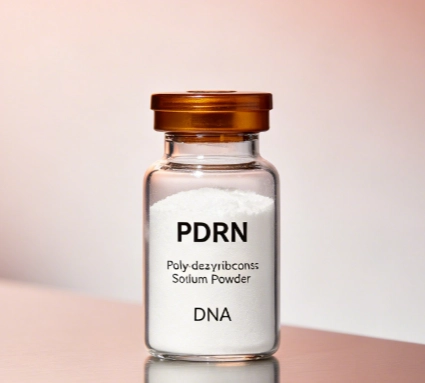
What Is PDRN (Polydeoxyribonucleotide / Sodium DNA)?
Polydeoxyribonucleotide (PDRN; INCI: Sodium DNA; CAS: 100403-24-5) is a biologically active mixture of linear, double-stranded DNA fragments obtained through controlled purification and sterilization of sperm DNA from salmon (Oncorhynchus mykiss, rainbow trout) or chum salmon (Oncorhynchus keta).
Key characteristics:
- Molecular weight: 50–1,500 kDa (chain length 50–2,000 base pairs)
- Purity: ≥98%
- Appearance: White to off-white, hygroscopic powder
- DNA homology: ~98% similarity to human DNA, minimizing immunogenic risk
- Source: Salmon sperm (not roe); the extraction process at high temperature ensures complete removal of active proteins and peptides that could trigger immune reactions
"PDRN" and "PN" (polynucleotide) Comparison
| Parameter | PDRN | PN (Polynucleotide) |
|---|---|---|
| Average MW | < 650 kDa | > 1,500 kDa |
| Primary focus | Anti-inflammatory, soothing, repair & regeneration, brightening & nourishment | Anti-aging & firming, anti-inflammatory, repair & nourishment, 3D volumizing |
| Viscosity | Lower, more fluid | Higher, more gel-like |
| Typical use | Skin boosters, wound healing, hair restoration, brightening | Dermal fillers, skin tightening, volumizing |
| Onset | Faster (anti-inflammatory within days) | Slower, longer-lasting (collagen remodeling over weeks) |
We supply both PDRN (<650 kDa) and PN (>1,500 kDa) fractions, as well as custom MW ranges upon request.
Medical grade PDRN powder Injectable & Therapeutic applications
Our GMP-certified medical grade PDRN is suitable for the following therapeutic and aesthetic applications:
Aesthetic Medicine — Skin Boosters
- Injectable skin rejuvenation: PDRN is the active ingredient in leading “salmon DNA” skin boosters (e.g., Rejuran®, Placentex®). It is administered via micro-injection (mesotherapy) or dermapen into the dermis to stimulate collagen synthesis, improve skin elasticity, reduce fine lines, and enhance overall skin texture and glow.
- Typical formulation: 0.5–2% PDRN in sterile saline or buffered solution; often combined with hyaluronic acid, amino acids, or peptides for synergistic effects.
- Treatment protocol: 3–4 sessions at 2–4 week intervals, with maintenance every 6–12 months.
Wound Healing & Tissue Regeneration
- Diabetic foot ulcers and chronic wounds: PDRN’s angiogenic and fibroblast-stimulating properties accelerate closure of chronic, hard-to-heal wounds. It is approved in several countries as a wound healing agent (Placentex®).
- Burns and surgical wounds: Topical or injectable PDRN supports granulation tissue formation and re-epithelialization.
- Scar revision: Intralesional PDRN injection improves the appearance of hypertrophic and atrophic scars by modulating collagen remodeling.
- Oral and maxillofacial healing: Extraction socket healing, gingival recession, and periodontal regeneration.
Other Medical Applications
- Osteoarthritis: Intra-articular PDRN injection reduces inflammation and supports cartilage repair (often combined with hyaluronic acid viscosupplementation).
- Dry eye disease: Ophthalmic PDRN solution supports corneal epithelial healing.
- Post-procedure recovery: Accelerates healing after laser resurfacing, chemical peels, microneedling, and plastic surgery.
- Radiation dermatitis: Supports skin recovery after radiation therapy.
Cosmetic grade PDRN (Sodium DNA) Topical Skincare Application
Anti-Aging & Skin Rejuvenation
- PDRN in topical serums and creams stimulates dermal fibroblast activity, promoting collagen and elastin synthesis that reduces the appearance of fine lines and wrinkles, improves skin firmness and elasticity, and restores a youthful glow.
- The anti-inflammatory action soothes redness and irritation, making PDRN suitable for sensitive and reactive skin types.
- Typical usage: 0.1% – 1.0% in anti-aging serums, creams, and essences.
Barrier Repair & Post-Procedure Care
- PDRN supports skin barrier recovery after chemical peels, laser treatments, microneedling, and dermabrasion by accelerating epidermal regeneration and reducing post-procedure inflammation and redness.
- It is an excellent active in “recovery creams” and “post-treatment” skincare lines.
- Typical usage: 0.05% – 0.5% in barrier repair creams and post-procedure balms.
Brightening & Even Skin Tone
- PDRN’s anti-inflammatory and regenerative properties help reduce post-inflammatory hyperpigmentation (PIH) and uneven skin tone by supporting healthy epidermal turnover and reducing melanocyte stimulation from inflammation.
- Typical usage: 0.1% – 0.5% in brightening serums, often combined with niacinamide, tranexamic acid, or vitamin C derivatives.
Hydration & Moisturization
- PDRN’s DNA structure binds water molecules, providing humectant moisturization that complements hyaluronic acid and glycerin in hydration-focused formulations.
- Typical usage: 0.01% – 0.3% in hydrating serums, moisturizers, and mists.
Hair & Scalp Care (Topical)
- PDRN in scalp serums, tonics, and shampoos supports scalp health, reduces inflammation (dandruff, seborrheic dermatitis), and creates a favorable environment for hair growth.
- Typical usage: 0.05% – 0.5% in scalp serums and hair tonics.
Frequently Asked Questions Salmon DNA Sodium
Q: What is the difference between PDRN and PN (polynucleotide)?
A: PDRN and PN are both salmon DNA-derived products but differ in molecular weight and clinical focus. PDRN has an average molecular weight below 650 kDa, is more fluid, and is primarily used for anti-inflammatory soothing, tissue repair and regeneration, and brightening. PN has an average molecular weight above 1,500 kDa, is more gel-like and viscous, and is primarily used for anti-aging firming, 3D volumizing, and longer-lasting collagen remodeling. We supply both fractions and can custom-blend them for specific product concepts.
Q: How should PDRN be formulated in topical skincare products?
A: PDRN is water-soluble and should be dissolved in the aqueous phase of your formulation. For best results: (1) Dissolve PDRN powder in purified water or hydrosol at 0.1–1% concentration with gentle stirring for 30–60 minutes (avoid high-shear mixing that can shear DNA); (2) Add during the cool-down phase of emulsion production (below 60°C) to prevent thermal degradation; (3) Use amber or opaque packaging to protect from UV light; (4) Maintain formulation pH between 5.0 and 7.5 for optimal stability and activity; (5) PDRN is compatible with most cosmetic actives but avoid strong oxidizers (high-concentration benzoyl peroxide, hydrogen peroxide). Typical usage is 0.05–1% depending on product type and desired efficacy.
Q: Can PDRN be combined with hyaluronic acid in the same product?
A: Yes, and this is one of the most common and effective combinations. PDRN + HA is the classic “skin booster” formula: HA provides immediate hydration and volume, while PDRN provides long-term tissue regeneration and collagen stimulation. In topical products, combine PDRN (0.1–0.5%) with high-MW HA (0.05–0.2%) for surface hydration and mini HA (0.1–0.3%) for dermal penetration. In injectable products, PDRN is often combined with non-crosslinked HA for skin boosters or with crosslinked HA for dermal fillers. Always verify compatibility and stability in your specific formulation.