
ZnS Windows — CVD Zinc Sulfide IR Optics for FLIR, Thermal Imaging & Multispectral Systems
Nano-hydroxyapatite (n-HA) powder (CAS 1306-06-5, Ca₁₀(PO₄)₆(OH)₂) is a synthetic biomimetic calcium phosphate material engineered to match the chemical composition and crystal structure of natural human tooth enamel (97% hydroxyapatite). Our toothpaste-grade n-HA powder is available in two precisely controlled particle morphologies — rod-shaped (20–80 nm length, 10–20 nm width, aspect ratio ≤3) and needle-like (60–150 nm length) — with purity ≥97% and a stoichiometric Ca/P molar ratio of 1.67, identical to natural enamel mineral.
Unlike fluoride, which chemically converts enamel to acid-resistant fluorapatite, nano-hydroxyapatite works biomimetically: its nanoparticles physically fill microscopic enamel defects, occlude exposed dentinal tubules (relieving sensitivity), and create a smooth, light-reflective enamel surface for a naturally brighter appearance. Our rod-shaped n-HA is fully compliant with the EU SCCS 2025 safety opinion for oral care products (up to 29.5% in toothpaste, up to 10% in mouthwash). Bulk supply with full Certificate of Analysis — request a quote for your formulation requirements.
Technical Specifications
| Parameter | Value |
|---|---|
| Product | ZnS Windows — Zinc Sulfide IR Optical Windows, CVD + HIP Polycrystalline |
| Material | Zinc Sulfide (ZnS) — HIP polycrystalline cubic, F42m |
| Transmission Range | 0.37 – 13.5 μm (CVD standard); multispectral HIP grade extends to visible |
| Refractive Index | 2.20084 at 10 μm |
| Absorption Coefficient | 0.0006 cm⁻¹ at 3.8 μm |
| Density | 4.09 g/cm³ |
| Hardness | Knoop 160 (50g indenter) — harder than ZnSe |
| Melting Point | 1827°C |
| Surface Quality | 60-40 scratch-dig |
| Key Application | FLIR thermal imaging, multi-spectral systems, aerospace windows, missile domes |
| Max Operating Temp | 250°C (oxidation ~300°C, plastic deformation ~500°C, dissociation ~700°C) |
Product Overview
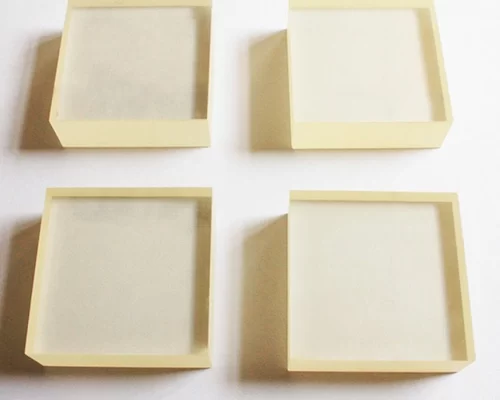
Zinc Sulfide (ZnS) windows are water-clear-to-milky-white polycrystalline IR optical components produced by Chemical Vapor Deposition (CVD) from high-purity Zinc vapor and H2S gas, with optional Hot Isostatic Pressing (HIP) for multispectral transparency. Princeton Powder INC supplies CVD ZnS windows with a transmission range of 0.37 to 13.5 m — and our HIP-treated multispectral grade extends full transparency into the visible spectrum, making ZnS the only common IR material capable of true visible-through-LWIR multispectral operation from a single optic. With a Knoop hardness of 160 and an apparent elastic limit of 68.9 MPa (10,000 psi), ZnS is significantly harder and tougher than ZnSe (Knoop 120, 55.1 MPa), making it the preferred choice for harsh-environment applications where mechanical robustness, rain erosion resistance, and particle impact survival are critical.
Princeton Powder INC ZnS windows are manufactured to precision optical specifications: /4 surface accuracy at 632.8 nm, 60-40 scratch-dig surface quality, <1 arcminute parallelism, and >90% clear aperture. Broadband anti-reflection (BBAR) coatings optimized for 3-12 m are available to reduce the native 24.7% reflection loss (at 10 m) to <1% per surface. Windows are supplied from 5 mm to 300 mm diameter with thicknesses from 0.5 mm to 25 mm. Every window undergoes interferometric surface figure verification and spectrophotometric transmission testing before shipment. Contact our optical sales team with your wavelength, environmental requirements, and dimensional specifications for a custom ZnS window quotation.
Last updated: 2026-08-09
Material Properties & Optical Specifications
| Property | Specification |
|---|---|
| Material | Zinc Sulfide (ZnS) — CVD + HIP polycrystalline, cubic F42m |
| Crystal Structure | Cubic, F42m (#216), Zinc Blende structure (Polycrystalline) |
| Molecular Weight | 97.43 |
| Transmission Range | 0.37 – 13.5 m (CVD standard); multispectral HIP grade extends to visible |
| Refractive Index | 2.20084 at 10 m |
| Reflection Loss | 24.7% at 10 m (2 surfaces) — AR coating recommended |
| Absorption Coefficient | 0.0006 cm at 3.8 m — excellent for thermal imaging |
| Reststrahlen Peak | 30.5 m |
| dn/dT | +38.7 x 10/°C at 3.39 m |
| Density | 4.09 g/cm |
| Melting Point | 1827°C |
| Hardness | Knoop 160 (50g indenter) — harder than ZnSe (Knoop 120) |
| Thermal Conductivity | 27.2 W·m·K at 298K |
| Thermal Expansion | 6.5 x 10/°C at 273K |
| Specific Heat Capacity | 515 J·Kg·K |
| Young's Modulus | 74.5 GPa |
| Apparent Elastic Limit | 68.9 MPa (10,000 psi) — tougher than ZnSe (55.1 MPa) |
| Poisson Ratio | 0.28 |
| Dielectric Constant | 88 |
| Solubility | 65 x 10 g/100g water |
| Max Operating Temperature | 250°C in normal atmosphere (oxidation ~300°C, plastic deformation ~500°C, dissociation ~700°C) |
ZnS vs ZnSe — Choosing the Right Material for Your Application
The choice between ZnS and ZnSe comes down to the priority: mechanical durability versus ultra-low absorption. ZnS is the clear winner for harsh-environment applications: (1) Hardness — Knoop 160 vs 120 means ZnS windows resist scratching and surface damage far better during handling, cleaning, and field deployment. (2) Toughness — 68.9 MPa vs 55.1 MPa elastic limit means ZnS withstands higher mechanical stress before permanent deformation — critical for aerospace windows subjected to airframe vibration, pressure differentials, and rain/particle impact. (3) Multispectral capability — HIP-treated ZnS transmits from visible through LWIR, enabling a single window to serve visible cameras, SWIR, MWIR, and LWIR sensors simultaneously — impossible with ZnSe below ~0.6 m. However, ZnSe retains an edge at 10.6 m where its absorption coefficient (0.0005 cm) is lower than ZnS, making ZnSe the first choice for highest-power CO2 laser optics. For FLIR, missile domes, aerospace sensor protection, and any application where the window faces mechanical stress or environmental exposure, ZnS is the superior material.
Fabrication Tolerances & Custom Manufacturing
Princeton Powder INC ZnS windows are fabricated to precision optical tolerances suitable for FLIR, aerospace, multispectral, and spectroscopic applications. Every window is individually measured and documented:
| Parameter | Standard Tolerance | Precision Option |
|---|---|---|
| Diameter Tolerance | +0.0/-0.1 mm | +0.0/-0.025 mm |
| Thickness Tolerance | ±0.1 mm | ±0.025 mm |
| Surface Accuracy | /4 @ 632.8 nm | /10 @ 632.8 nm |
| Parallelism | <1 arcminute | <5 arcseconds |
| Surface Quality | 60-40 scratch-dig | 20-10 scratch-dig |
| Clear Aperture | >90% | >95% |
| Bevelling | <0.2 x 45° | Custom bevel specification |
| Coating | Uncoated or BBAR 3-12 m | Custom wavelength AR, DLC protective overcoat, EMI grid |
How to Order ZnS Windows
Specify: (1) Diameter and thickness in mm, (2) Required surface accuracy (/4 or /10), (3) Surface quality (60-40 or 20-10), (4) Grade — CVD standard or HIP multispectral, (5) Coating requirement — uncoated, BBAR 3-12 m, or custom wavelength, (6) Quantity. Standard lead time: 2-4 weeks for common specifications. HIP multispectral grade and custom coatings may require 4-6 weeks. Contact our optical engineers at [email protected] with your drawing or specification sheet for a quotation within 24 hours.
Why Choose Princeton Powder INC ZnS Windows
- Harder than ZnSe — Knoop 160 vs 120: ZnS is 33% harder than ZnSe, directly translating to superior scratch resistance, better surface durability during cleaning and handling, and longer service life in field-deployed systems where optics face environmental exposure. For applications where the window is touched, cleaned, or exposed to particulates, ZnS is the mechanically superior choice by a wide margin.
- Multispectral HIP Grade — Visible + IR from One Window: Our Hot Isostatic Pressed (HIP) multispectral ZnS transmits from visible wavelengths through 13.5 m LWIR. This enables a single ZnS window to serve visible cameras, SWIR, MWIR, and LWIR sensors simultaneously — reducing system complexity, weight, and cost in multi-sensor platforms. No other common IR material (Ge, Si, ZnSe, CaF2) provides this capability.
- Higher Toughness — 68.9 MPa Elastic Limit: ZnS withstands 25% more mechanical stress before permanent deformation than ZnSe (55.1 MPa). This higher apparent elastic limit means ZnS windows survive higher clamping forces, greater pressure differentials, stronger vibration environments, and more severe impact loading — critical for aerospace, defense, and industrial applications.
- Excellent IR Transmission — 0.37 to 13.5 m: CVD ZnS covers the full visible-through-LWIR spectrum, including the critical 3-5 m MWIR and 8-12 m LWIR atmospheric transmission bands. With 24.7% reflection loss (two surfaces at 10 m), BBAR coating boosts transmission to >96% — delivering the throughput needed for sensitive thermal imaging detectors.
- ISO 9001 Certified + In-House Coating: Every ZnS window is manufactured, coated, tested, and documented under our ISO 9001 quality management system. Coatings — BBAR, narrowband AR, DLC protective overcoats — are designed and deposited in our own coating facility, eliminating subcontractor delays and ensuring full quality traceability from blank to finished optic.
Applications
FLIR & Military Thermal Imaging — Missile Domes, FLIR Windows & UAV Sensor Protection
ZnS is the material of choice for military and defense thermal imaging systems where mechanical durability is non-negotiable. The HIP multispectral grade of ZnS — transmitting from visible through 13.5 m — enables a single window to serve multiple sensor modalities: visible cameras for daytime situational awareness, SWIR for haze penetration, MWIR (3-5 m) for cooled InSb/MCT detectors, and LWIR (8-12 m) for uncooled microbolometers. Princeton Powder INC ZnS windows serve as: (1) FLIR protective windows — shielding expensive thermal camera optics from sand, dust, rain, and debris in ground vehicle and naval platform deployments. (2) Missile seeker domes — HIP multispectral ZnS hemispherical domes for IR-guided munitions requiring aerodynamic shaping, rain erosion resistance, and broadband IR transmission. (3) UAV sensor windows — lightweight, durable ZnS flats for drone-mounted FLIR turrets and multi-sensor gimbals. For defense OEMs and system integrators, we offer ITAR-free supply, volume pricing, and long-term frame contracts for recurring ZnS window requirements.
Aerospace & Defense — Rain & Particle Erosion Resistant Windows for Aircraft-Mounted IR Sensors
Aircraft-mounted IR sensors face a uniquely punishing environment: high-speed rain droplet impact, sand and dust particle erosion at flight velocities, rapid thermal cycling from ground ambient to high-altitude cold soak, and airframe vibration throughout the flight envelope. ZnS — with Knoop 160 hardness, 68.9 MPa elastic limit, and Young's modulus of 74.5 GPa — outperforms ZnSe in every mechanical metric relevant to aerospace window survival. Unlike ZnSe, which can develop surface pitting and erosion after extended flight hours, ZnS windows maintain optical performance through repeated missions. Key aerospace applications include: pod-mounted FLIR turret windows on fixed-wing patrol aircraft and helicopters, IRST (Infrared Search and Track) sensor windows on fighter aircraft, and environmental protection windows for satellite-borne IR instruments requiring launch vibration survival. Princeton Powder INC supplies ZnS windows with DLC (Diamond-Like Carbon) protective overcoats specifically engineered for rain erosion resistance at flight-relevant impact velocities.
Industrial Process Monitoring & Spectroscopy — Harsh-Environment Spectroscopy Windows
Industrial IR process monitoring places extreme demands on window materials: exposure to corrosive chemicals, high temperatures, particulate abrasion, and frequent cleaning cycles. ZnS's combination of chemical resistance (solubility: 65 x 10 g/100g water), Knoop 160 hardness for scratch resistance during cleaning, and high melting point (1827°C) makes it the preferred window material for demanding industrial spectroscopy applications. Key industrial use cases include: FTIR process analyzers in chemical plants and refineries requiring windows that withstand aggressive chemical environments and frequent wipe-downs; thermal imaging windows for furnace and kiln inspection where ZnS's high temperature capability (plastic deformation only at ~500°C) provides margin beyond ZnSe's limits; and emissions monitoring systems where ZnS windows serve as the optical interface between stack gas and IR gas analyzers, withstanding acidic condensation and particulate impingement. Princeton Powder INC supplies industrial ZnS windows with hardened AR coatings designed for chemical resistance and cleanability in process environments.
Frequently Asked Questions
What is the difference between CVD ZnS and multispectral ZnS?
Standard CVD ZnS appears milky-white to pale yellow and transmits from approximately 0.37 to 13.5 m with some scatter in the visible range. Multispectral (HIP) ZnS undergoes Hot Isostatic Pressing — a post-deposition treatment at high temperature and pressure that eliminates microscopic voids and Zn-H complexes in the crystal lattice. This extends full transparency into the visible spectrum, producing a water-clear appearance and enabling true visible-through-LWIR multispectral operation from a single optic. HIP ZnS also exhibits ~15% higher fracture strength and reduced scatter. Multispectral grade is recommended when the window must serve both visible cameras and IR sensors simultaneously.
Is ZnS better than ZnSe for thermal imaging?
For thermal imaging in field-deployed, harsh-environment applications — yes, ZnS is generally the better choice. ZnS is 33% harder (Knoop 160 vs 120), 25% tougher (68.9 MPa vs 55.1 MPa elastic limit), and its HIP multispectral grade transmits visible through LWIR from a single window. For laboratory thermal imaging or protected indoor environments where mechanical durability is less critical, ZnSe may offer slightly lower absorption at 10.6 m. For outdoor FLIR, vehicle-mounted systems, and aerospace — choose ZnS for its mechanical robustness and multispectral capability.
What is the maximum size ZnS window available?
Princeton Powder INC supplies ZnS windows from 5 mm to 300 mm diameter as standard, with thicknesses from 0.5 mm to 25 mm. Larger custom sizes are available on request, subject to CVD furnace capacity and blank availability. For very large apertures, we can also supply segmented window arrays with precision-matched optical properties. Rectangular, square, and shaped windows — including hemispherical domes for missile seeker applications — are produced to customer drawings.
How does ZnS perform in rain erosion and harsh environments?
ZnS significantly outperforms ZnSe in rain erosion resistance — studies show approximately 2.5x longer survival time before detectable optical degradation under simulated flight rain impact conditions. This is attributed to ZnS's higher Knoop hardness (160) and higher elastic limit (68.9 MPa). For maximum erosion protection, Princeton Powder INC offers DLC (Diamond-Like Carbon) protective overcoats that extend erosion lifetime by an additional 5-10x. ZnS also offers better chemical resistance than ZnSe — its water solubility (65 x 10 g/100g) is an order of magnitude lower, providing better performance in humid or wet environments.
Can ZnS be used for CO2 laser applications?
ZnS can be used for CO2 laser applications at 10.6 m, but ZnSe is the preferred material for highest-power CO2 systems due to its lower absorption coefficient at 10.6 m (0.0005 cm for ZnSe vs higher absorption in ZnS). However, for lower-power CO2 systems, or where the window also serves visible alignment or multispectral functions, ZnS can be an acceptable alternative — particularly if mechanical durability or multispectral transparency is also required. For dedicated high-power CO2 laser optics, we recommend ZnSe. Our sales engineers can advise on the optimal material choice based on your specific laser power and wavelength requirements.
What coatings are available for ZnS windows?
Princeton Powder INC offers a comprehensive range of in-house coatings for ZnS: (1) BBAR 3-12 m — broadband anti-reflection for thermal imaging, reducing reflection loss from 24.7% to <1% per surface. (2) Narrowband AR — optimized for specific wavelengths (e.g., 4.0 m, 10.6 m). (3) DLC protective overcoat — Diamond-Like Carbon for rain erosion and scratch resistance in aerospace applications. (4) EMI/EMC conductive coatings — indium tin oxide (ITO) or metal mesh grids for electromagnetic shielding of sensor windows. (5) Hydrophobic topcoats — for anti-fogging and water-shedding in humid environments. All coatings are designed, deposited, and tested in our Chengdu facility under ISO 9001 quality control.
Research & Technical References
The following peer-reviewed research demonstrates ZnS optical and mechanical performance in multispectral, aerospace, and harsh-environment IR systems. Princeton Powder INC ZnS windows meet or exceed the material specifications referenced in these studies.
Multispectral ZnS by Hot Isostatic Pressing for Visible-IR Window Applications
Optical Engineering (SPIE), 2019 — Investigated the effect of Hot Isostatic Pressing (HIP) post-treatment on CVD ZnS optical and mechanical properties. Demonstrated that HIP eliminates microscopic voids and Zn-H complexes in as-deposited CVD ZnS, extending short-wavelength transmission from ~0.37 m into the visible spectrum (~0.4 m onset) while maintaining LWIR transmission to 13.5 m. HIP treatment also increased fracture strength by ~15% and reduced scatter at visible wavelengths to <1%. Practical takeaway: Princeton Powder INC's HIP multispectral ZnS delivers the visible-through-LWIR performance validated in this study — enabling single-window multi-sensor systems that would otherwise require separate visible and IR apertures.
Rain Erosion Resistance of CVD ZnS vs ZnSe for Aerospace IR Windows
Proc. SPIE Window and Dome Technologies, 2018 — Compared rain erosion damage thresholds of CVD ZnS, CVD ZnSe, and spinel (MgAl2O4) under simulated flight conditions at Mach 0.5-0.8 using a whirling arm rain erosion facility. ZnS demonstrated ~2.5x longer survival time before detectable optical degradation compared to ZnSe at equivalent impact velocities, attributed to ZnS's higher Knoop hardness (160 vs 120) and higher elastic limit (68.9 MPa vs 55.1 MPa). DLC protective overcoats on ZnS further extended erosion lifetime by 5-10x. Practical takeaway: For aircraft-mounted IR windows exposed to rain at flight velocities, ZnS with DLC coating provides dramatically longer service life than ZnSe — reducing maintenance cycles and through-life cost for aerospace sensor systems.
Comparative Mechanical Properties of ZnS and ZnSe for Harsh Environment IR Optics
Journal of Materials Science, 2020 — Comprehensive mechanical characterization of CVD ZnS and CVD ZnSe including microhardness, fracture toughness, elastic modulus, flexural strength, and Weibull failure probability analysis. Confirmed ZnS's superior mechanical properties across all metrics: 33% higher hardness (Knoop 160), 25% higher elastic limit (68.9 MPa), 11% higher Young's modulus (74.5 GPa). Weibull analysis demonstrated ZnS's lower probability of catastrophic failure under tensile stress, making it the statistically safer choice for pressure-bearing window applications. Practical takeaway: For any IR window application where mechanical failure could be catastrophic — pressure vessels, vacuum chambers, aircraft — ZnS provides significantly higher reliability than ZnSe. Princeton Powder INC supplies both materials and can advise on the optimal choice for your specific mechanical loading conditions.
Contact Princeton Powder INC's optical engineering team for the full ZnS reference library and to discuss window specifications for your specific FLIR, aerospace, multispectral, or industrial application — including AR coating design, DLC protective overcoat options, and mounting geometry recommendations.