
Zirconium Oxide (ZrO₂) Sputtering Target
Zirconium Oxide (ZrO₂) Sputtering Target is a high-performance ceramic material widely used in PVD (physical vapor deposition) systems for creating thin films in optical, electronic, and protective coating applications. Known for its thermal stability, chemical inertness, and high hardness, ZrO₂ targets enable the deposition of dense, durable films with excellent dielectric and mechanical properties.
Princeton Powder offers zirconium oxide sputtering targets in a variety of purity grades (typically 99.5% to 99.99%), shapes, and bonding configurations, compatible with RF magnetron sputtering and other PVD systems. These targets are manufactured using advanced ceramic processing and sintering methods to ensure uniform grain structure, high density, and low gas release during deposition.
| Product Name | Zirconium Oxide ZrO2 Target |
Product Code | ZR021 |
Purity | 99.9%, 4N |
Shape | Discs, Rectangle, Step, Plates, Sheets, Rods, Custom-Made |
| Density | 5.68 g/cm3 |
Melting Point | 4300 ℃ |
Dimensions | Dia.: 2.0″, 3.0″, 4.0″, 5.0″, 6.0″ Customized |
Bonding | With/No Bonding, or customized |
Backing Material | Molybdenum Or Copper, Customized |
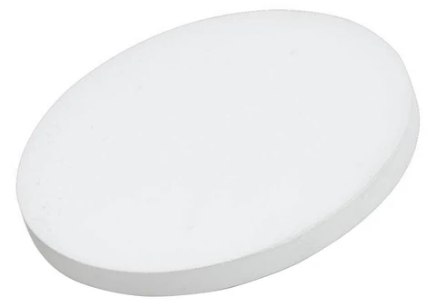
Description of Zirconium Oxide Sputtering Target
The zirconium oxide (ZrO₂) sputtering target offered by Princeton Powder is composed of high-purity zirconium and oxygen. Also known as a zirconium dioxide sputtering target or zirconia sputter target, it is a white crystalline oxide commonly used in PVD thin film deposition, optical coatings, and semiconductor applications. The naturally occurring form of ZrO₂ with a monoclinic crystalline structure is known as baddeleyite, while cubic zirconia, a dopant-stabilized cubic phase of zirconia, is widely synthesized for optoelectronic uses, thermal barrier coatings, and as a gemstone simulant.
Chemical composition of Zirconium Oxide Zirconia Sputtering Target
Typical Analysis for 99.9% ZrO2 by ICP -AES | |
Element | ppm |
Fe | 203 |
Si | 142 |
Ca | 40 |
Mg | 12 |
W | 46 |
Al | 60 |
Cu | 69 |
Zirconium Oxide Zirconia Sputtering Target Application
- Optical coatings (e.g., anti-reflective, IR mirrors)
- Semiconductors (e.g., high-k dielectric layers)
- Hard coatings for tools, wear-resistant surfaces
- Transparent conductive films and barrier layers
- Display and thin film transistor (TFT) technology
Zirconium oxide ZrO₂ Sputtering Target FAQ
What purity grades are available for zirconium oxide sputtering targets?
Typical purities include 99.5%, 99.9%, and 99.99%, depending on your application and film quality requirements.
What deposition techniques are ZrO₂ targets used for?
They are mainly used in RF magnetron sputtering, reactive sputtering, and PVD coating systems that require ceramic targets.
Can you customize the size and shape of ZrO₂ targets?
Yes. We provide custom diameters, thicknesses, and rectangular or disc shapes. Backing plate bonding is also customizable.
What are typical applications of zirconium oxide thin films?
ZrO₂ films are widely used in optical devices, semiconductor gate dielectrics, wear-resistant coatings, and oxygen sensors.
Do zirconium oxide targets require special handling?
As a ceramic, ZrO₂ is brittle and should be handled with care. Proper backing and bonding are recommended to ensure safe use in vacuum systems.
Zirconium oxide ZrO₂ Sputtering Target Scholar Articles
Investigation of various properties for zirconium oxide films synthesized by sputtering
The aim of this paper is to deposit zirconium oxide films by magnetron sputtering process at different argon partial pressure values of 45%, 55%, 62% and 67%. The effect of argon partial pressure on structural, optical and wettability properties of zirconium oxide films is investigated in this research work. The increase in argon partial pressure leads to increase in intensity of (111) peak for zirconium oxide thin films as observed by X-ray Diffraction. The average crystallite size of zirconium oxide films increases from 19 nm to 25 nm with increase in argon partial pressure. Wettability properties of zirconium oxide films such as contact angle and surface energy were determined by contact angle measuring system.