
Plant-Based Chondroitin from Marine Algae — Vegan Chondroitin Alternative for Joint & Skincare
Plant-based chondroitin from marine algae is a vegan, animal-free alternative to animal-derived chondroitin sulfate, produced by extracting and purifying sulfated polysaccharide complexes from marine algae that mimic the mucopolysaccharide structure and biological activity of chondroitin sulfate. Marketed under branded names such as Phytodroitin™ and Plondroitin™, plant-based algae chondroitin addresses the fastest-growing constraints in the supplement and cosmetic industries: vegan/vegetarian consumer demand, animal welfare concerns, BSE/TSE and allergen risk avoidance, religious dietary restrictions (kosher/halal without animal source concerns), and sustainability (algae is a renewable, low-environmental-footprint resource). The sulfated polysaccharides in marine algae, and alginate-derived sulfated fractions — share key structural features with chondroitin sulfate: negatively charged sulfate groups, repeating disaccharide units, water-binding capacity, and the ability to stimulate glycosaminoglycan synthesis, inhibit inflammatory mediators, and support connective tissue health. Human clinical studies and in vitro/in vivo research demonstrate that plant-based algae chondroitin (200–400 mg/day) supports joint comfort and mobility, cartilage matrix maintenance, and skin hydration and elasticity, with a safety profile equivalent to or better than animal-derived chondroitin (no risk of BSE, no animal allergens, no fish/shellfish contamination).
Our plant-based chondroitin from marine algae is available as a free-flowing, compressible powder suitable for capsules, tablets, gummies, beverages, and skincare formulations, in nutraceutical, cosmetic, and food grades, with full vegan/vegetarian certification and traceability from algae farm to finished powder. As a leading bulk plant-based chondroitin supplier, we provide full CoA documentation and competitive pricing for vegan supplement brands, clean-label cosmetic formulators, and food & beverage companies worldwide.
Technical Specifications
| ITEMS | SPECIFICATIONS |
|---|---|
| Appearance | Beige Powder |
| Identification | Infra Red Confirmed |
| Loss on Drying | ≤10.0% |
| pH (1%H₂O Solution) | 5.5~7.5 |
| Particle Size | NLT 95% through 60 M |
| Bulk Density | ≥0.4 g/mL |
| Tapped Density | ≥0.6 g/mL |
| Content (as CS) | ≥90% |
| Lead | ≤0.5 ppm |
| Cadmium | ≤0.5 ppm |
| Mercury | ≤1.0 ppm |
| Arsenic (Inorganic) | ≤1.5 ppm |
| Total Aerobic Microbial Count | ≤1000 CFU/g |
| Total Yeasts and Moulds Count | ≤50 CFU/g |
| Escherichia coli | Negative in 25 g |
| Salmonella species | Negative in 25 g |
| Staphylococcus aureus | Negative in 25 g |
| Pseudomonas aeruginosa | Negative in 25 g |
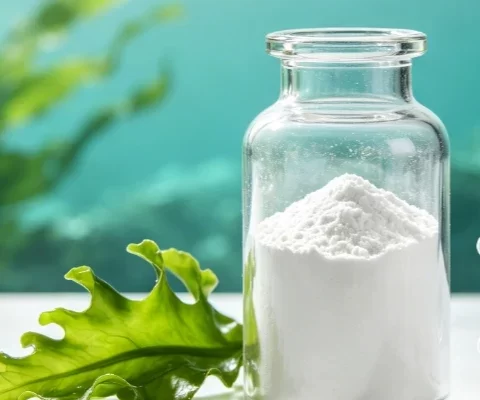
What Is Plant-Based Chondroitin from Marine Algae?
Plant-based chondroitin from marine algae is a vegan, animal-free chondroitin alternative consisting of purified sulfated polysaccharide complexes extracted from marine algae that structurally and functionally mimic animal-derived chondroitin sulfate.
The problem it solves:
- Traditional chondroitin sulfate is exclusively animal-derived (bovine trachea, shark cartilage, porcine/avian cartilage) — this excludes:
- Vegans and vegetarians (estimated 8–15% of global consumers, growing rapidly)
- Consumers with animal welfare concerns
- Those avoiding BSE/TSE risk (bovine spongiform encephalopathy)
- Individuals with meat/poultry allergens
- Kosher/Halal consumers who prefer animal-free ingredients (or require specific animal sourcing that may not be available)
- Clean-label and plant-based product brands seeking 100% animal-free formulations
- Plant-based algae chondroitin provides the joint and skin benefits of chondroitin without any animal derivatives — opening the entire vegan/plant-based market (worth $16.6B globally in 2023, projected to reach $28.9B by 2028).
Plant-Based Chondroitin for Vegan Joint & Skin Health
Stimulates glycosaminoglycan (GAG) and proteoglycan synthesis: Algal sulfated polysaccharides are taken up by chondrocytes and stimulate the synthesis of endogenous chondroitin sulfate, aggrecan, and hyaluronic acid — supporting cartilage matrix maintenance and repair.
Gut health: Algal sulfated polysaccharides act as prebiotics, feeding beneficial gut bacteria (Bifidobacterium, Lactobacillus) and producing short-chain fatty acids (SCFAs) — supporting gut barrier and immune health. (Note: this is an additional benefit beyond chondroitin-mimetic activity.)
Cardiovascular support: Some algal sulfated polysaccharides (fucoidans) have anticoagulant, anti-atherosclerotic, and lipid-lowering effects — though this is more specific to fucoidan-rich extracts.
Immunomodulatory: Algal sulfated polysaccharides modulate immune responses (anti-viral, anti-tumor, immunostimulatory effects documented for carrageenans and fucoidans).
Eye health: Can be used in vegan artificial tears and eye drops for dry eye (hydration and lubrication).
Plant-based vs. animal chondroitin — comparison
| Parameter | Plant-Based (Marine Algae) | Bovine / Shark Chondroitin |
|---|---|---|
| Source | Marine algae (red/green/brown) | Bovine trachea / shark cartilage |
| Vegan/Vegetarian | 100% | Animal-derived |
| BSE/TSE risk | None | Low (certified sources) but exists |
| Allergens | Free from common allergens | Meat/poultry/fish allergens (rare) |
| Kosher/Halal | Easily certifiable | Requires specific animal sourcing |
| Sustainability | Algae: no land/water/fertilizer, carbon-negative | Animal agriculture footprint; shark sustainability concerns |
| Active component | Sulfated polysaccharide complex (carrageenan/ulvan/fucoidan) | Chondroitin sulfate (specific GAG) |
| Sulfate content | 15–35% | 20–30% |
| Molecular weight | 5–200 kDa (custom low-MW available) | 20–60 kDa (standard); <10 kDa (LMWCS) |
| Joint health efficacy | Clinical evidence growing; 200–400 mg/day | Extensive clinical data; 800–1200 mg/day |
| Skincare efficacy | Hydration, anti-aging, anti-inflammatory | Hydration, anti-aging (standard MW = surface only; LMW = dermal) |
| Cost | Premium (specialty ingredient) | Standard (bovine) to premium (shark) |
| Market trend | Fast-growing (vegan/plant-based trend) | Mature market |
| Best for | Vegan/vegetarian products, clean-label, allergen-free, sustainable brands | Standard joint supplements, pharmaceuticals, eye drops |
Plant-based chondroitin application
- Plant chondroitin + Vegan glucosamine (fermented/corn-derived): The classic joint duo, 100% vegan. Vegan glucosamine HCl is now available from fermentation (non-animal, non-shellfish source).
- Plant chondroitin + Vegan hyaluronic acid (fermentation-derived): Premium vegan joint/skin duo. Vegan HA is produced by microbial fermentation (Streptococcus), 100% animal-free.
- Plant chondroitin + Vegan collagen (fermented/yeast-derived): Plant-based collagen peptides (produced by recombinant yeast or bacteria) + algae chondroitin = 100% vegan beauty/joint formula.
- Plant chondroitin + Curcumin / Boswellia / Ginger: Vegan anti-inflammatory botanicals enhance joint pain relief.
- Plant chondroitin + Vitamin D3 (lichen-derived, vegan) + Calcium (algae-derived): Vegan bone + joint support formula.
- Plant chondroitin + Omega-3 (algae-derived DHA/EPA, vegan): Vegan anti-inflammatory joint support.
- Skincare: Plant chondroitin + Vegan HA + Peptides + Niacinamide: Premium vegan anti-aging serum.
Frequently Asked Questions
- Is plant-based chondroitin as effective as animal chondroitin? Plant-based algae chondroitin uses sulfated polysaccharides that mimic chondroitin’s structure and biological activity. Clinical evidence is growing (200–400 mg/day shows joint benefits), though animal chondroitin has more extensive long-term data. For vegan consumers, it is the only option and provides meaningful joint/skin benefits.
- What is it made from? Sulfated polysaccharides extracted from marine algae — primarily red algae (carrageenan), green algae (ulvan), and/or brown algae (fucoidan/alginate). It is NOT chemically synthesized and contains no animal derivatives.
- Is it truly vegan? Yes — 100% plant-based, no animal derivatives, no animal testing, no animal-derived processing aids. We provide full vegan certification and documentation.
- Can it be used in skincare? Yes — algal sulfated polysaccharides provide excellent hydration, anti-aging, and anti-inflammatory benefits. Low-MW fractions can penetrate the dermis. Ideal for vegan/clean beauty brands.