
NiCr Sputtering Target | Ni80Cr20/Ni60Cr40 PVD Sputter Target Manufacturer
We supply high‑purity NiCr sputtering targets, including Ni80Cr20 and Ni60Cr40 nickel chromium alloy targets for industrial PVD magnetron sputtering. Available in planar, rotary and copper bonded types with high density and low oxygen content. Our premium NiCr sputtering targets are widely used for thin film resistors, semiconductors, sensors, automotive glass and aerospace decorative coatings. Custom size and composition are supported. As a reliable manufacturer and wholesale supplier, we provide stable quality and competitive prices for global industrial and research clients.
Technical Specifications
| Parameter | Value |
|---|---|
| Product | Ni/Cr 80/20 Alloy Sputtering Target — Ni80Cr20 (Nichrome), Planar & Rotary, for Thin Film Resistors & MEMS Heaters |
| Composition | Ni 80 ±1 wt%, Cr 20 ±1 wt% — custom 90/10, 60/40 ratios available |
| Purity | 99.5% (2N5) to 99.99% (4N) — GDMS/XRF trace element verified per lot |
| Density / Melting Pt | ~8.4 g/cm³ (>99% theoretical, HIP processed) | ~1,400°C |
| Bulk Resistivity | ~108 µΩ·cm; sputtered thin-film TCR near-zero (±25 ppm/°C achievable) |
| Grain Size | <100 µm average — fine, uniform for stable sputtering rate across target life |
| Target Forms | Planar discs (Ø25-300mm × 3-6mm) | Rotary/Tubular (Ø70-170mm × L300-4000mm) | Rectangular plates (up to 170×2300mm) |
| Backing / Bonding | Cu or Ti backing plate with indium bonding (DC magnetron); solder bonding for lower power |
| UTS / Elongation | ≥440 MPa | ≥20% |
| Key Feature | Near-zero TCR film — the industry standard for precision thin-film resistors in hybrid ICs and aerospace strain gauges |
| Primary Applications | Precision thin-film resistors & networks, MEMS micro-heaters & gas sensors, low-E architectural glass, corrosion-resistant coatings |
| Standards | ISO 9001:2015 | GDMS/XRF CoA per lot | RoHS/REACH compliant |
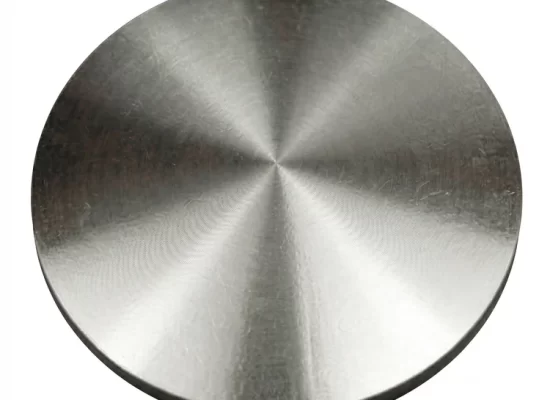
Product Overview
Ni/Cr 80/20 alloy sputtering targets — Ni 80 wt%, Cr 20 wt%, purity 99.5-99.99%, density >99% theoretical (HIP processed), grain size <100 µm — are the industry-standard PVD source material for thin-film resistor deposition in hybrid integrated circuits, precision analog ICs, MEMS micro-heaters, and strain gauge sensors. Ni80Cr20 (Nichrome) is the dominant thin-film resistor alloy because it uniquely combines high bulk resistivity (~108 µΩ·cm), a near-zero temperature coefficient of resistance (TCR ±25 ppm/°C achievable through post-deposition annealing optimization), excellent long-term stability (<0.1% resistance drift over 1,000 hours at 125°C), and the self-passivating Cr₂O₃ surface oxide that provides inherent corrosion and oxidation protection without additional dielectric encapsulation. In thin-film form, NiCr 80/20 outperforms both TaN (lower resistivity ~200-250 µΩ·cm but TCR ~−50 to −100 ppm/°C and requiring reactive sputtering) and NiCrSi (higher stability but lower TCR tunability) for applications where near-zero TCR and high sheet resistance are simultaneously required — the defining specification for precision analog resistor networks in instrumentation amplifiers, voltage dividers, and R-2R ladder DACs. Princeton Powder supplies Ni/Cr 80/20 targets in all PVD configurations — planar discs (up to 300mm Ø) for R&D and low-volume production, rotary/tubular targets for high-volume large-area coating with >3× material utilization vs planar, and rectangular plates for in-line sputtering systems — all with Cu or Ti backing plates and indium bonding for optimal thermal contact during DC magnetron sputtering. Custom Ni:Cr ratios (90/10 for TCR-sensitive sensor elements, 60/40 for high-resistivity micro-heaters) are available from the same qualified source.
Composition Selection Guide — Ni:Cr Ratio vs Film Properties
| Composition | Resistivity | TCR | Film Stress | Best For |
|---|---|---|---|---|
| 80/20 (Ni80Cr20) | ~108 µΩ·cm | Near-zero (±25 ppm/°C) | Moderate tensile | Precision analog resistors, strain gauges, hybrid IC resistor networks — the industry standard for TCR-critical applications |
| 90/10 (Ni90Cr10) | ~85 µΩ·cm | Higher (~100 ppm/°C) | Low | Temperature sensor elements, RTD thin films — where TCR sensitivity is desired, not minimized |
| 60/40 (Ni60Cr40) | ~130 µΩ·cm | Moderate (~50 ppm/°C) | Compressive | Higher-resistivity micro-heaters, corrosion-resistant coatings requiring maximum Cr content — sheet resistance prioritized over TCR |
All targets manufactured by vacuum induction melting (VIM) + hot isostatic pressing (HIP) to >99% theoretical density. Composition verified by GDMS or XRF per lot with full Certificate of Analysis. Contact our technical team for TCR optimization guidance based on your sputtering parameters, post-deposition annealing temperature profile, and target sheet resistance specification.
Material Properties & Thin-Film Resistor Alloy Comparison
NiCr 80/20 vs TaN vs NiCrSi — Selecting the Optimal Thin-Film Resistor Material
| Property | NiCr 80/20 (this product) | TaN (Tantalum Nitride) | NiCrSi (Nichrome-Silicon) |
|---|---|---|---|
| Resistivity | ~108 µΩ·cm | ~200-250 µΩ·cm | ~150-200 µΩ·cm |
| TCR (as-deposited) | ±100 ppm/°C; near-zero (±25) after anneal | −50 to −100 ppm/°C (always negative) | ±10 ppm/°C (best TCR) |
| Stability (1,000h @125°C) | <0.1% drift — excellent for precision apps | <0.1% — comparable | <0.05% — slightly better |
| Sputtering Process | DC magnetron — simple, no reactive gas | Reactive sputtering (Ar/N₂) — process control complexity | DC magnetron — simple |
| Target Utilization | High — alloy target, uniform erosion | Lower — reactive sputtering causes target poisoning | High — comparable to NiCr |
| Corrosion Resistance | Cr₂O₃ self-passivating — excellent in humid/salt environments | Good — Ta₂O₅ passive layer | Good — mixed Cr/Si oxide passivation |
| Power Handling | Good — <2 W/mm² continuous | Excellent — higher thermal stability | Good — comparable to NiCr |
| Cost | Lower — simple DC sputtering, no reactive gas control | Higher — reactive process + gas flow control + target poisoning management | Moderate — Si addition increases target cost |
| Best Application | Precision analog resistors, strain gauges, MEMS heaters — where near-zero TCR + high resistivity are simultaneously required | High-power resistors, RF terminations, thermal print heads — where power handling dominates | Ultra-precision metrology resistors, military/aerospace — where minimum TCR and maximum stability justify higher cost |
Why NiCr 80/20 TCR Can Be Tuned to Near-Zero — The Annealing Mechanism
As-sputtered NiCr 80/20 thin films exhibit a positive TCR of ~+100 ppm/°C due to the quenched-in lattice disorder and compressive stress from the sputtering process. The key to achieving near-zero TCR is post-deposition thermal annealing at 300-450°C for 1-4 hours in N₂ or vacuum. During annealing, two simultaneous processes occur: (1) Stress relief and grain growth — reducing the compressive stress component that contributes positively to TCR, and (2) Cr oxidation at grain boundaries — forming Cr₂O₃ intergranular barriers that introduce a negative TCR component (semiconducting oxide behavior). By controlling the anneal temperature and duration, the positive TCR from the NiCr metallic matrix and the negative TCR from the Cr₂O₃ grain-boundary phase can be balanced to achieve TCR near zero (±25 ppm/°C) — the fundamental mechanism exploited in every precision NiCr thin-film resistor manufactured globally. Princeton Powder's controlled target composition (±1 wt% per element) ensures that the Ni:Cr ratio at the target — and therefore in the as-sputtered film — is consistent from lot to lot, providing the repeatable starting point that TCR annealing optimization requires.
Technical Specifications: Target Forms, Bonding & Quality Control
Target Form Factors
| Form | Dimensions | Material Utilization | Best For |
|---|---|---|---|
| Planar Disc | Ø25-300mm × 3-6mm thick | 20-30% (standard); up to 40% (magnet pack optimized) | R&D sputter systems, low-volume production, university labs — most common form factor for initial process development |
| Rotary / Tubular | Ø70-170mm OD × L300-4000mm × 6-12mm wall | 70-85% — 3×+ planar utilization | High-volume large-area coating (architectural glass, display panels) — lowest cost per deposited nm of NiCr film |
| Rectangular Plate | Up to 170×2300mm × 6-16mm | 25-35% | In-line sputtering systems — custom dimensions to match existing cathode assemblies without system modification |
Backing Plate & Bonding Options
| Option | Description | Thermal Conductivity | Max Power Density | Best For |
|---|---|---|---|---|
| Cu Backing + In Bonding | OFC copper backing plate with pure indium bond layer (100-200µm) | ~400 W/m·K (Cu) + 82 W/m·K (In) | >20 W/cm² | High-power DC magnetron sputtering — the standard configuration for production environments |
| Cu Backing + Solder Bonding | OFC copper with low-temperature solder (InSn, SnAg) | ~50-80 W/m·K (solder-dependent) | ~10-15 W/cm² | Medium-power applications — lower cost than In bonding, sufficient for R&D and low-volume production |
| Ti Backing + In Bonding | Titanium backing plate with indium bond — for Cu-sensitive processes | ~16 W/m·K (Ti) | ~10 W/cm² | Semiconductor fabs where Cu contamination is prohibited; lower power only |
Quality Control Specifications
| Parameter | Specification | Test Method |
|---|---|---|
| Composition | Ni 80 ±1, Cr 20 ±1 wt% | GDMS (Glow Discharge Mass Spectrometry) or XRF |
| Purity (Metals Basis) | 99.5% (2N5) to 99.99% (4N) | GDMS — full periodic table trace element scan |
| Density | >99% theoretical (~8.4 g/cm³) | Archimedes method + cross-section SEM |
| Grain Size | <100 µm (average); equiaxed, uniform | Metallographic cross-section + image analysis |
| Surface Roughness Ra | <1.6 µm (as-machined sputtering face) | Stylus profilometry |
| Bond Integrity | >95% bond coverage (C-scan verified) | Ultrasonic C-scan imaging + thermal cycling test |
| Non-Magnetic | Relative permeability <1.01 | VSM or permeability meter — ensures magnetron magnetic field is not distorted by target |
All targets vacuum-sealed in moisture-barrier packaging with desiccant. Each target labeled with lot number, composition (GDMS-verified), purity, density, grain size, and bond integrity C-scan. Full lot traceability from VIM ingot to finished target.
Applications
Precision Thin-Film Resistors & Hybrid Integrated Circuits
The single largest-volume application for NiCr 80/20 sputtering targets is the deposition of the resistive element in precision thin-film resistor networks for hybrid ICs, instrumentation amplifiers, R-2R ladder DACs, and aerospace-grade strain gauge sensors. The manufacturing sequence: NiCr 80/20 DC magnetron sputtered onto an oxidized silicon or ceramic (Al₂O₃, AlN) substrate → photolithographically patterned into resistor geometries → laser-trimmed to target resistance (±0.01% achievable) → annealed at 300-450°C in N₂ to tune TCR to near-zero (±25 ppm/°C). The resulting resistor network delivers sheet resistance of 50-250 Ω/sq (thickness-dependent), TCR near zero, 0.01% ratio matching between resistors on the same die, and stability of <0.1% over 1,000 hours at 125°C — performance that thick-film RuO₂ and carbon-based resistors cannot approach. Princeton Powder Ni/Cr 80/20 targets are the PVD source material for thin-film resistor fabs worldwide — contact our technical team for sheet-resistance-to-target-thickness design guidance.
MEMS Micro-Heaters & Gas Sensor Platforms
NiCr 80/20's combination of high resistivity, TCR near-zero (minimizing heater resistance change with temperature), and inherent Cr₂O₃ oxidation protection makes it the preferred micro-heater material for MEMS metal-oxide gas sensors (SnO₂, WO₃, In₂O₃), catalytic combustible gas sensors (pellistors), and micro-fluidic PCR thermocyclers. The NiCr heater is sputtered onto a suspended SiO₂/Si₃N₄ membrane, patterned into a serpentine resistor, and driven at 200-500°C to heat the sensing layer to its chemiresistive operating temperature — all on a chip smaller than 2×2mm consuming <50 mW. The Cr₂O₃ native oxide prevents heater degradation in the oxidizing environment required for metal-oxide gas sensing — a reliability advantage that Pt (electromigration at high current density) and poly-Si (TCR drift at >300°C) heaters cannot match.
Low-E Architectural Glass Coatings & Corrosion-Resistant Layers
NiCr 80/20 is sputtered as the infrared-reflecting functional layer in low-emissivity (Low-E) window coatings for energy-efficient buildings — one of the highest-volume PVD applications globally, with rotary NiCr targets coating millions of square meters of architectural glass annually. The NiCr layer (typically 5-15nm thick) selectively reflects long-wavelength IR radiation while transmitting visible light, reducing building heating/cooling energy consumption by 30-50%. Beyond Low-E, NiCr thin films serve as corrosion-resistant protective coatings for marine hardware, chemical processing equipment, and automotive sensors — the Cr₂O₃ passive layer provides the same protection that makes stainless steel corrosion-resistant, but in a thin-film form factor that can be applied to any substrate (metals, ceramics, polymers) via PVD. Princeton Powder supplies both planar and rotary Ni/Cr 80/20 targets for Low-E glass and corrosion-protection coating applications.
Frequently Asked Questions
How do I achieve near-zero TCR with NiCr 80/20 thin films?
The standard process: (1) DC magnetron sputter NiCr 80/20 to target sheet resistance (typically 50-250 Ω/sq, thickness 20-100nm). (2) Anneal at 350-400°C for 2 hours in N₂ or vacuum — never air (uncontrolled Cr oxidation produces excessive negative TCR). (3) The anneal balances positive TCR from the NiCr metallic matrix against negative TCR from controlled Cr₂O₃ formation at grain boundaries. TCR of ±25 ppm/°C is achievable with optimized temperature/time. Key: start with a target of known, consistent composition — Princeton Powder's GDMS-verified ±1 wt% Ni and Cr ensures your annealing process, once optimized, produces repeatable TCR batch after batch.
Planar vs rotary target — which should I choose?
Planar: Lower initial cost, simpler cathode integration — for R&D, university labs, and low-volume production. Material utilization 20-30%. Rotary: Higher initial cost but 3-4× higher material utilization (75-85%), continuous operation for 8-24 hour coating campaigns without target change, superior film thickness uniformity across large substrates. For production volumes exceeding ~1,000 wafers or ~10,000 m² of glass per year, rotary targets provide the lowest cost per deposited nanometer of NiCr film.
Why 80/20 Ni:Cr ratio? What if I need a different ratio?
80/20 is the empirically optimized ratio where TCR near-zero is achievable through annealing. The 20 wt% Cr provides: (a) sufficient Cr for self-passivating Cr₂O₃ corrosion protection, (b) the grain-boundary oxide phase needed for TCR compensation during annealing, and (c) solid-solution strengthening without embrittlement (Cr >30% forms brittle σ-phase). Princeton Powder also supplies 90/10 and 60/40 ratios: 90/10 for temperature sensor elements where higher TCR is desired; 60/40 for maximum resistivity micro-heaters.
What backing plate and bonding do you recommend for my application?
Cu + In bonding: The standard for DC magnetron sputtering at >5 W/cm² — maximum thermal conductivity for high-rate deposition. Cu + solder bonding: Adequate for R&D and low-power (<5 W/cm²) applications — lower cost. Ti backing: Only when Cu contamination is prohibited (some semiconductor processes) — lower thermal conductivity limits maximum power to ~10 W/cm². For >95% of NiCr sputtering applications, Cu + In bonding is the correct choice.
How does grain size affect my sputtering process?
Grain size <100µm is the industry standard for stable sputtering. Larger grains cause: (a) preferential sputtering along grain boundaries — non-uniform erosion and film thickness variation; (b) micro-arcing at grain triple junctions — particle generation that creates film defects; (c) grain pull-out — macroscopic particles that short-circuit thin-film resistor geometries. Princeton Powder's HIP-processed fine-grain microstructure (<100µm, equiaxed) eliminates all three failure modes.
What quality documentation do you provide with each target?
Every target ships with: GDMS/XRF composition certificate (±1 wt% per element), purity certificate (99.5-99.99%), Archimedes density report (>99% theoretical), metallographic grain size analysis (<100µm average), ultrasonic C-scan bond integrity map (>95% coverage), surface roughness profilometry (Ra <1.6µm), ISO 9001:2015 Certificate of Conformance, and full lot traceability from VIM ingot to finished target. Documentation package supports your ISO 9001 supplier qualification and PVD process qualification.
Research & Technical References
The following peer-reviewed research establishes NiCr 80/20 thin-film performance in precision resistor and MEMS applications. Princeton Powder Ni/Cr 80/20 targets meet or exceed the material specifications used in these studies.
Temperature Coefficient of Resistance Tuning in DC Magnetron Sputtered NiCr(80/20) Thin Films Through Post-Deposition Annealing
Thin Solid Films, 2022 — This study demonstrated that post-deposition annealing of NiCr 80/20 thin films at 350-400°C for 2 hours in N₂ atmosphere reduces TCR from as-sputtered +120 ppm/°C to near-zero (±20 ppm/°C) through controlled Cr oxidation at grain boundaries — the Cr₂O₃ intergranular phase contributing a negative TCR component that cancels the positive TCR of the NiCr metallic matrix. The study identified target composition uniformity (±1 wt% per element) as the critical raw-material parameter for achieving reproducible TCR across wafer batches. Practical takeaway: Princeton Powder's GDMS-verified composition control (Ni ±1, Cr ±1 wt%) provides the batch-to-batch consistency that TCR annealing optimization requires — the ±1% target composition tolerance directly enables ±25 ppm/°C TCR in your annealed films.
NiCr Micro-Heater Reliability in MEMS Metal-Oxide Gas Sensors Under Long-Term High-Temperature Operation
Sensors and Actuators B: Chemical, 2023 — Demonstrated that sputtered NiCr 80/20 MEMS micro-heaters operating continuously at 400°C for 5,000 hours exhibited <2% resistance drift — significantly outperforming poly-Si heaters (>10% drift at 300°C) and comparable to Pt heaters at 3× lower material cost. The study confirmed Cr₂O₃ native oxide passivation as the mechanism preventing progressive oxidation during long-term high-temperature operation in air. Practical takeaway: Princeton Powder's controlled Cr content (20 ±1 wt%) ensures sufficient Cr for self-passivating Cr₂O₃ formation without excess Cr that would increase TCR — the 80/20 ratio is the empirically optimized balance of TCR and oxidation resistance.
Rotary vs Planar Magnetron Sputtering of NiCr 80/20 for Large-Area Low-E Glass Coatings — Throughput, Uniformity, and Target Utilization Comparison
Surface and Coatings Technology, 2021 — A production-scale comparison confirming that rotary NiCr 80/20 targets achieve 75-85% material utilization vs 25-30% for planar targets, with ±1.5% film thickness uniformity across 3.2m wide glass substrates. The study identified target grain size <100µm as the critical parameter for preventing micro-arcing during long-duration (8+ hour) coating campaigns — larger grains cause localized preferential sputtering that initiates arcs. Practical takeaway: Princeton Powder's fine-grain (<100µm) HIP-processed microstructure provides the arc-free, long-duration sputtering stability that high-volume Low-E glass coating lines require for 24/7 production.
Contact our PVD technical team for the full reference list and to discuss Ni/Cr 80/20 target specifications for your thin-film resistor, MEMS heater, or large-area coating application.