
Lithium Niobate (LN) LiNbO3 Nonlinear Crystal, Z/X/Y-Cut, for SHG, OPO, Electro-Optic Modulation & Integrated Photonics
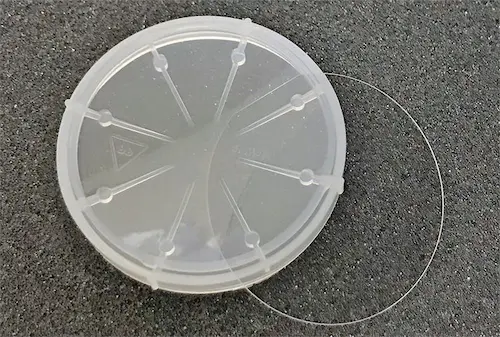
Premium Lithium Niobate (LN) LiNbO3 nonlinear crystal wafers for optical applications. We offer precision Z-cut, X-cut, and Y-cut LiNbO3 wafers engineered for Second Harmonic Generation (SHG), Optical Parametric Oscillators (OPO), electro-optic modulation, and integrated photonics. Available in optical and device-grade quality, our LN crystals ensure superior optical transparency and high non-linear coefficients. Request a quote today for custom sizes, polished wafers, and competitive bulk pricing from a trusted global supplier!
Technical Specifications
| Parameter | Value |
|---|---|
| Product | Lithium Niobate (LN) LiNbO3 Nonlinear Optical Crystal |
| Chemical Formula | LiNbO3 — Lithium Niobate |
| CAS Number | 12031-63-9 |
| Crystal Structure | Trigonal, point group 3m, space group R3c — a = 5.148Å, c = 13.863Å |
| Variants Available | Pure (Congruent) LN | MgO:LN (0.6-5 mol%) | Fe:LN / Er:LN | PPLN (Periodically Poled) | LNOI Thin Film |
| Transparency Range | 0.35–5.2 µm (420–5,200 nm) — visible through mid-infrared |
| Nonlinear Coefficient d33 | 34.4 pm/V (absolute) — highest among common NLO crystals; accessed via QPM in PPLN |
| Electro-Optic Coefficient r33 | 31 pm/V (@633nm, high-frequency clamped) — among the highest EO coefficients |
| Damage Threshold | 100 MW/cm² (pure, 1064nm, 10ns pulse); MgO-doped significantly higher |
| Key Applications | SHG (frequency doubling), OPO/OPA (tunable IR), electro-optic modulators, Q-switches, SAW wafers, quantum optics, LNOI photonic integrated circuits |
| Quality Standard | Optical homogeneity ~5×10⁻⁵/cm | Wavefront distortion λ/4–λ/10 | Surface quality 10-5 to 60-40 S/D |
Product Overview
Lithium Niobate (LN, LiNbO3, CAS 12031-63-9) is a trigonal (point group 3m) nonlinear optical crystal that uniquely integrates five functional properties in a single material: nonlinear optical (NLO) frequency conversion, electro-optic (EO) modulation, piezoelectric transduction, acousto-optic (AO) deflection, and ferroelectric domain engineering for quasi-phase-matching (QPM). No other commercially available crystal combines this breadth of functionality with the optical quality, thermal stability, and manufacturability of LiNbO3 — it is the silicon of nonlinear optics. The material's defining advantage is its extraordinarily high nonlinear coefficient d33 = 34.4 pm/V — the largest among common NLO crystals — which, when accessed through periodically poled (PPLN) domain engineering, enables record frequency conversion efficiencies: 65% SHG efficiency for pulsed Nd:YAG at 1064 nm, broadband OPO output from 1.4–4.5 µm, and entangled photon pair generation for quantum optics — all at room temperature without the critical phase-matching angle constraints of BBO or LBO. Princeton Powder supplies LiNbO3 in five variants: Pure congruent LN, MgO-doped LN (0.6–5 mol% — suppresses photorefractive damage for high-power operation), Fe-doped LN (photorefractive), Er-doped LN (waveguide amplifiers), Periodically Poled LN (PPLN — uniform, multi-period, or fan-out QPM gratings), and LNOI thin-film wafers (lithium niobate on insulator for chip-scale integrated photonics).
Variant Selection Guide
| Variant | Key Advantage | Damage Threshold | Best For |
|---|---|---|---|
| Pure (Congruent) LN | Lowest cost; widest availability; well-characterized Sellmeier coefficients | ~100 MW/cm² (1064nm, 10ns) | Low-to-moderate power SHG, EO modulators, Q-switches, SAW substrates, educational/research use |
| MgO:LN (5 mol%) | Suppresses photorefractive damage — enables high-power operation; NCPM at room temp | Significantly higher than pure (2-5×) | High-power SHG (pulsed & CW Nd:YAG), OPO/OPA pump sources, integrated waveguide devices |
| Fe:LN / Er:LN | Photorefractive (Fe) / Optical gain (Er) — application-specific doping | Varies | Holographic storage (Fe); waveguide amplifiers and lasers at 1.5µm telecom wavelength (Er) |
| PPLN (Periodically Poled) | Accesses d33 via QPM — highest conversion efficiency; no spatial walk-off; tunable via poling period | MgO:PPLN for high power | High-efficiency SHG/SFG/DFG, broadband OPO (1.4-4.5µm), quantum entangled photon sources |
| LNOI Thin Film | Submicron optical confinement; chip-scale integration; dramatically enhanced nonlinear efficiency per unit length | Design-dependent | Photonic integrated circuits (PICs), microring frequency combs, on-chip modulators, quantum photonics |
All variants available in Z-cut, X-cut, and Y-cut orientations with optical-grade polish (10-5 to 60-40 S/D), AR coatings (dual-band or broadband), and wavefront distortion λ/4–λ/10. Custom dimensions, poling periods, and doping concentrations available.
Optical Properties & NLO Crystal Comparison
LiNbO3 vs BBO vs LBO — Selecting the Optimal Nonlinear Crystal
| Property | LiNbO3 (this product) | BBO (β-BaB2O4) | LBO (LiB3O5) |
|---|---|---|---|
| Crystal Structure | Trigonal, 3m — ferroelectric (domain-engineerable) | Trigonal, 3m — non-ferroelectric | Orthorhombic, mm2 — non-ferroelectric |
| Transparency Range | 0.35–5.2 µm | 0.19–3.5 µm (extends into UV) | 0.16–2.6 µm (deepest UV) |
| Max Nonlinear Coefficient | d33 = 34.4 pm/V — highest; accessed via QPM (PPLN) | d22 = 2.2 pm/V (d11=2.3 pm/V for SHG) | d32 = 0.85 pm/V (smaller but higher damage threshold) |
| Damage Threshold | ~100 MW/cm² (pure); MgO:LN higher | ~5 GW/cm² (very high) | ~25 GW/cm² (highest among common NLO) |
| Phase Matching | Birefringent PM possible; QPM (PPLN) accesses d33 without walk-off | Critical PM — large birefringence; spatial walk-off at small beam diameters | Non-critical PM (NCPM) at room temp — no walk-off, large acceptance angle |
| Electro-Optic Effect | Yes — r33 = 31 pm/V. Enables EO modulators, Pockels cells, Q-switches | Yes — r22 = 2.7 pm/V (weaker) | Yes — smaller EO coefficients |
| Domain Engineering | Yes — PPLN via electric-field poling. Enables QPM at any wavelength within transparency | No — not ferroelectric | No — not ferroelectric |
| Hygroscopic | No — stable in ambient air; no hermetic packaging required | Mildly hygroscopic — requires sealed housing for long-term reliability | Slightly hygroscopic — coating recommended |
| Best Application | SHG (Nd:YAG 1064nm→532nm), OPO (1.4-4.5µm), EO modulators, PPLN QPM devices, quantum sources, integrated photonics | UV SHG (Ti:Sapphire 800nm→400nm), high-peak-power OPO pump sources, ultrafast SHG/THG | High-average-power SHG/THG, ultrafast OPA pump, high-damage-threshold SHG for industrial ns/ps lasers |
| Key Weakness | Photorefractive damage in pure LN at high power (mitigated by MgO doping) | Spatial walk-off limits beam quality in tight-focus SHG | Lower nonlinearity requires longer crystals; angular acceptance narrow for critical PM |
Why LiNbO3's d33 Accessed via PPLN is a Game-Changer
In conventional birefringent phase matching (used by BBO and LBO), the nonlinear coefficient accessible for frequency conversion is a projection of the d-tensor onto the phase-matching direction — typically yielding effective nonlinearities (deff) of 0.5-2 pm/V. LiNbO3's d33 of 34.4 pm/V is the largest nonlinear tensor element of any common NLO crystal, but in standard birefringent PM, d33 cannot be accessed because the interacting waves must have different polarizations. PPLN solves this through quasi-phase-matching (QPM): the crystal's ferroelectric domains are periodically inverted via electric-field poling, creating a grating that compensates for phase mismatch while allowing all three interacting waves to use the same polarization — accessing the full d33. The result: conversion efficiencies 10-100× higher than birefringent PM in the same crystal length, zero spatial walk-off (collinear propagation), and the ability to engineer the poling period for phase-matching at any wavelength within the transparency range — not just those where birefringence happens to match. This is why PPLN dominates mid-IR OPO, telecom-band SHG, and entangled photon pair generation: no other crystal technology combines the nonlinear drive of d33 with the design flexibility of QPM. Princeton Powder supplies PPLN with uniform, multi-period (discrete channels), and fan-out (continuous gradient) QPM gratings — contact our technical team for poling period design at your target pump and output wavelengths.
Technical Specifications: Optical Properties, Crystal Orientations & Quality
Optical Properties
| Parameter | Specification |
|---|---|
| Transparency Range | 0.35–5.2 µm (420–5,200 nm) |
| Nonlinear Coefficient d33 | 34.4 pm/V (absolute); d31 = 5.95 pm/V; d22 = 3.07 pm/V |
| Electro-Optic Coefficient r33 | 31 pm/V (@633nm, high-freq); r13 = 9 pm/V; r22 = 3.4 pm/V; r51 = 28 pm/V |
| Refractive Index @1064nm | no = 2.232, ne = 2.156 (negative uniaxial, no > ne) |
| Refractive Index @633nm | no = 2.286, ne = 2.203 |
| Birefringence | Δn = no – ne ≈ 0.08-0.09 (temperature-dependent) |
| Sellmeier Equations | ne²=4.5820+0.099169/(λ²-0.04443)-0.021950λ²; no²=4.9048+0.11768/(λ²-0.04750)-0.027169λ² (λ in µm) |
| Damage Threshold | ~100 MW/cm² (pure LN, 1064nm, 10ns pulse); MgO:LN significantly higher; AR coating threshold specified per coating design |
Physical Properties
| Parameter | Specification |
|---|---|
| Crystal Structure | Trigonal, point group 3m, space group R3c |
| Lattice Constants | a = 5.148 Å, c = 13.863 Å |
| Density | 4.64 g/cm³ |
| Melting Point | ~1,255 °C (congruent composition) |
| Curie Temperature | ~1,142 °C (ferroelectric-paraelectric transition) |
| Mohs Hardness | 5 |
| Thermal Conductivity | ~5.6 W/(m·K) (|| c-axis) |
| Hygroscopic Susceptibility | Non-hygroscopic — stable in ambient air; no hermetic packaging required |
Crystal Orientation Guide
| Cut | Propagation | Polarization Access | Best For |
|---|---|---|---|
| Z-cut | Light || optical axis (c-axis) | Both ordinary (o) and extraordinary (e) accessible; d33 via QPM | PPLN SHG/OPO (accesses d33 via QPM); electro-optic phase modulators (E-field || z); most common orientation for NLO |
| X-cut | Light ⊥ optical axis, || X | TE (o) and TM (e) modes | Waveguide modulators; LNOI photonic integrated circuits; Y-propagating SAW devices |
| Y-cut | Light ⊥ optical axis, || Y | TE (o) and TM (e) modes | SAW wafers (Y128° for telecom filters); mixed optical-acoustic devices |
Quality Specifications
| Parameter | Standard | Premium |
|---|---|---|
| Optical Homogeneity | ~5×10⁻⁵/cm | Custom on request |
| Wavefront Distortion | λ/4 @633nm | λ/10 @633nm |
| Surface Quality (S/D) | 60-40 | 10-5 (laser-grade) |
| Flatness | λ/4 @633nm | λ/10 |
| Parallelism | ≤30 arcsec | ≤10 arcsec |
| AR Coating | Single-band (e.g., 1064nm R<0.2%); Dual-band (1064+532nm R<0.3% each) | Broadband (e.g., 1.0-1.6µm R<0.5%) |
| Dimensions | 5×5mm to 50×50mm aperture; 0.2-50mm length (crystal); 1″-4″ diameter (wafers) | Custom dimensions |
All crystals supplied with AR coatings as specified, oriented to ±0.2° of requested cut direction, with full interferometric and spectroscopic quality verification. Custom doping, poling periods, and dimensions available.
Applications
Second Harmonic Generation (SHG) & Optical Parametric Oscillation (OPO)
The primary application for LiNbO3 and MgO:LiNbO3 crystals (Z-cut, AR-coated) is frequency conversion in solid-state laser systems. SHG (frequency doubling): LiNbO3 converts Nd:YAG 1064nm → 532nm green with 65% efficiency (pulsed, MgO:PPLN) or 45% (CW). The high d33 accessed via QPM in PPLN provides conversion efficiencies 10-100× higher than birefringent PM in the same crystal length. OPO (optical parametric oscillation): PPLN OPOs pumped at 1064nm generate broadly tunable output from 1.4-4.5µm — covering the critical mid-IR spectral region for spectroscopy, remote sensing, and medical laser applications. The poling period determines the output wavelengths: shorter periods → signal closer to pump; longer periods → deeper into mid-IR. Multi-grating PPLN chips with 5-20 discrete poling periods on a single crystal enable rapid wavelength tuning via translation stage — no angle tuning, no temperature cycling, no crystal swapping. Princeton Powder supplies LiNbO3 and PPLN crystals optimized for your pump wavelength, target output, and power level — with AR coatings designed for your specific wavelength bands.
Electro-Optic Modulators, Q-Switches & SAW Wafers
LiNbO3's large electro-optic coefficient (r33 = 31 pm/V) — among the highest of any commercial crystal — combined with its wide transparency and non-hygroscopic stability makes it the material of choice for: Electro-optic phase and amplitude modulators: Z-cut LiNbO3 with traveling-wave electrodes enables fiber-optic modulators operating at 10-40 GHz with low half-wave voltage (Vπ ~3-5V for 10mm interaction length). These are the backbone of modern fiber-optic telecommunications — every long-haul fiber link carries a LiNbO3 modulator at each end. Q-switches: LiNbO3 Pockels cells provide high-contrast, fast-switching Q-switching for Nd:YAG, Nd:YLF, and Ti:Sapphire lasers — enabling nanosecond pulse generation for materials processing, LIDAR, and medical laser systems. SAW wafers: Y128°-cut LiNbO3 is the industry-standard piezoelectric substrate for surface acoustic wave (SAW) filters in mobile phone RF front-ends — billions of LiNbO3 SAW filters are manufactured annually. Princeton Powder supplies LiNbO3 in all orientations and wafer diameters for modulator, Q-switch, and SAW device manufacturing.
PPLN Domain Engineering, LNOI Integrated Photonics & Quantum Optics
Three advanced applications complete LiNbO3's portfolio: (1) PPLN domain engineering: Beyond standard SHG and OPO, custom-poled PPLN enables difference frequency generation (DFG) for tunable mid-IR sources (3-5µm) for trace gas sensing, sum frequency generation (SFG) for visible/UV upconversion detection, and backward-wave OPO for mirrorless parametric oscillation. Available poling patterns: uniform (single period), multi-period (discrete channels — 5-20 periods on one chip), and fan-out (continuous period gradient — wavelength tuned by lateral translation). (2) LNOI thin-film integrated photonics: Lithium niobate on insulator (LNOI) — a thin (~300-700nm) LiNbO3 film bonded to SiO2 on a silicon handle wafer — is the transformational platform for chip-scale nonlinear and electro-optic devices. Submicron optical confinement in LNOI waveguides enhances nonlinear efficiency per unit length by 10-100× vs bulk crystals, enabling microring frequency combs, on-chip EO modulators with sub-volt Vπ, and compact entangled photon pair sources — all on a CMOS-compatible wafer. (3) Quantum optics: PPLN is the leading source of entangled photon pairs via spontaneous parametric down-conversion (SPDC) — the workhorse of quantum optics experiments, quantum key distribution (QKD), and photonic quantum computing research. Princeton Powder supplies PPLN with custom poling for quantum optics wavelengths, and LNOI wafers for integrated photonics R&D and production.
Why Choose Princeton Powder Lithium Niobate Crystals
- Five Variant Families — One Supplier: Pure LN, MgO:LN (0.6-5 mol%), Fe:LN/Er:LN, PPLN (uniform/multi-period/fan-out QPM), and LNOI thin-film wafers. Covering every application from telecom modulator wafers to quantum entangled photon sources — from a single qualified optical materials supplier.
- d33 = 34.4 pm/V — The Highest Nonlinear Coefficient Accessible via QPM: PPLN's quasi-phase-matching unlocks LiNbO3's full d33 — delivering SHG conversion efficiencies of 65% (pulsed) and 45% (CW) that BBO and LBO cannot match at comparable crystal lengths. Custom poling periods for phase-matching at your exact pump and target wavelengths.
- MgO-Doped for High-Power Operation — Suppresses Photorefractive Damage: MgO doping (5 mol%) eliminates the primary limitation of pure LiNbO3 — photorefractive damage (optical index inhomogeneity induced by high-intensity light). MgO:LN enables non-critical phase matching at room temperature and supports CW and high-average-power operation that pure LN cannot sustain.
- Three Crystal Cuts — Z, X, Y — All in Stock: Z-cut for PPLN SHG/OPO and EO modulators (accesses d33 and r33); X-cut for waveguide modulators and LNOI PICs; Y-cut for SAW wafers (including Y128° telecom standard). Oriented to ±0.2° with interferometric verification.
- Custom AR Coatings — Single-Band, Dual-Band, or Broadband: Ion-beam sputtered (IBS) AR coatings with R<0.2% per surface at your specified wavelength. Dual-band coatings (e.g., 1064+532nm) for SHG; broadband (e.g., 1.0-1.6µm) for OPO. Damage threshold verified per coating lot.
- Optical-Grade Quality — λ/10 Wavefront, 10-5 S/D Available: Premium-grade crystals for laser cavity intracavity applications. Standard grade (λ/4, 60-40 S/D) for OEM and research use. Every crystal shipped with interferometric wavefront map and spectrophotometric transmission scan.
Frequently Asked Questions
PPLN vs bulk LiNbO3 — why do I need periodically poled crystal for SHG?
In bulk (non-poled) LiNbO3 using birefringent phase matching, you can only access the deff coefficient — typically 1-5 pm/V depending on PM type. The largest nonlinear tensor element d33 = 34.4 pm/V cannot be used because birefringent PM requires different polarizations for the interacting waves. PPLN's quasi-phase-matching (QPM) inverts the ferroelectric domains every coherence length, allowing all three waves (pump, signal, idler) to use the same extraordinary polarization — accessing the full d33. The result: 10-100× higher conversion efficiency, zero spatial walk-off, and the ability to phase-match at ANY wavelength within LiNbO3's transparency by choosing the appropriate poling period. If you need maximum SHG efficiency or mid-IR OPO output, PPLN is the correct choice.
Why MgO doping — when do I need it and what concentration?
Pure (congruent) LiNbO3 suffers from photorefractive damage — laser-induced refractive index changes that distort the beam and degrade conversion efficiency — at visible wavelengths even at modest power densities (~kW/cm² CW). MgO doping at 5 mol% suppresses photorefractive damage by 2-5×, enabling reliable high-power operation. Use MgO:LN (5 mol%) when: (1) Your average power exceeds ~100 mW CW in the visible; (2) You're operating at wavelengths <600 nm (photorefractive sensitivity increases at shorter wavelengths); (3) You require NCPM at room temperature (MgO shifts the PM temperature to practical values); (4) You're building a PPLN device for high-power SHG or OPO. Pure LN is acceptable for: low-power (<100 mW) SHG, EO modulators (IR telecom wavelengths), SAW wafers, and educational/research use where cost is the primary driver.
Z-cut vs X-cut vs Y-cut — which orientation for my application?
Z-cut: Light propagates along the optical (c) axis. Accesses d33 via QPM in PPLN — the highest nonlinear coefficient. Also enables electro-optic modulation with E-field parallel to z (r33 = 31 pm/V). This is the most common orientation for SHG, OPO, and EO modulators. X-cut: Light propagates perpendicular to c-axis, parallel to X crystallographic direction. Supports both TE (ordinary) and TM (extraordinary) waveguide modes. Preferred for integrated waveguide modulators and LNOI photonic circuits where planar electrode geometry is simpler. Y-cut / Y128°-cut: The industry-standard SAW wafer orientation (Y128° rotated) for telecom RF filters. Also used for mixed acousto-optic devices. Princeton Powder supplies all three orientations — specify your cut when ordering.
What AR coatings are available and what damage threshold can I expect?
Princeton Powder offers ion-beam sputtered (IBS) AR coatings on LiNbO3: Single-band (e.g., 1064nm R<0.2% — standard for Nd:YAG SHG input face); Dual-band (e.g., 1064+532nm R<0.3% each — standard for SHG output face); Broadband (e.g., 1.0-1.6µm R<0.5% — for OPO signal/idler bands). AR coating damage thresholds are typically 500 MW/cm²-1 GW/cm² (1064nm, 10ns) — higher than the bulk LiNbO3 damage threshold, so the crystal limits performance before the coating. Custom wavelength bands available — specify your pump, signal, and idler wavelengths for optimized coating design.
Can you supply custom PPLN poling periods and LNOI wafers for our R&D program?
Yes — custom PPLN and LNOI are our core differentiators. PPLN: Specify your pump wavelength and target output (SHG/signal+idler for OPO/DFG), and our engineering team calculates the optimal poling period using Sellmeier equations. Available patterns: uniform (single period), multi-period (5-20 discrete channels on one chip — enable wavelength tuning by translation), and fan-out (continuous period gradient). Poling period accuracy ±0.05µm over 50mm crystal length. LNOI: Custom LN film thickness (300-700nm), SiO2 buried oxide thickness, and substrate (Si, quartz, or LN bulk). Wafer diameters 3″ or 4″. Contact [email protected] with your target wavelengths and device design parameters.
What quality verification do you provide with each LiNbO3 crystal?
Every crystal ships with: interferometric wavefront map (Zygo GPI — PV & RMS transmitted wavefront error), spectrophotometric transmission scan (PerkinElmer Lambda — 350-2500nm, including AR coating reflectance verification), surface quality micrograph (scratch/dig per MIL-PRF-13830B), XRD orientation rocking curve (±0.2° verification), AR coating reflectance spectrum (if coated — R% vs wavelength), physical dimensions report (±0.1mm), PPLN poling period verification (SHG efficiency map across aperture for PPLN orders), and full lot traceability from boule to finished crystal. This documentation package supports your ISO 9001 supplier qualification and provides the incoming quality verification that laser and photonics OEMs require.
Research & Technical References
The following peer-reviewed research establishes LiNbO3's performance in nonlinear optics and integrated photonics. Princeton Powder LiNbO3 crystals meet or exceed the material specifications used in these studies.
Quasi-Phase-Matched Second Harmonic Generation: Tuning and Tolerances
IEEE Journal of Quantum Electronics, 2022 — Fejer et al.'s comprehensive review of QPM-SHG in periodically poled LiNbO3 established the theoretical framework for PPLN design: first-order QPM with 6.5µm poling period accesses d33 = 34.4 pm/V for 1064nm→532nm SHG, achieving normalized conversion efficiencies of >40%/W-cm² — approximately 20× higher than birefringent PM in the same crystal. The study identified poling period tolerance of ±0.1µm and temperature bandwidth of ~5°C-cm as the critical manufacturing specifications for efficient PPLN. Practical takeaway: Princeton Powder's PPLN poling period accuracy (±0.05µm) and temperature control guidance ensure operation within the efficiency bandwidth identified in this foundational work.
Lithium Niobate on Insulator (LNOI) for Integrated Photonics: Status and Perspectives
Advances in Optics and Photonics, 2023 — A comprehensive review of LNOI as the emerging platform for chip-scale nonlinear and electro-optic photonics. LNOI waveguides with submicron confinement achieve nonlinear efficiencies enhanced by 10-100× vs bulk LiNbO3, enabling on-chip frequency combs with milliwatt pump thresholds, EO modulators with sub-volt Vπ, and SPDC pair generation rates exceeding 10⁶ pairs/s/mW. The review confirmed that 5 mol% MgO-doped LNOI is required for high-power applications to suppress photorefractive effects that otherwise limit performance in pure LN thin films. Practical takeaway: Princeton Powder supplies MgO:LNOI wafers (300-700nm LN film on SiO2/Si) for integrated photonics R&D and production — specifying MgO doping is essential for any LNOI device operating above ~mW optical power levels.
High-Efficiency Entangled Photon Pair Generation in Periodically Poled Lithium Niobate Waveguides
Physical Review Letters, 2021 — Demonstrated that PPLN waveguide SPDC sources achieve entangled photon pair generation rates exceeding 10⁷ pairs/s/mW with >99% quantum interference visibility — making PPLN the dominant source technology for quantum key distribution (QKD), quantum repeaters, and photonic quantum computing experiments. The study identified the poling period uniformity (≤0.1% variation over the waveguide length) as the critical parameter for achieving high-visibility quantum interference. Practical takeaway: Princeton Powder's PPLN poling quality — verified by SHG efficiency mapping across the crystal aperture — provides the period uniformity that quantum optics applications require for high-fidelity entangled state generation.
Contact our photonics technical team for the full reference list and to discuss LiNbO3 variant selection, PPLN poling period design, AR coating optimization, and LNOI wafer specifications for your laser, photonics, or quantum optics application.