
Nitinol Strip & Foil (ASTM F2063) — Superelastic & Shape Memory NiTi, 0.05–2.0mm Thick
High-quality ASTM F2063 medical grade Superelastic Nitinol Strip & Foil is precision-engineered for advanced medical devices, laser-cut components, and high-performance engineering applications. Manufactured in thicknesses from 0.05mm to 2.0mm and widths up to 100mm, it provides the ideal geometry for manufacturing laser-cut vascular stents, chemically etched micro-filters, and flat springs. This versatile material combines dual active properties: Superelasticity (SE) for extreme flexibility, kink resistance, and high strain recovery, along with Shape Memory Alloy (SMA) capability for precise, temperature-dependent actuation and superior biocompatibility. To satisfy diverse downstream processing needs, we offer multiple specialized surface finishes, including oxide-coated, polished, chemically etched, and bright-annealed surfaces. We maintain strict control over transition temperatures, mechanical properties, and dimensional tolerances under ISO 13485 certified quality management. Contact our engineering team today to discuss custom sizes, surface treatments, or volume pricing for your next medical component project.
Technical Specifications
| Parameter | Value |
|---|---|
| Product | Nitinol Strip & Foil — Nickel-Titanium (NiTi) Shape Memory Alloy, Flat-Rolled Rectangular Cross-Section, ASTM F2063 |
| Material | Nitinol (NiTi) — near-equiatomic nickel-titanium shape memory alloy, 54.5–57.0 wt% Ni, balance Ti per ASTM F2063 |
| Grades Available | TiNi-SS (Medical SE, Af 33±3°C) | Nitinol #1 (SE, Af +10 to +18°C) | Nitinol #2 (SE, Af 0 to +18°C) | SM495 (SMA, Af +20 to +40°C) | SM502 (SMA, Af +45 to +90°C) |
| Thickness Range | Foil: 0.05–0.50mm (0.002″–0.020″) | Strip: 0.50–2.0mm (0.020″–0.080″) — custom within range |
| Width Range | 0.5–100mm (0.020″–4.0″) — dependent on thickness; W/T ratio 2:1 to 20:1 |
| Length | Cut-to-length flat pieces (up to 18″ / 457mm) or continuous coils — fully customizable |
| AF Temperature | −15°C to +100°C — fully customizable via alloy composition + heat treatment; ±5°C standard tolerance |
| Surface Finishes | Cold-rolled (as-rolled), pickled/etched (oxide-free), flat annealed, bright annealed, polished |
| Key Properties | Superelastic strain recovery 8-10% | Shape memory effect | Biocompatible (ISO 10993) | Corrosion-resistant TiO₂ passive layer | Fatigue life >10⁷ cycles (EMP) |
| Primary Applications | Laser-cut self-expanding stents, photochemically etched filters & frames, flat springs, formed clips, micro-actuators, gaskets & seals |
| Standards | ASTM F2063 (Medical Implant-Grade Wrought NiTi) | ASTM F2082 (Transformation Temperature) | ISO 9001:2015 | ISO 13485:2016 |
Product Overview
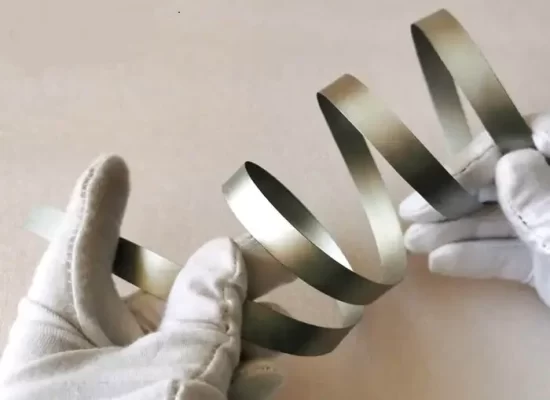
Nitinol strip and foil (ASTM F2063) are flat-rolled nickel-titanium (NiTi) shape memory alloy products with a wide rectangular cross-section — engineered as the starting material for laser-cut and photochemically etched medical device components. Unlike Nitinol wire (round, isotropic bending) or flat wire (narrow rectangular, directional stiffness), strip and foil provide broad, thin sheets optimized for 2D cutting processes — where multiple identical complex geometries (stent frameworks, filter meshes, actuator plates) are cut from a single sheet. Princeton Powder supplies Nitinol strip and foil in two thickness categories: Foil (0.05–0.50mm / 0.002"–0.020") for micro-stents, photochemical etching, and thin-film actuators; and Strip (0.50–2.0mm / 0.020"–0.080") for larger stent frameworks, formed clips, flat springs, and structural components — with widths up to 100mm (4.0") depending on thickness. Five SE and SMA grade families are available, all manufactured to ASTM F2063 with DSC-verified Af temperatures (±5°C per ASTM F2004) and full ISO 13485 medical device traceability.
Nitinol Strip vs Wire vs Flat Wire — Which Form for Your Application?
| Form | Cross-Section | Thickness | Width | W/T Ratio | Primary Use | Typical Manufacturing Process |
|---|---|---|---|---|---|---|
| Strip / Foil (this page) | Wide rectangular | 0.05–2.0mm | 0.5–100mm | 2:1 to 20:1 | Laser-cut stents, etched filters, formed plates, actuator sheets | Laser cutting, photochemical etching, stamping, EDM |
| Straight Wire | Round | N/A (Ø 0.025–7.0mm) | N/A | 1:1 | Guidewire cores, stent strut precursor (wire→tube), springs, actuator wires | Wire drawing, coiling, forming, grinding |
| Flat Wire | Narrow rectangular | 0.05–2.0mm | 0.3–10mm | 1:1 to 10:1 | Orthodontic archwires, stone retrieval baskets, directional springs | Wire drawing + flattening, coiling, forming |
Grade Selection Guide
| Grade | Type | Active Af | At Body Temp (37°C) | Best For |
|---|---|---|---|---|
| TiNi-SS | Medical SE | 33°C ± 3°C | Fully superelastic | Self-expanding stents, implantable device frameworks — the body-temp SE standard |
| Nitinol #1 | Superelastic | +10 to +18°C | Fully superelastic | Flat springs, formed clips, orthodontic components, consumer products |
| Nitinol #2 | Superelastic | 0 to +18°C | Fully superelastic | Room-temperature SE devices, industrial springs, outdoor equipment |
| SM495 | Shape Memory | +20 to +40°C | May activate near body temp | Thermal actuators, deployable structures, body-temp SMA devices |
| SM502 | Shape Memory | +45 to +90°C | Shape memory (stable) | Aerospace deployment, fire safety actuators, industrial thermal controls |
All Nitinol strip and foil is manufactured to ASTM F2063. Every lot is DSC-verified per ASTM F2004 with Af tolerance of ±5°C standard. When ordering, specify: (1) Grade with target Af, (2) Thickness × Width × Length, (3) Surface finish, (4) Quantity (pieces or coil length). Contact our technical team for grade recommendation and quotation.
Material Properties & Performance
| Property | Nitinol Strip / Foil | Significance for Strip Applications |
|---|---|---|
| Alloy | Nickel-Titanium (NiTi) — 54.5–57.0 wt% Ni, balance Ti | ASTM F2063 chemistry — the medical implant standard for all Nitinol forms |
| Density | 6.45 g/cm³ | Lighter than stainless steel (8.0) — weight-optimized implantable device frameworks |
| Melting Point | ~1,310°C | Shape setting at 400-500°C — well below melting; strip can be fixtured and heat-treated without melting risk |
| Elastic Modulus (Austenite) | 75–83 GPa | ~60% lower than 316L SS (193 GPa) — better biomechanical compliance for vascular stents |
| Elastic Modulus (Martensite) | 28–41 GPa | Ultra-low stiffness when deformed — enables easy crimping of laser-cut stents into delivery catheters |
| Superelastic Strain Recovery | 8–10% fully recoverable | Laser-cut stent struts recover from crimped to expanded state without plastic deformation |
| Tensile Strength | Up to 850 MPa (strip) / ~1,241 MPa (cold-worked wire precursor) | Sufficient for structural implant frameworks; final properties depend on cold work + heat treatment |
| Elongation | 25–50% (annealed strip) | High ductility for formability — strip can be stamped, bent, or formed without cracking |
| Fatigue Life | >10⁷ cycles (electropolished) | Critical for cardiovascular stents — 400M+ cycles over 10-year implant life |
| Corrosion Resistance | TiO₂ passive layer — stable in chloride environments at pH 5.2+ | Superior to 316L SS in acidic conditions; reduced nickel ion release with electropolishing |
| Biocompatibility | ISO 10993 compliant — decades of clinical implant use | The foundational requirement for strip used in implantable medical device manufacturing |
| Cold Work (%CW) | Typically >20% final cold work for superelastic sheet | Cold work level + subsequent heat treatment determine final Af and mechanical properties |
Why Strip? The Manufacturing Logic of Nitinol Medical Devices
The vast majority of Nitinol medical devices are not machined from bar stock — they are cut from flat-rolled strip or sheet. The manufacturing workflow is: (1) Vacuum induction melt (VIM) Nitinol ingot → (2) Hot forge + hot roll to slab → (3) Cold roll to target strip/foil thickness with controlled cold work % → (4) Flat anneal to set transformation temperature → (5) Laser cut or photochemically etch component geometry → (6) Shape-set on fixture at ~500°C → (7) Electropolish to remove recast layer and surface micro-cracks → (8) Final inspection + passivation. The strip's thickness uniformity, surface finish, and cold work level at step (4) directly determine the final device's Af temperature, fatigue life, and biocompatibility at step (8). This is why specifying strip from an ISO 13485-certified supplier with DSC-verified Af — not just buying "Nitinol sheet" from a catalog — is the difference between a 510(k)-ready device and a lot rejection. Princeton Powder's controlled cold-rolling process, ASTM F2004 DSC verification per lot, and full material traceability from ingot to finished strip ensure that every sheet meets the demanding consistency requirements of medical device manufacturing.
Thickness, Width, AF Temperature, Surface Finishes & Packaging
Strip & Foil Dimensions
| Category | Thickness Range | Width Range | Thickness Tolerance | Width Tolerance | Typical Application |
|---|---|---|---|---|---|
| Foil (Ultra-Thin) | 0.05–0.10mm (0.002"–0.004") | 0.5–50mm | ±25% (thickness <0.05mm) | ±0.05mm | Neurovascular micro-stents, photochemically etched filters, thin-film micro-actuators |
| Foil (Standard) | 0.10–0.50mm (0.004"–0.020") | 1–100mm | ±10% | ±0.1mm | Coronary/peripheral stents, heart valve frames, embolic filters, laboratory samples |
| Strip (Thin) | 0.50–1.0mm (0.020"–0.040") | 5–100mm | ±10% | ±0.1mm | Formed clips, flat springs, larger stent frameworks, industrial actuator plates |
| Strip (Standard) | 1.0–2.0mm (0.040"–0.080") | 10–100mm | ±10% | ±0.15mm | Structural SMA components, orthopedic implant plates, aerospace deployment hinges |
Common stock sizes (flat pieces): 0.05×30×50mm, 0.127×100×100mm, 0.30×50×100mm, 0.55×80×380mm. Continuous coils available for high-volume production. Custom W×T×L — specify your target dimensions and tolerance class.
AF (Austenite Finish) Temperature
Af determines superelastic vs shape memory behavior at the use temperature. A 0.1 at.% Ni shift changes Af by ~10°C — specify by Af, not just grade name. All lots DSC-verified per ASTM F2004.
| Grade | Type | Active Af Range | At 20-25°C | At 37°C | Strip/Foil Application |
|---|---|---|---|---|---|
| Nitinol #2 | SE | 0 to +10°C | Fully superelastic | Fully superelastic | Room-temperature flat springs, industrial components, consumer products |
| Nitinol #1 | SE | +10 to +18°C | Superelastic | Fully superelastic | Formed clips, orthodontic brackets, surgical instrument components |
| TiNi-SS | Medical SE | 33°C ± 3°C | Partially martensitic | Fully superelastic | Laser-cut self-expanding stents, heart valve frames, vascular implants — the medical device standard |
| SM495 | SMA | +20 to +40°C | Shape memory | May activate | Body-temperature actuators, deployable medical devices |
| SM502 | SMA | +45 to +90°C | Shape memory | Shape memory (stable) | Aerospace deployment panels, fire safety actuators, industrial thermal controls |
Surface Finishes for Strip & Foil
| Finish | Appearance | Process | Best For |
|---|---|---|---|
| Cold-Rolled (As-Rolled) | Smooth, light oxide sheen | Final cold-rolling pass — natural oxide from rolling process | Industrial applications, pre-processing material — lowest cost |
| Pickled / Etched | Matte, oxide-free, uniform | Chemical removal of oxide layer + light base metal removal | Pre-laser-cutting surface prep — clean surface for consistent laser absorption |
| Flat Annealed | Smooth, stress-relieved | Heat treatment in flat condition to set Af + relieve rolling stress | SE strip requiring specific Af — the standard for medical device starting material |
| Bright Annealed | Bright, clean surface | Annealed under protective atmosphere — no surface oxidation | Cosmetic/consumer applications, applications requiring oxide-free starting surface |
| Polished | Mirror-like metallic | Mechanical polishing post-annealing | Surgical instrument components — reduced friction, improved appearance |
Note: Electropolishing is typically applied after laser cutting and shape setting — not to the raw strip. For post-processed electropolished components, Princeton Powder offers electropolishing as a value-added service on finished parts.
Packaging Options
| Format | Description | Best For |
|---|---|---|
| Cut-to-Length Flat Pieces | Individual sheets — W×T×L per order, interleaved with protective paper | R&D, prototype builds, small-batch production, laser-cutting job shops |
| Continuous Coils | Strip wound on spools — custom coil lengths for automated production lines | High-volume stent manufacturing, continuous photochemical etching lines |
All packaging: Vacuum-sealed with desiccant for moisture protection. Each piece/coil labeled with heat number, Af temperature, grade, W×T dimensions, surface finish, and ASTM F2063 compliance statement. Full lot traceability from ingot to finished strip.
Applications
Laser-Cut Self-Expanding Stents & Medical Device Frameworks
The single largest application for Nitinol strip and foil (TiNi-SS, Af 33±3°C, flat annealed, pickled surface) is as the starting material for laser-cut self-expanding cardiovascular, peripheral, and neurovascular stents. The manufacturing sequence: Nitinol foil (typically 0.10-0.50mm thick for coronary stents) is laser-cut into the stent pattern → expanded to the target diameter on a fixture → shape-set at ~500°C for 5+ minutes → water quenched → electropolished to remove the laser recast layer and surface micro-cracks → crimped into a delivery catheter. The foil's thickness uniformity directly determines strut width consistency — a ±10% thickness variation translates to ±10% radial force variation in the deployed stent. Beyond stents, Nitinol strip is laser-cut into heart valve frames, vena cava filters, distal protection device baskets, septal defect occluders, and neurovascular flow diverters. Princeton Powder's controlled cold-rolling process with ±10% thickness tolerance and DSC-verified Af provides the consistent starting material that stent manufacturers depend on for FDA PMA and CE Mark production lots.
Photochemically Etched Filters, Flat Springs & Formed Clips
For components too thin or too intricate for laser cutting, Nitinol foil (0.05-0.15mm thick, Nitinol #1 SE, etched surface) is photochemically etched — a process that uses photoresist masking and chemical milling to produce burr-free, stress-free, ultra-fine geometries at high volumes with zero tooling wear. Embolic protection filters: Etched Nitinol foil with 80-200µm pore sizes captures debris dislodged during carotid stenting or saphenous vein graft intervention. Flat springs & formed clips: Strip (0.3-1.0mm thick, Nitinol #1 SE, flat annealed) is stamped or formed into constant-force flat springs, surgical clips, and orthodontic brackets that deliver consistent force over wide deflection ranges — the superelastic plateau ensures predictable clinical performance cycle after cycle. Princeton Powder supplies Nitinol strip in both cut-to-length sheets (R&D) and continuous coils (production) with etched or flat annealed surface — ready for your photochemical etching or stamping process.
Aerospace Actuators, Robotics & Consumer Products
Beyond medical, Nitinol strip and foil serve applications where the unique combination of shape memory, superelasticity, and a flat form factor enables functionality impossible with conventional materials: Aerospace: SM502 grade (Af +45 to +90°C) strip actuators deploy satellite solar array hinges and thermal louver panels — activated passively by the temperature change between orbital sunlight and shadow, requiring zero electrical power, zero pyrotechnics, and zero moving parts to fail. Robotics: Nitinol foil micro-actuators serve as artificial muscles in soft robotic grippers — electrically heated for contraction, passively cooled for relaxation — achieving lifelike motion without motors or gears. Consumer: Superelastic Nitinol #2 strip (Af 0 to +10°C) is used in flexible eyeglass frame bridges, foldable phone hinge reinforcement plates, and mechanical watch mainsprings that deliver constant torque throughout the unwinding cycle — a 200+ year-old horological problem solved by Nitinol's superelastic plateau. Princeton Powder supplies strip and foil for all applications — from R&D prototype sheets to full production coils — with the same ASTM F2063 quality and lot traceability as our medical-grade product line.
Frequently Asked Questions
Nitinol strip vs flat wire — what's the difference and which do I need?
The distinction is primarily width and application: Nitinol strip is wider (typically >10mm, up to 100mm) with W/T ratios of 2:1 to 20:1 — it is the starting material for laser cutting and photochemical etching where multiple identical parts are produced from a single sheet. Nitinol flat wire is narrower (<10mm, typically 0.3-10mm) with W/T ratios of 1:1 to 10:1 — it is a finished product form used directly in devices (orthodontic archwires, stone retrieval baskets, flat springs). Think of strip as the raw material for cutting processes; flat wire as a finished component form. Princeton Powder supplies both — strip for your laser-cutting production line, flat wire for your finished device assembly.
What thickness tolerance should I specify for laser-cut stent manufacturing?
±10% or better for production. A ±10% thickness variation in the starting strip directly translates to ±10% variation in strut width and radial force in the finished stent — which can be the difference between a stent that apposes the vessel wall adequately and one that either under-expands (migration risk) or over-expands (dissection risk). For neurovascular flow diverters with strut widths <50µm, ±5% thickness tolerance is strongly recommended. Princeton Powder provides dimensional inspection reports with every strip/foil order — specify your tolerance class when requesting quotation.
What Af temperature should I specify for laser-cut stent strip?
TiNi-SS with Af 33°C ± 3°C per ASTM F2063 — the body-temperature superelastic standard for self-expanding implants. At this Af, the strip is partially martensitic (softer, more formable) at room temperature for laser cutting and crimping, and fully austenitic (superelastic) at body temperature for stent deployment and chronic vessel scaffolding. Always specify Af range, not just "TiNi-SS" — a strip with Af of +28°C vs +38°C will behave completely differently at 37°C. Princeton Powder provides DSC verification with every lot so you can confirm Af before cutting.
What surface finish should I order for laser cutting vs photochemical etching?
For laser cutting: Pickled/Etched — the chemically cleaned, oxide-free surface provides consistent laser absorption and minimizes the recast layer that must be removed by post-cut electropolishing. For photochemical etching: Cold-Rolled or Pickled — the photoresist adhesion and etch uniformity depend on a clean, consistent surface; pickled is preferred for critical medical applications. For formed/stamped parts: Flat Annealed — the stress-relieved condition with set Af provides consistent formability and springback. Princeton Powder provides application-specific surface finish recommendations — contact our technical team.
Can you supply strip in continuous coils for automated production?
Yes — continuous coils are our standard production format. For high-volume stent manufacturing or continuous photochemical etching lines, Princeton Powder supplies Nitinol strip wound on spools in custom coil lengths. The same ASTM F2063 chemistry, DSC-verified Af, dimensional tolerances, and full lot traceability as our cut-to-length pieces — in a format optimized for automated material handling. R&D quantities available as individual cut-to-length sheets for process development before scaling to coil production.
What documentation is provided for FDA and CE Mark medical device submissions?
Every medical-grade Nitinol strip and foil order includes: ASTM F2063 chemical composition certificate (GDMS/ICP-OES with impurity limits), ASTM F2004 DSC thermogram (Af/As/Ms/Mf ±5°C verification), dimensional inspection report (W×T×L + tolerance + thickness uniformity across sheet), surface roughness (Ra) report for polished finishes, cold work level (%CW) documentation for the rolling process, ISO 9001:2015 + ISO 13485:2016 certificates, and full lot traceability from VIM ingot to finished strip. Contact our regulatory support team for device-specific documentation requirements, supplier qualification audits, or raw material justification reports for your technical file.
Research & Technical References
The following peer-reviewed research demonstrates Nitinol's performance in medical device applications where strip and foil are the foundational starting materials. Princeton Powder Nitinol strip meets or exceeds ASTM F2063 specifications referenced in these studies.
Nitinol Shape Memory Alloy (NiTi SMA): Materials and Applications in Medical Devices — A Comprehensive Review
SAGE Journals — Proceedings of the Institution of Mechanical Engineers, Part H: Journal of Engineering in Medicine, 2026 — Gholizadeh & Sivarasu provided the most comprehensive current review of Nitinol in medical devices, with detailed coverage of laser-cut stent manufacturing from Nitinol sheet and the critical impact of strip thickness uniformity on final device performance. The review confirmed that ±10% thickness tolerance in the starting strip translates to ±10% radial force variation in laser-cut stents — making incoming strip quality control a regulatory requirement, not just a manufacturing preference. Practical takeaway: Princeton Powder's dimensional inspection report with every strip/foil order provides the documented thickness verification that FDA and notified body auditors expect to see in your device master record — closing the loop from raw material to finished implant.
Mechanical and Corrosion Behaviour of Superelastic Additively Manufactured Nitinol for Biomedical Applications
Procedia CIRP, 2024 — Guarise et al. demonstrated that surface condition — specifically electropolishing to remove surface micro-cracks and the laser recast layer — is the single most critical post-processing step for achieving >10⁷ cycle fatigue life in Nitinol medical devices. While this study focused on LPBF Nitinol, the surface integrity principles apply equally to laser-cut strip-based devices: the recast layer from laser cutting and micro-cracks from cold rolling must be removed before implantation. Practical takeaway: Princeton Powder's pickled/etched strip finish provides a clean, oxide-free, micro-crack-minimized starting surface — optimizing laser-cutting consistency and reducing the post-cut electropolishing burden to achieve fatigue life requirements.
Self-Expanding Nitinol Stents: Material and Design Considerations
European Journal of Vascular and Endovascular Surgery, 2023 — A clinical engineering review of Nitinol stent design parameters, establishing that chronic outward force (COF), radial resistive force (RRF), and Af temperature are the three interdependent material-driven performance characteristics that determine stent clinical outcomes. The review demonstrated that strip cold work level (%CW) during rolling is the primary metallurgical lever controlling all three parameters after shape setting. Practical takeaway: When specifying Nitinol strip for stent manufacturing, three parameters must be controlled at the strip level: (1) Af temperature via DSC verification, (2) thickness tolerance (±10% max), and (3) documented cold work level (%CW). Princeton Powder provides all three with every medical-grade strip shipment — ask for our strip specification datasheet for your target stent design.
Contact our technical team for the full reference list and to discuss Nitinol strip and foil specifications for your specific medical device, aerospace actuator, or industrial application.