
TZM Molybdenum Alloy Bar and Rod ASTM B387
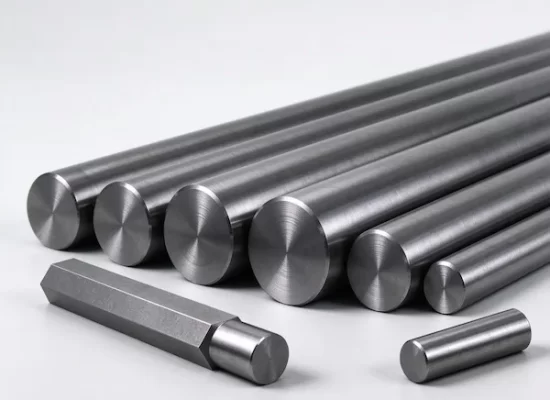
TZM molybdenum alloy bar and rod is a high-temperature refractory product manufactured to ASTM B387 (Type 36x) from powder-metallurgy or arc-cast molybdenum strengthened with titanium, zirconium, and carbon. The nominal composition is Mo-balanced, 0.40–0.55% Ti, 0.06–0.12% Zr, and 0.01–0.04% C — typically written Mo-0.5Ti-0.08Zr-0.03C. The Ti-Zr-C additions form fine carbide precipitates that pin grain boundaries, raising the recrystallization temperature to ~1250–1400°C and making TZM roughly twice as strong as pure molybdenum at 1300°C. Supplied as round bar from 6 mm to 80 mm diameter, plus hexagonal and square bar, in lengths up to 2000 mm, in stress-relieved, annealed, or as-forged condition. Surface finishes include centerless ground, turned/polished, chemically cleaned, or as rolled. TZM bar is the standard refractory stock for rocket nozzle throats and combustion chamber components, jet engine hot-section parts, aluminum die-casting inserts and extrusion dies, isothermal forging billets, vacuum furnace heating elements and supports, X-ray rotating-anode target base bodies, sputtering target backing plates, glass-melting electrodes, and nuclear reactor sheath hardware. All batch ships with a Mill Test Certificate covering chemistry, density, tensile/yield and dimensional inspection. We supply cut-to-length bar, precision-ground rod, and custom-machined parts per drawing. As a direct TZM molybdenum alloy bar and rod manufacturer, we offer the TZM alloy with competitive prices and premium quality.
Technical Specifications
| Property | Value |
|---|---|
| Standard | ASTM B387 (Type 36x); also cross-referenced with ASTM B386 for plate/sheet |
| Density | 10.2 g/cm³ |
| Melting point | 2620°C |
| Recrystallization temperature | ~1250 – 1400°C (vs. ~1000°C for pure Mo) |
| Service temperature range | 1000 – 1700°C (in vacuum or reducing atmosphere) |
| UTS at room temp (annealed) | 700 – 900 MPa |
| UTS at 1300°C | ~250 – 350 MPa (≈2× pure Mo) |
| Yield strength (RT) | 550 – 700 MPa |
| Elongation | 10 – 20% |
| Hardness | HV 220–280 (annealed); HRC ~20–28 (worked) |
| Young’s modulus | ~320 – 330 GPa |
| Coefficient of thermal expansion | ~5.5 × 10⁻⁶ /K (20–1000°C) |
| Thermal conductivity | ~130 – 140 W/(m·K) |
| Stress-relief treatment | 1 h at 1095 – 1260°C |
What Is TZM Molybdenum Alloy? Composition and Standard
TZM stands for Titanium-Zirconium-Molybdenum — the most widely used molybdenum-based high-temperature alloy. It is produced by powder metallurgy (P/M) or vacuum arc-casting, then worked (forged, rolled, swaged) into bar and rod.
Chemical Composition (wt%)
| Element | Ti | Zr | C | O | Mo |
|---|---|---|---|---|---|
| Content | 0.40 – 0.55 | 0.06 – 0.12 | 0.01 – 0.04 | ≤0.03 | Balance |
Bar & Rod Dimensions
| Parameter | Specification |
|---|---|
| Forms | Round bar, hexagonal bar, square bar, rod, billet |
| Round bar diameter | 6 mm – 80 mm (0.24″ – 3.15″); larger billets on request |
| Hex bar | Across-flats 8 – 50 mm |
| Square bar | 8 – 60 mm |
| Length | Up to 2000 mm (80″); cut-to-length |
| Temper / condition | Stress-relieved; annealed; as-forged / as-rolled |
| Surface finish | Centerless ground; turned/polished; chemically cleaned; as-rolled |
| Straightness | ≤ 1.5 mm/m (ground bar) |
| Standard | ASTM B387 |
| Inspection | Chemistry (OES/LECO), density, RT/elevated-temp tensile, hardness, grain size, ultrasonic, dimensional |
Why TZM Instead of Pure Molybdenum?
- Higher recrystallization temperature (~1300°C vs. ~1000°C for pure Mo) — stays strong and non-embritled longer at temperature.
- 2× the strength of pure Mo at 1300°C — critical for rocket nozzles and hot-work dies.
- Better creep resistance at 1000–1400°C.
- Good thermal conductivity — essential for die-casting dies and heat-transfer components.
- Lower thermal expansion than steels — dimensional stability at temperature.
- Good weldability (TIG / electron-beam) for sub-assemblies.
- Oxidation caveat: like all molybdenum alloys, TZM oxidizes rapidly above ~500°C in air — used in vacuum, hydrogen, inert, or reducing atmosphere, or coated (silicide) for prolonged air service.
TZM molybdenum alloy application
- Aerospace & defense: Rocket nozzle throats and inserts, combustion chamber components, jet engine hot-section parts, missile leading edges, gas valve bodies.
- Hot-work tooling: Aluminum die-casting die inserts, extrusion dies, isothermal forging dies, hot-press dies, die-casting shot sleeves.
- Vacuum & high-temperature furnaces: Heating elements, support rails, hearth plates, fixtures for HIP, sintering, and annealing furnaces (up to 1400°C boats).
- Semiconductor & X-ray: Sputtering target backing plates, X-ray rotating-anode target base bodies, ion-implantation hardware.
- Glass industry: Glass-melting electrodes, glass-forming tools, and handlers for high-optical-quality glass.
- Electronics: Electron-tube cathodes and grids, high-voltage rectifiers, thin-film deposition hardware.
- Nuclear: Reactor sheath materials, valves, and in-core components.
Frequently Asked Questions
Q: What does TZM stand for?
A: Titanium-Zirconium-Molybdenum. Nominal composition Mo-0.5Ti-0.08Zr-0.03C (Ti 0.40–0.55%, Zr 0.06–0.12%, C 0.01–0.04%, balance Mo).
Q: What standard does TZM bar meet?
A: ASTM B387 (Standard Specification for Molybdenum and Molybdenum Alloy Bar, Rod, and Wire). Plate/sheet is covered by ASTM B386.
Q: Can TZM be used in air?
A: TZM oxidizes rapidly above ~500°C in air. For prolonged air service above that temperature, it requires a silicide (MoSi2-type) coating. In vacuum, hydrogen, or inert atmosphere, it is used up to ~1700°C.
Q: Is TZM magnetic?
A: No — molybdenum and TZM are non-magnetic.