
Molybdenum Disulfide Sputtering Target ( For CVD and PVD application)
Molybdenum Disulfide (MoS2) sputtering targets are manufactured by Princeton Powder Inc—a trusted supplier of PVD thin-film materials—in 99.9% (3N) to 99.99% (4N) purity grades with high relative density (>95%–98%) and uniform fine-grained microstructure. Produced via precision vacuum hot pressing, these MoS2 targets deliver stable plasma discharge, low arcing, and consistent stoichiometry during RF and pulsed-DC magnetron sputtering. Widely used for aerospace solid-lubricant coatings, 2D TMD semiconductor devices, precision wear-resistant bearings, and optoelectronic thin films, our targets are available in custom planar or rotary dimensions with optional metallic indium bonding, COA, SDS, and fast global delivery.
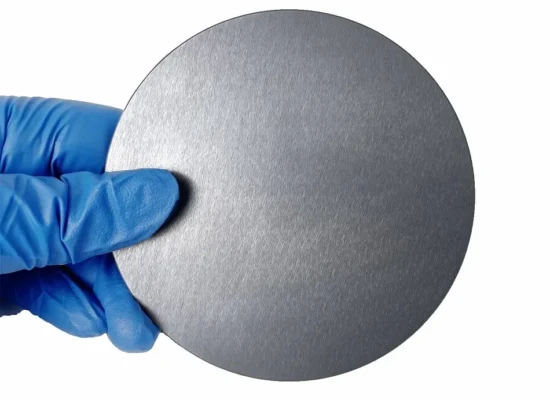
Molybdenum Disulfide (MoS₂) sputtering targets are used to deposit thin films with excellent lubricating, anti-wear, and corrosion-resistant properties for aerospace, electronics, and optical coatings. MoS₂ targets are suitable for both DC and RF sputtering, as well as CVD and PVD deposition processes. Princeton Powder offers high-purity MoS₂ targets with excellent flatness and surface finish, available with or without bonding and optional copper or molybdenum backing plates. Molybdenum Disulfide (MoS₂) sputtering targets are for sale at a good price.
Material | Molybdenum Disulfide Sputtering Target |
CAS Number | 1317-33-5 |
Purity | 99.9% |
Shape | Discs, Plates, Column Targets, Step Targets, Custom-made |
| Density | 5.06g/cm3 |
Melting Point | 2375 ℃ |
Dimensions | Dia.: 2.0″, 3.0″, 4.0″, 5.0″, 6.0″ Customized |
Bonding | With/No Bonding, or customized |
Backing Material | Molybdenum Or Copper |
Description of Molybdenum Disulfide Sputtering Target
Molybdenum Disulfide (MoS₂) sputtering targets are specialized materials used to deposit thin MoS₂ films, valued for their excellent lubricating, anti-wear, and corrosion-resistant properties. Manufactured using high-purity MoS₂ powder through powder metallurgy and hot pressing, these targets achieve a dense, uniform composition ideal for sputtering. In the sputtering process, MoS₂ atoms are ejected and deposited as a coating on a substrate, producing a thin film with low friction and high-temperature stability.
Dimensions of Molybdenum Disulfide Sputtering Target
Circular Sputtering Targets | Diameter | 1.0” 2.0” 3.0” 4.0” 5.0” 6.0” Customized |
Rectangular Sputtering Targets | Width x Length | 5” x 12” 5” x 15” 5” x 20” 5” x 22” 6” x 20” Customized |
Thickness can be customized (With/No Bonding) | 0.125”, 0.25”, Customized | |
Molybdenum Disulfide Sputtering Target Application
Solid Lubricant Coatings: lubrication for rocket engine valves and satellite gyroscopes.
Semiconductor and Electronics: MoS₂ films are used in thin-film transistors (TFTs) and field-effect transistors (FETs)
Optical Coatings: MoS₂ coatings protect lenses by providing high wear resistance and corrosion protection
- High-Temperature Bearing Coatings: In high-temperature industrial settings, like oil drilling or furnace bearings
Molybdenum Disulfide Sputtering Target Scholar Articles
Crystal structure and tribological properties of molybdenum disulfide films prepared by magnetron sputtering technology
Molybdenum disulfide (MoS2) is widely used in practice due to its excellent lubricating properties. However, research on the tribological properties of magnetron sputtering for depositing MoS2 films remains limited. Herein, the tribological properties of MoS2 films were investigated in detail through a series of characterization and friction coefficient tests. MoS2 films were deposited onto silicon substrates by magnetron sputtering under different radio-frequency powers (Prf). With increased Prf, the crystallinity of the films gradually increases, whereas the friction coefficient initially decreases and then increases. Prf also affects the chemical composition, surface morphology, and grain size of MoS2 films. At Prf = 300 W, the film surface is dense and smooth, the grain distribution is uniform. Moreover, the films have superior tribological properties and low friction coefficient, which can be attributed to the weak van der Waals force among MoS2 layers and the microscopic morphology of the films. All these results indicate that by reasonably controlling the preparation parameters, MoS2 films with excellent tribological properties can be prepared by magnetron sputtering.
Frequently Asked Questions About MoS2 Sputtering Targets
1. How are Molybdenum Disulfide (MoS2) sputtering targets manufactured?
Molybdenum Disulfide sputtering targets are manufactured via vacuum hot pressing (VHP) rather than melting, as MoS2 sublimes and decomposes at elevated temperatures under ambient pressure. Vacuum hot pressing consolidates high-purity MoS2 powder under controlled heat and uniaxial pressure to achieve >95%–98% theoretical density with fine, uniform grain structure and low oxygen content.
2. Should I choose RF or DC magnetron sputtering for a MoS2 target?
RF magnetron sputtering is generally recommended because MoS2 is a semiconductor, and RF power prevents surface charge accumulation and micro-arcing. However, pulsed-DC sputtering can also be used effectively for higher deposition rates when the target is indium-bonded to a water-cooled copper backing plate and conditioned with a gradual power ramp.
3. Why is indium bonding recommended for Molybdenum Disulfide sputtering targets?
Hot-pressed MoS2 is a layered ceramic-like material with relatively low fracture toughness and moderate thermal conductivity. Bonding the MoS2 target to an OFHC copper or molybdenum backing plate using high-purity metallic indium ensures uniform cooling, prevents thermal stress cracking, and allows higher sputtering power densities.
4. What purity grades and custom sizes are available for MoS2 sputtering targets?
We offer 99.9% (3N) and 99.99% (4N) purity grades in planar circular discs (1″ to 16″ diameter), rectangular plates, and cylindrical rotary targets. Custom dimensions, stepped edges, and complete target-plus-backing-plate assemblies are fabricated to customer drawings.