
Platinum thermocouples wire
Premium 99.95% pure platinum wire available in diameters from 0.01 mm to 5 mm, perfect for thermocouples, jewelry making, and lab applications. ASTM B561 compliant with cold-drawn or annealed finishes.
Princeton Powder is a leading supplier of high purity Platinum wire in the United States, offering pure Pt spool wire at a competitive price.
| Parameter | Specification |
|---|---|
| Product Family | Platinum / Platinum-Rhodium (Pt-Rh) Thermocouple Wire |
| Types Available | Type S, Type R, Type B, Pure Pt wire |
| Pure Pt CAS | 7440-06-4 |
| Pure Pt Atomic Weight | 195.08 g/mol |
| Pure Pt Density | 21.45 g/cm³ |
| Pure Pt Melting Point | 1,772°C |
| Pure Pt Thermal Conductivity | 72 W/(m·K) |
| Purity | ≥99.99% (standard, 4N); ≥99.999% (special/calibration grade, 5N) |
| Diameter Range | 0.025 mm (0.001″) – 1.0 mm (0.040″); standard 0.5 mm (0.020″) |
| Diameter Tolerance | ±1% (precision); ±2–5% (standard) |
| Wire Form | Round wire (standard); flat wire, square wire available |
| Temper | Annealed (soft, standard for thermocouples); as-drawn (hard) available |
| Surface Finish | Bright, clean, oxide-free |
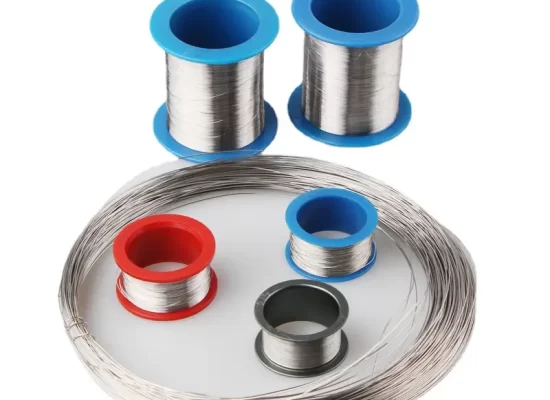
Description of Platinum wire
Platinum Wire (Pt wire) is a premium material widely used in chemical equipment manufacturing, including reactors, heat exchangers, and catalytic systems, due to its exceptional corrosion resistance, thermal stability, and catalytic activity. In the fields of electronics, temperature sensing, and chemical analysis, Pt wire serves as a reliable electrode thanks to its high purity, excellent conductivity, wear resistance, and long service life. With proven performance in extreme environments, platinum wire also plays a critical role in aerospace and automotive industries, where it is used in high-temperature alloys, jet engines, rocket propulsion systems, and high-performance automotive components.
Thermocouple Type Comparison (S vs. R vs. B)
| Feature | Type S | Type R | Type B |
|---|---|---|---|
| Positive (+) Leg | Pt90Rh10 (90% Pt, 10% Rh) | Pt87Rh13 (87% Pt, 13% Rh) | Pt70Rh30 (70% Pt, 30% Rh) |
| Negative (−) Leg | 100% Pt (pure platinum) | 100% Pt (pure platinum) | Pt94Rh6 (94% Pt, 6% Rh) |
| Continuous Temp Range | 0 – 1,480°C | 0 – 1,480°C | 600 – 1,700°C |
| Short-Term Max | 1,600°C | 1,650°C | 1,820°C |
| NIST Full Range | −50 to 1,768°C | −50 to 1,768°C | 0 to 1,820°C |
| Sensitivity (approx.) | ~10 μV/°C at 1,000°C | ~11 μV/°C at 1,000°C (slightly higher than S) | ~5 μV/°C at 1,000°C (lower) |
| Room Temp Output | ~0 μV (needs compensation) | ~0 μV (needs compensation) | ~0 μV (no compensation wire needed) |
| Class 1 Accuracy | ±1°C (0–1,100°C); ±(1+0.003(t−1100))°C (1,100–1,600°C) | Same as Type S | ±0.25% (600–1,700°C) |
| Class 2 Accuracy | ±1.5°C (0–600°C); ±0.25% (600–1,600°C) | Same as Type S | ±0.5% (600–1,700°C) |
| High-Temp Stability | Good | Good (slightly better than S due to higher Rh) | Best (both legs contain Rh, minimal grain growth/contamination) |
| Rh Contamination Risk | Negative leg (pure Pt) can absorb Rh vapor at very high temps | Same as S | Both legs contain Rh — no cross-contamination |
| Cost | Lower (less Rh) | Medium | Higher (more Rh, especially 30% Rh leg) |
| Best For | General high-temperature measurement, glass industry, heat treatment | Higher-sensitivity precision measurement, steel/superalloy, aerospace | Ultra-high temperature (>1,500°C), steelmaking, no compensation wire needed |
Platinum wire Specifications
| Color | White |
| Appearance | Silvery white wire |
| Density | 21.45g/cm3 at 20°C |
| Assay Percent Range | 99.9% (Metals basis) |
| Quantity | 25 cm |
| Odor | Odorless |
| Form | Wire |
| Chemical Name or Material | Platinum |
Application
Platinum Wire (Pt wire) is widely used as an electrode material in electrochemical analysis, temperature sensors (like thermocouples), and laboratory instrumentation due to its excellent conductivity and chemical stability. In the chemical industry, it serves in catalysts, reactors, and high-temperature processing equipment. Platinum wire also plays a critical role in aerospace and automotive applications, including jet engine components, rocket propulsion, and high-performance electrical contacts.
Q: What is the difference between Type S, R, and B thermocouples?
A:
- Type S (Pt10Rh vs. Pt): Positive leg = 90%Pt/10%Rh, negative leg = pure Pt. Range 0–1,480°C continuous (1,600°C short-term). The most common Pt-Rh type, widely used in glass and heat treatment.
- Type R (Pt13Rh vs. Pt): Positive leg = 87%Pt/13%Rh, negative leg = pure Pt. Same range as Type S but slightly higher sensitivity and better high-temperature stability. Used in steel, superalloy, and aerospace.
- Type B (Pt30Rh vs. Pt6Rh): Positive leg = 70%Pt/30%Rh, negative leg = 94%Pt/6%Rh. Range 600–1,700°C continuous (1,820°C short-term). Both legs contain Rh — best high-temperature stability, no compensation wire needed (near-zero output at room temp). Used for ultra-high temperature steelmaking. For general use up to 1,480°C, Type S is the standard and most cost-effective. For above 1,500°C, Type B is required.
Q: What diameter wire should I choose?
A: Diameter depends on temperature, environment, and required lifetime:
- 0.025–0.13 mm (0.001–0.005″): Ultra-fine, for laboratory, small sensors, fast response, low thermal mass — limited max temp and short life
- 0.20–0.38 mm (0.008–0.015″): Fine, for general laboratory and light industrial use — good balance of response and durability
- 0.50 mm (0.020″): Standard industrial diameter — most common, good durability and lifetime up to 1,480°C
- 0.64–1.0 mm (0.025–0.040″): Heavy-duty, for harsh environments, long-life industrial use, higher contamination resistance Thicker wire = longer life, slower response, higher cost. For most industrial furnace applications, 0.5 mm (0.020″) is standard.
Q: How long do Pt-Rh thermocouples last?
A: Service life depends on temperature, atmosphere, wire diameter, and contamination:
- At 1,000°C, clean atmosphere, 0.5mm wire: 6–12 months continuous use
- At 1,200°C: 3–6 months
- At 1,400°C+: 1–3 months (or shorter in contaminated atmospheres)
- Laboratory intermittent use: 2–5 years Factors that shorten life: contamination (base metals, carbon, silicon, sulfur), thermal cycling, mechanical vibration, high gas velocity, and exceeding temperature ratings. Regular calibration and visual inspection are recommended. Drift of >1–2°C indicates the thermocouple should be replaced or recalibrated.
Q: Can I use Pt-Rh thermocouples in vacuum or reducing atmospheres?
A:
- Vacuum: Yes — Pt-Rh thermocouples are stable in vacuum and are commonly used in vacuum furnaces. However, at very high temperatures (>1,500°C) in high vacuum, platinum may exhibit some evaporation.
- Inert (argon, nitrogen): Yes — stable.
- Hydrogen / reducing: Generally yes, but avoid carbon-containing reducing atmospheres (carburizing, endothermic gas with high carbon potential) — carbon can diffuse into platinum, causing embrittlement and “platinum disease” (intergranular cracking). Use a protection tube if carbon is present.
- Oxygen / air: Yes — stable in oxidizing atmospheres; in fact, annealing in air is used to clean and stabilize Pt-Rh wire.
- Sulfur-containing atmospheres: Avoid — sulfur can contaminate platinum at high temperatures.
- Molten metals / glasses: Avoid direct contact with base metal melts (Fe, Cu, Ni) — alloying causes permanent damage. Use protection tubes.
Platinum wire scholar article
Platinum Wire-Embedded Culturing Device for Interior Signal Recording from Lollipop-Shaped Neural Spheroids
Abstract: In this paper, we present a novel 3D cell culturing and noninvasive characterization technique of neural spheroids. Based on embedded platinum wires, the cultured cells are lollipop-shaped spheroids where axons are extended and integrated around the embedded wires. Electrical microstimulation enhanced the connectivity between spheroids and demonstrated signal propagation among them.