
Niobium Tubing and Piping (Seamless and Welded Tube ASTM B394)
Source premium Niobium tubing and piping engineered for extreme thermal, cryogenic, and corrosive environments. Manufactured to strict ASTM B394 standards, our seamless and welded Niobium tubes are available in high-purity Reactor Grade (UNS R04200, 99.95% min), Commercial Grade (UNS R04210, 99.9% min), and Nb-1Zr alloy. With custom outside diameters (0.5 mm to 150 mm), precision wall thicknesses, and annealed or stress-relieved tempers, our refractory metal piping delivers superior ductility, superconducting performance, and acid resistance—ideal for particle accelerators (SRF cavities), chemical heat exchangers, aerospace propulsion, and medical imaging systems.
Princeton Powder is a leading manufacturer of high purity Niobium Tube and Pipe, offering pure Seamless Niobium Tubes, Welded Niobium Tubes, niobium-titanium (Nb-Ti) or niobium-zirconium (Nb-Zr) Tubes that meet ASTM B392 standards. Niobium tube are manufactured via extrusion, cold drawing, or welding. It is for sale at a competitive price.
Material | Niobium Tube, Nb |
CAS Number | 7440-03-1 |
Standard | ASTM B392 |
Color/Appearance | Gray, Metallic |
| Density | 8.57 g/cm3 |
Melting Point | 2468 ℃ |
Diameter | Customized |
Surface Treatment | Pickling or Polishing |
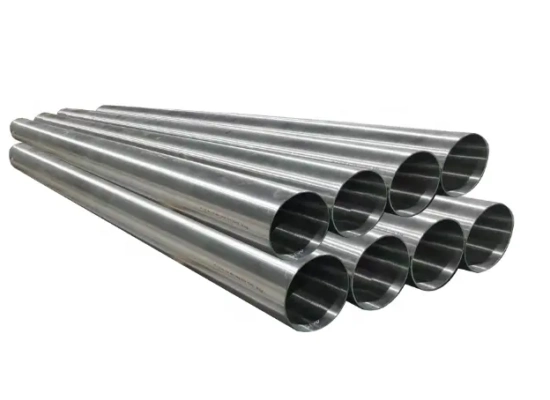
Description of Niobium Tube and Pipe (Extrusion, Cold Drawing, and Welding Method)
Niobium, with the atomic symbol Nb and atomic number 41, is a ductile, silvery metal often alloyed to improve durability and resistance in various applications. Niobium tubing and piping are known for their excellent chemical resistance, high melting point, superconducting properties, and biocompatibility.
Chemical Compositions of Niobium Tube
Material | Main elements(%) | Impurities (Maximum %) | ||||||||||
Nb | Fe | Si | Ni | W | Mo | Ti | Ta | O | C | H | N | |
RO4200 | Remainder | 0.004 | 0.004 | 0.002 | 0.005 | 0.005 | 0.002 | 0.07 | 0.015 | 0.0040 | 0.0015 | 0.003 |
RO4210 | Remainder | 0.01 | 0.01 | 0.005 | 0.02 | 0.01 | 0.004 | 0.10 | 0.02 | 0.01 | 0.0015 | 0.01 |
Technical Specifications of Niobium Tube
| Parameter | Value |
|---|---|
| Product | Seamless and Welded Niobium Tube / Pipe to ASTM B394-18 — unalloyed Nb and Nb-1Zr |
| CAS / Material | Nb, CAS 7440-03-1, atomic number 41, BCC refractory metal |
| Correct Standard | ASTM B394-18 (seamless and welded tubes). B391 ingot / B392 bar, rod, wire / B393 strip, sheet, plate are adjacent, not applicable |
| Grades | R04200 Type 1 (reactor-grade unalloyed Nb) · R04210 Type 2 (commercial-grade unalloyed Nb) · R04251 Type 3 / R04261 Type 4 (Nb-1Zr, Zr 0.8–1.2 wt%) |
| Forms | Seamless tube, welded tube, capillary tube, coil / U / square shapes, cut-to-length |
| Dimensions (industry envelope, not our stock) | OD 1–150 mm · WT 0.1–5.0 mm · L 10–8000 mm; capillary OD 0.2–6 mm / WT 0.015–0.5 mm |
| Condition / Finish | Annealed (or hard / semi-hard by agreement); pickled or polished; vacuum-bright anneal available |
| Density | 8.57 g/cm³ (pure Nb, 20 °C) |
| Melting Point | 2477 °C / 2750 K (modern); 2468 °C in older references |
| Thermal / Mechanical Constants | k 53.7 W/m·K (300 K) · CTE 7.3 ×10⁻⁶/K · E 105 GPa · Poisson 0.40 · resistivity 152 nΩ·m at 0 °C |
| Superconducting | Tc ≈9.2 K (highest of any element); SRF performance depends on interstitial purity and RRR |
| Mechanical Minima (annealed) | R04200 125 / 73 MPa / 25% · R04210 seamless 125 / 73 MPa / 25% · R04210 welded 125 / 59 MPa / 25% · Types 3/4 195 / 125 MPa / 20% |
| Typical Annealed (context only) | UTS 200–275 MPa · YS 105–170 MPa · El 30–40% · ~80 HV — typical, not a minimum |
| Corrosion | Resists HCl / HNO₃ / H₂SO₄ / H₃PO₄ and many organic acids at RT via Nb₂O₅; not resistant to HF, hot concentrated alkalis or fluoride media |
| Service Limitation | Soft lining/cladding material, not structural; oxidises and absorbs O/N/H at elevated temperature — hot work, welding and high-temp service need vacuum or inert gas |
| Testing | Chemistry, tensile, hydrostatic/pneumatic, UT, eddy current, flaring, flattening, microstructure, dimensional report |
| Key Applications | Chemical-processing heat exchanger and thermowell tubing, SRF / cryogenic and vacuum systems, nuclear and aerospace / high-temperature furnace components |
| Related Products | Tantalum tube, titanium tube, zirconium tube, molybdenum tube, tungsten tube, niobium rod/bar, niobium crucible, niobium sheet/plate, pure Nb powder |
Application
- Nuclear Reactors – Fuel cladding in reactors due to radiation resistance.
- Superconductors – SRF cavities in particle accelerators.
- Aerospace – Heat exchangers in rocket engines.
- Chemical Processing – Corrosion-resistant tubing in acid systems.
- Medical Devices – Stents and pacemaker casings due to biocompatibility.
- Electronics – Capacitors and energy storage components
How to select Niobium Tubing and Piping
Niobium tubing is selected for applications in scientific, medical, and industrial fields. Below are the key factors that you should consider when you choose a suitable Niobium Tube/Pipe
Diameter and Wall Thickness
- Specified based on application requirements, such as high-pressure or high-vacuum environments
Purity and Alloying
- Purity (99.9%+ for high-performance applications) or specific alloying elements for enhanced properties, like superconductivity or corrosion resistance
Surface Finish
- Smooth finishes are preferred in medical and superconducting applications to minimize resistance and interaction with other materials
Cost and Availability
- Seamless tubes are generally more costly but preferred for critical applications, while welded tubes may be suitable for standard or budget-constrained uses
Research Reference
ASTM International (2018). “B394-18 Standard Specification for Niobium and Niobium Alloy Seamless and Welded Tubes.” ASTM International, West Conshohocken, PA. Listed alongside B391-18 (ingots), B392-18 (bar, rod and wire), B393-18 (strip, sheet and plate) and B521-25 (tantalum and tantalum alloy seamless and welded tubes) in ASTM’s nonferrous metals standards listing.
Padamsee, H.S. (2014). “Superconducting Radio-Frequency Cavities.” Annual Review of Nuclear and Particle Science, 64, 175–196. DOI 10.1146/annurev-nucl-102313-025612.
El-Genk, M.S. & Tournier, J.-M. (2005). “A review of refractory metal alloys and mechanically alloyed-oxide dispersion strengthened steels for space nuclear power systems.” Journal of Nuclear Materials, 340(1), 93–112. DOI 10.1016/j.jnucmat.2004.10.118.
Niobium Tubing and Piping (ASTM B394) FAQ
Q1: What are the key characteristics of Niobium (Nb) tubing and piping?
Answer: Niobium is a refractory metal prized for its unique combination of properties, making it a superior choice for demanding industrial environments. Key characteristics include:
Exceptional Corrosion Resistance: Highly resistant to many acids (including hydrofluoric acid) and oxidation at high temperatures.
High Ductility & Weldability: Offers excellent formability and is easily welded, which is crucial for complex piping systems.
High Melting Point: Maintains structural integrity in extreme heat.
Low Density: Provides a high strength-to-weight ratio, making it ideal for aerospace applications.
Q2: What does the ASTM B394 standard specify for Niobium tubing?
Answer: ASTM B394 is the primary industry standard for Niobium tubing. It covers the specifications for both seamless and welded Niobium tubes. The standard ensures:
Chemical Composition: Strict limits on impurities to maintain material purity.
Mechanical Properties: Defined standards for tensile strength, yield strength, and elongation.
Dimensional Tolerances: Precise requirements for outer diameter (OD), wall thickness, and straightness.
Testing Requirements: Standardized protocols for hydrostatic testing and non-destructive examination (NDE).
Q3: When should I choose Seamless vs. Welded Niobium tubes?
Answer: The choice depends on your specific pressure requirements and budget:
Seamless Niobium Tubes: These are manufactured without any longitudinal weld. They are the gold standard for high-pressure systems, critical aerospace components, and applications where maximum structural integrity and uniform wall thickness are non-negotiable.
Welded Niobium Tubes: These are joined by welding. They are a cost-effective solution for applications with lower pressure demands, such as general chemical processing or heat exchanger components where a longitudinal seam is permissible.
Q4: In which industries is Niobium piping most commonly utilized?
Answer: Because of its unique resistance to harsh environments, Niobium tubing is widely used in:
Chemical Processing: Handling aggressive acids and corrosive chemicals at high temperatures.
Aerospace & Defense: Used in rocket engines, heat shields, and high-temperature structural components.
Nuclear Power: Employed in systems requiring high-temperature stability and radiation resistance.
Medical & Research: Used in specialized vacuum systems and high-purity gas delivery.
Q5: Can you manufacture Niobium tubes with custom specifications?
Answer: Yes. We specialize in custom fabrication of Niobium tubing and piping. We can manufacture parts to your exact requirements, including:
Custom Dimensions: Specific OD, wall thickness, and lengths.
Specialized Finishes: Various surface treatments based on your application needs.
Project-Specific Engineering: We can work directly from your technical drawings to ensure the final product meets your exact project tolerances.