
Tungsten Tube and Pipe
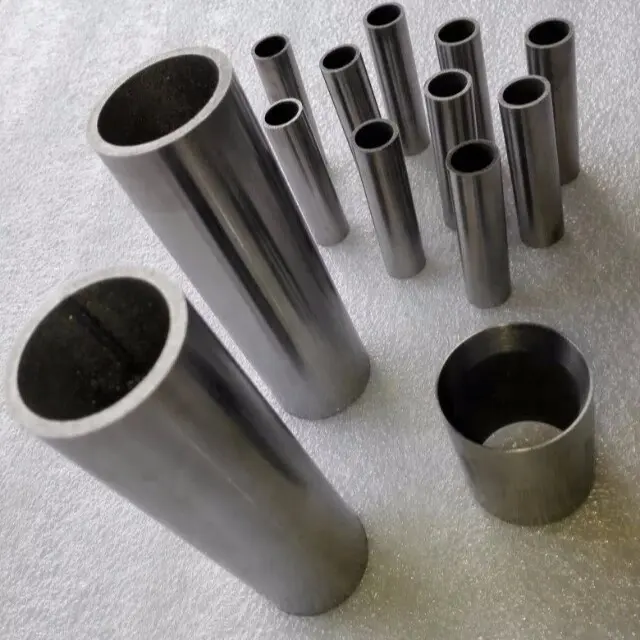
Tungsten Tube and Pipe are refractory components, available in pure tungsten and W alloys with 99.5%–99.95% purity, density 19.3 g/cm³ and melting point 3,422°C, our seamless tubes meet ASTM B760 and come in sintered or drilled types, custom outer diameters, wall thicknesses and lengths, with pickled or polished surfaces. Widely used for thermocouple protection tubes, sapphire crystal growth furnaces, high-temperature sintering furnaces, radiation shielding, aerospace, medical imaging and semiconductor parts, they deliver excellent heat resistance, strength and dimensional accuracy. Factory-direct supply, custom sizes and full COA documentation support.
Princeton Powder is a top supplier of high-purity tungsten tubes in the United States, offering pure tungsten tubes that meet ASTM B760 standards. We manufacture sintered (OD 80 mm and above), drilled-from-rod (below 80 mm), forged and welded types in pure W (99.95%), W-La, W-Re and W-Ni-Fe heavy alloys, with OD 6–500 mm, wall 1–30 mm and length to 1500 mm per ASTM B760.
Material | Tungsten Tube and Pipe |
CAS Number | 7440-33-7 |
Standard | ASTM B760, ASTM B521 |
Purity | 99.5% – 99.95% |
| Density | 19.3 g/cm3 |
Melting Point | 3.422 ℃ |
Dimensions | Customized |
Surface Treatment | Pickling or Polishing |
Description of Tungsten Tube and Pipe
Tungsten tubes are high-performance components made from pure tungsten or tungsten alloys, known for their exceptional strength, high melting point (3,422°C), and resistance to heat and wear. These tubes are produced using extrusion, drawing, or welding techniques to ensure precision and meet strict dimensional tolerances. They are commonly used in aerospace, medical devices, nuclear reactors, and high-temperature manufacturing due to their durability and radiation shielding properties. Tungsten tubes provide superior mechanical properties, including corrosion resistance and low thermal expansion, making them suitable for extreme conditions. Manufactured to international standards like ASTM B760, they offer reliable performance in demanding applications.
Application
- Aerospace and Defense: Tungsten tubes are used in rocket nozzles, jet engines, and shielding for their strength, heat resistance, and radiation absorption.
- Medical: Tungsten pipes protect against X-rays and gamma rays in medical imaging and devices.
- Nuclear: Used as structural components in reactors for their radiation resistance and high-temperature stability.
- Manufacturing and Machining: Tungsten tubes are key in tools and equipment requiring high wear and heat resistance.
- Energy and Electronics: Used in thermionic emitters and electrical contacts for their excellent conductivity and stability under high currents.
How to select Tungsten Tube and Pipe
Tungsten tubes and pipes present extreme heat resistance, mechanical strength, and durability. They are essential in advanced industries like aerospace, nuclear energy, and medical technology. Below are the key parameters to select a correct W tubes and pipes.
Diameter and Wall Thickness
- The diameter and wall thickness of tungsten tubes should be selected based on the specific application, particularly considering pressure resistance, thermal conductivity, and mechanical stress
Purity
- High-purity tungsten (99.9% or higher) is preferred for critical applications such as aerospace, nuclear, and medical fields, where material performance is paramount
Alloy Composition
- Tungsten alloys are chosen when improved machinability, ductility, or enhanced properties are required, such as in certain aerospace or manufacturing applications
Surface Finish
- A smooth surface is crucial in applications such as medical radiation shielding or aerospace components, where surface quality can impact performance
Temperature Resistance
- Depending on the application, the temperature resistance and strength of the tungsten tube or pipe may be an important factor, especially in high-heat or high-stress environments
Tungsten (W) and Alloy Tubes and Pipe FAQ
Q1: What types of Tungsten alloys do you use for tube and pipe manufacturing?
Answer: We manufacture high-quality tungsten components using several premium alloys tailored for specific industrial needs, including:
Pure Tungsten (W 99.95%): For ultra-high purity requirements.
W-La (Tungsten-Lanthanum): For enhanced ductility and workability.
W-Re (Tungsten-Rhenium): For high-temperature structural applications.
W-Ni-Fe (Tungsten-Nickel-Iron): Our most common heavy alloy for high density and wear resistance.
Q2: What manufacturing processes do you offer for Tungsten tubes?
Answer: We employ three primary manufacturing techniques depending on the required dimensions and properties:
Sintering: Best for larger components (OD 80 mm and above).
Drilling-from-rod: Ideal for precision-machined smaller parts (below 80 mm).
Forging & Welding: Used for heavy-duty applications requiring superior structural integrity and high-strength welds.
Q3: What are the typical dimensions for your custom Tungsten alloy pipes?
Answer: We offer highly flexible manufacturing capabilities. Our standard production range includes:
Outer Diameter (OD): 6 mm to 500 mm.
Wall Thickness: 1 mm to 30 mm.
Maximum Length: Up to 1500 mm.
Note: We can also manufacture custom sizes based on your technical drawings.
Q4: Do your Tungsten alloy products comply with international standards?
Answer: Yes, all our Tungsten heavy alloy tubes and pipes are manufactured in strict accordance with ASTM B760 standards. This ensures consistent density, mechanical properties, and structural reliability for demanding industrial environments.
Q5: What are the primary applications of Tungsten alloy tubes and pipes?
Answer: Due to their exceptional high density, heat resistance, and wear resistance, our Tungsten alloy tubes are widely used in:
Mining & Oil Drilling: For heavy-duty wear parts and drill strings.
Aerospace & Defense: For heat shields and high-temperature structural components.
Nuclear Industry: For radiation shielding and high-density components.
Chemical Processing: For components requiring extreme durability in corrosive environments.
Q6: Can you provide custom fabrication based on my engineering drawings?
Answer: Absolutely. We specialize in custom fabrication. Simply provide us with your CAD drawings or technical specifications, and our engineering team will review them to provide a precise quote, material selection advice, and production timeline.