
Spherical CoCrMo Powder for LPBF, EBM, and Thermal spray
Spherical Cobalt-Chromium-Molybdenum (CoCrMo) powder is a medical-grade alloy powder engineered for laser powder bed fusion (LPBF) and electron beam melting (EBM) additive manufacturing. Meeting ASTM F75 and F1537 standards, our gas-atomized CoCrMo powder offers excellent sphericity, high flowability and low oxygen content, making it ideal for dental crowns, bridges, orthopedic implants and surgical instruments. Available in standard particle size distributions (15–45 μm, 53–150 μm), with customizable PSD upon request. Trusted by medical device manufacturers and 3D printing service providers worldwide. Contact us for bulk pricing and sample orders.
| Parameter | Value |
|---|---|
| Product | CoCrMo Cobalt-Based Metal Powder — Spherical Co-Cr-Mo Alloy Powder for AM, Cladding & Thermal Spray |
| Alloy System | Co-Cr-Mo (cobalt-based, ASTM F75 / F1537 chemistry) | Co balance |
| CAS Reference | Components: Co 7440-48-4 | Cr 7440-47-3 | Mo 7439-98-7 |
| Nominal Composition | Cr 26–30% | Mo 5–7% | Mn ≤1.0% | Si ≤1.0% | Fe ≤0.75% | Ni ≤0.5% | W ≤0.2% | N ≤0.25% | C 0.10–0.35% |
| Density | 8.3–8.4 g/cm³ |
| Melting Point | 1,427 °C (2,601 °F) nominal |
| Tensile Strength | 780–1,280 MPa (as-built / heat-treated, grade dependent) |
| Yield Strength | 480–840 MPa |
| Elastic Modulus | ~190–240 GPa (dense material) |
| Hardness | 30–45 HRC (grade and heat treatment dependent) |
| Morphology | Spherical, gas atomized (VIGA — vacuum induction melting + inert gas atomization) |
| Particle Size Grades | 0–15 µm (MIM) | 15–53 µm (LPBF/SLM) | 45–105 µm (EBM/DED) | 45–150 µm (laser cladding) | 45–106 µm (HVOF/plasma spray) |
| Interstitial Control | O ≤500 ppm | N ≤100 ppm (low-oxygen grades available on request) |
| Standards | ASTM F75 (cast) | ASTM F1537 (wrought) | ASTM F3213 (AM) | ISO 5832-4 | ISO 5832-12 | UNS R30075 / R31537 / R31538 |
| Manufacturing Process | VIM → Inert Gas Atomization → Sieving/Classification → Inspection → Packaging |
| Key Applications | Orthopedic & dental implants, aerospace turbine wear parts, laser cladding, HVOF/plasma spray, wear-resistant tooling |
| Related Products | Spherical CoCr alloy powder, stainless steel 316L, nickel-based alloy powders |
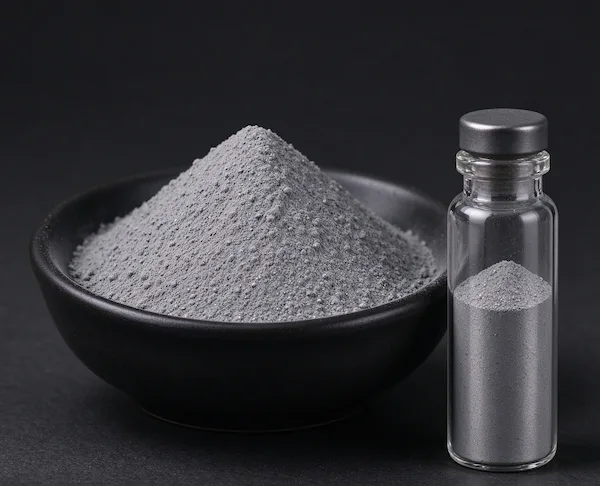
Description of Spherical CoCrMo Powder
CoCrMo (cobalt-chromium-molybdenum) metal powder is a spherical, gas-atomized alloy powder built on the Co-28Cr-6Mo chemistry defined by ASTM F75 — the benchmark cobalt-based alloy for wear resistance and biocompatibility. Princeton Powder supplies CoCrMo powder in five classified particle-size grades from 0–15 µm to 45–150 µm, produced by vacuum induction melting followed by inert gas atomization (VIGA) to deliver spherical particles, high tap density, excellent flowability, and low oxygen content. Nominal composition: Cr 26–30%, Mo 5–7%, with controlled Mn, Si, Fe, Ni, W and C. Density 8.3–8.4 g/cm³; melting point 1,427 °C. Produced typically through gas atomization, the powder has spherical particles that offer excellent flowability, making it ideal for additive manufacturing and powder metallurgy.
Cobalt-based alloy powder occupies a unique position among engineering metals: it combines superior wear resistance, high-temperature strength, and corrosion resistance in a single material — properties that neither stainless steel nor titanium can match simultaneously. In laser powder bed fusion (LPBF/SLM), CoCrMo produces dense, fine-grained dental frameworks, partial dentures, and orthopedic implant components with mechanical properties that meet or exceed cast ASTM F75. In electron beam melting (EBM) and directed energy deposition (DED), the coarser 45–105 µm grades support high-throughput build rates for larger components. Beyond additive manufacturing, CoCrMo powder is the workhorse consumable for laser cladding and HVOF/plasma thermal spray, where it restores and hardens valve seats, pump components, extrusion screws, and turbine wear surfaces. Princeton Powder’s low-oxygen (O ≤500 ppm, N ≤100 ppm) spherical powder and US-based inventory support both production-scale AM operations and single-batch qualification trials.
Princeton Powder is a leading supplier of Spherical CoCrMo powder. We specialize in a comprehensive range of spherical powder products and possess extensive expertise in additive manufacturing (3D printing) industry. Spherical CoCrMo powder is for sale at a competitive price.
Chemical Composition
Chemical Composition (wt%) | ||||||||||
Item | Fe | Co | Mn | Si | Ni | Cr | Mo | W | Be | Cd |
CoCrMo | – | Bal. | – | – | ≤0.02 | 26.1~30.1 | 4.3~6.3 | 4.0~6.0 | ≤0.02 | ≤0.02 |
Oxygen≤500 ppm; Nitrogen≤100 ppm
Particle Size distribution
0-15μm, 15-53μm, 45-105μm, 45-150μm. (Various particle sizes can be customized)
CoCrMo Cobalt-Based Metal Powder Applications
Medical & Dental — Orthopedic Implants, Dental Frameworks & Surgical Instruments
CoCrMo is the <strong>long-established benchmark alloy for load-bearing orthopedic and dental devices, and additive manufacturing has extended its capabilities rather than replaced it. In laser powder bed fusion, 15–53 µm CoCrMo powder produces dental crowns, bridges, partial denture frameworks, and implant components with fine feature resolution and mechanical properties that meet or exceed cast ASTM F75 — while eliminating the shrinkage porosity that plagues investment casting. Peer-reviewed comparison of cast versus LPBF CoCrMo for dental applications (Journal of the Mechanical Behavior of Biomedical Materials, 2024) reported that the additively manufactured alloy exhibited refined grain structure, superior tensile strength and ductility, and improved corrosion resistance relative to the cast counterpart.
In orthopedics, CoCrMo powder supports hip and knee implant componen — femoral heads, acetabular liners, and tibial trays — where the alloy’s combination of hardness, wear resistance, and corrosion resistance in physiological fluid is decisive. AM also enables porous and lattice structures that reduce stiffness toward that of bone: dense CoCrMo has an elastic modulus of roughly 190–240 GPa versus 10–30 GPa for cortical bone, and a fully dense implant can cause stress shielding that leads to bone resorption around the device. Lattice architectures built from CoCrMo powder address this directly. Beyond implants, the alloy is used for surgical instruments, orthopedic reamers and rasps, and dental prosthetics where edge retention and corrosion resistance matter. For implantable applications, specify powder produced under a documented quality system with full lot traceability and interstitial control — Princeton Powder supplies CoCrMo with ICP-OES chemistry and oxygen/nitrogen analysis on every CoA.
Aerospace & Gas Turbine — High-Temperature Wear and Galling Resistance
In aerospace and industrial gas turbines, CoCrMo earns its place where wear resistance and hot hardness matter more than weight. The alloy retains useful strength and oxidation resistance to roughly 900 °C in air, and its strain-induced γ→ε phase transformation provides a self-hardening response under sliding contact that resists galling and adhesive wear — a failure mode that destroys softer alloys in high-load, low-lubrication interfaces. Typical applications include turbine blade damper and shroud wear surfaces, combustor and transition-duct hardware, fuel nozzle components, and bushing and seal interfaces
Additive manufacturing has changed how these parts are produced. Rather than machining a wear pad from wrought bar and attaching it, engineers now deposit CoCrMo directly onto the base component by DED or laser cladding, or print the wear feature as part of the component itself with 45–105 µm powder. This reduces part count, eliminates joining operations, and allows the wear-resistant alloy to be placed exactly where it is needed. For HVOF and plasma spray, 45–106 µm CoCrMo produces dense, well-bonded coatings that restore dimensional tolerance on worn shafts and protect against combined wear and corrosion. Because turbine hardware qualification demands documented feedstock, Princeton Powder supplies CoCrMo with lot-specific chemistry, particle size distribution, and interstitial data — and can hold material for customer witness testing.
Laser Cladding, Thermal Spray & Wear-Resistant Tooling — Repair and Hardfacing
CoCrMo is one of the most widely used hardfacing and repair alloys in industrial maintenance, and powder-based deposition has largely displaced welding for precision work. Laser cladding with 45–150 µm CoCrMo deposits a metallurgically bonded overlay with minimal dilution (typically 2–5%) and a fine, rapidly solidified microstructure — producing a wear-resistant surface that can be finished to tolerance rather than requiring post-weld machining of a distorted part. Typical substrates and components include valve seats and gates, pump sleeves and impellers, extrusion screws and barrels, forging dies, and mining and drilling tool components.
For HVOF and plasma spray<, 45–106 µm CoCrMo produces coatings with high density, low porosity, and strong adhesion, used to restore worn shaft journals, protect hydraulic rods, and provide combined wear and corrosion resistance on marine and chemical-processing equipment. The key powder attributes for these processes are tight particle size distribution (consistent melt behavior in the laser or spray plume) and low oxygen content (reduces porosity and oxide inclusions in the deposit). Coarse, tightly cut fractions flow reliably through powder feeders without surging. For tooling and wear-part manufacturers, CoCrMo overlays offer a practical alternative to replacing an entire component — extending service life and reducing downtime for high-value parts. Princeton Powder supplies cladding and spray grades with lot-specific size distribution and flow data to support process qualification.
Spherical CoCrMo Powder reference
Study on Biocompatibility of CoCrMo Alloy Parts Manufactured by Selective Laser Melting
- The biocompatibility of implant is generally believed to be an important factor affecting the operation success and service life of implant, the biocompatibility study of CoCrMo alloy fabricated by selective laser melting (SLM) method thus becomes the key for the successful application of personalized implant. We determined both the blood compatibility and the release rate of ions of SLM-manufactured and cast CoCrMo alloy implants following submersion in various corrosive solutions. The surface structure and morphology of the samples before and after the experiment were investigated to ascertain the mechanisms of ion release and blood compatibility. The results indicated that the concentrations of Co and Cr ions of the SLM-manufactured parts after incubation in the different corrosive liquids were less than that of the cast parts, in which increased roughness presented greater potential for Co ion release compared to surfaces with low roughness.
Cobalt-chromium alloy CoCrMo. Biocompatible metallic printing material made of cobalt-chromium-molybdenum alloy. Finished products made of this material have a very high specific strength, wear resistance and corrosion resistance. Supplied in powder form with a nominal particle size of 15 to 45 microns.