
90W-NiCu Tungsten Alloy Foil and Strip — ASTM B777
90W‑NiCu non‑magnetic tungsten heavy alloy (WHA) foil and strip is a magnetically clean, high‑density rolled material. It is produced from tungsten‑nickel‑copper composite via sintering, rolling and vacuum heat treatment, meeting ASTM B777 Class 1 (Non‑Magnetic). This specification aligns with AMS 7727E Type 1 Class 1 and MIL‑T‑21014. Nominal composition is 90% tungsten, 6% nickel and 4% copper. Its key characteristic is non‑magnetic performance. Under ASTM B193 testing, maximum magnetic permeability μ ≤ 1.05, meaning the material is practically non‑ferromagnetic. This is achieved by using Ni‑Cu binder instead of iron, which is present in conventional magnetic W‑Ni‑Fe tungsten heavy alloys. That is why this grade is widely selected for parts working close to gyroscopes, accelerometers, inertial measurement units (IMUs), magnetic sensors, or equipment near MRI systems, where magnetic disturbance cannot be tolerated. Typical applications cover balance weights for gyroscopes and accelerometers, inertial masses for IMUs, balancing components for satellites and space platforms, medical parts used near MRI systems, non-magnetic radiation shielding for sensor assemblies, precision instrument weights, and magnetically clean aerospace & defense hardware.
Technical Specifications
| Property | Value |
|---|---|
| ASTM B777 Class | Class 1 (Non-Magnetic) |
| Density | 16.85 – 17.30 g/cm³ (typical 17.0–17.1) |
| Density (lb/in³) | ~0.61–0.62 |
| Magnetic permeability | μ ≤ 1.05 (per ASTM B193) — effectively non-magnetic |
| Hardness | HRC 24 – 26 |
| Min. Ultimate Tensile Strength | ≥675 MPa (≈100 ksi) |
| Typical UTS range | 700 – 980 MPa |
| Yield Strength | ~600 – 805 MPa |
| Elongation | 20 – 33% (most ductile WHA grade) |
| Young’s modulus | ~300–320 GPa |
| Melting range | ~1450–1480°C |
| Corrosion resistance | Excellent |
| Toxicity | Non-toxic, lead-free |
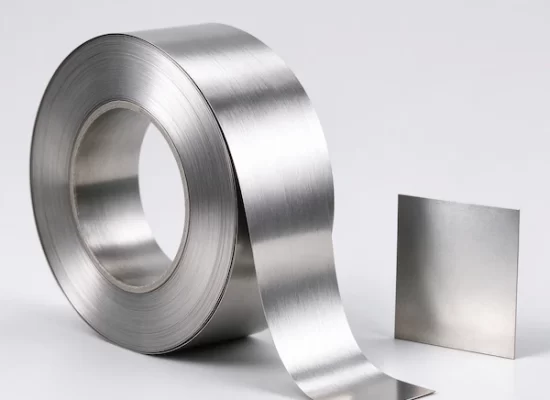
What Is 90W-NiCu Non-Magnetic Tungsten Heavy Alloy?
90W-NiCu is a tungsten heavy alloy in which the binder is nickel-copper instead of nickel-iron. Replacing iron with copper removes the ferromagnetic response, yielding the only widely specified non-magnetic WHA grade under ASTM B777. We offer this material as foil and strip, with thickness ranging from 0.05 mm to 2.0 mm and maximum width up to 350 mm. It can be supplied as cut-to-length pieces or continuous coils. Its mechanical properties meet or surpass the minimum requirements for ASTM B777 Non-Magnetic Class 1. Ultimate tensile strength is ≥675 MPa (≈100 ksi), yield strength around 805 MPa, and hardness falls between HRC 24–26. Among standard tungsten heavy alloys, this grade delivers excellent ductility, with elongation values of 20–33%. Our standard processing route is sintering, rolling followed by vacuum stress relief. Available surface finishes include as-rolled, ground, or polished.
Besides foil, strip and sheet stock, we also produce custom machined components according to customer drawings. Each shipment comes with a full Material Test Certificate (MTC). The certificate includes magnetic permeability testing (μ ≤ 1.05), Archimedes density measurement, tensile, yield and elongation data, HRC hardness results, plus full lot traceability. As a direct manufacturer, we provide factory pricing, custom sizing options, support from prototype batches up to full tonnage orders, and worldwide shipping.
Chemical Composition (wt%)
| Element | W | Ni | Cu | Impurities (max) |
|---|---|---|---|---|
| wt% | 90.0 ±0.5 | ~6.0 | ~4.0 | Each ≤0.05 |
| Ni:Cu ratio | — | ≈ 6 : 4 | — | — |
90W-NiCu Tungsten Alloy Foil and Strip Dimensions
| Parameter | Specification |
|---|---|
| Forms | Foil, strip, sheet, coil/tape, custom parts |
| Thickness | 0.05 mm – 2.0 mm (foil/strip); up to 6 mm sheet on request |
| Width | Up to 350 mm standard; slit to narrow widths on request |
| Length | Cut-to-length (up to 600 mm) or continuous coil |
| Thickness tolerance | ±10% standard; ±5% on request |
| Supply condition | Sintered → rolled → vacuum stress-relieved |
| Surface | As-rolled (matte); ground; polished on request |
| Mandatory test | Magnetic permeability μ ≤ 1.05 (ASTM B193) on every lot |
| Other inspection | Archimedes density, tensile/yield/elongation, HRC, dimensional |
ASTM B777 Non-Magnetic (W-Ni-Cu) — different composition comparison
Our W-NiCu non-magnetic tungsten heavy alloy foil and strip covers the full ASTM B777 non-magnetic family — Class 1 (90W-6Ni-4Cu), Class 2 (93W-4Ni-3Cu), and Class 3 (95W-3.5Ni-1.5Cu) — equivalent to AMS 7727E. All grades feature magnetic permeability μ ≤ 1.05 per ASTM B193, densities from 16.85 to 18.35 g/cm³, UTS 650–900 MPa, and elongation 5–33%. Foil/strip is supplied 0.05–2.0 mm thick, up to 350 mm wide, cut-to-length or coil. Choose 90W-NiCu for maximum ductility or 95W-NiCu for maximum density with magnetic cleanliness. As a direct bulk manufacturer and supplier, we ship with full MTC (permeability, density, tensile, HRC) and offer mill-direct pricing, custom dimensions, and global delivery to aerospace, defense, MRI, and precision-instrument customers.
| ASTM B777 Class | Class 1 (Non-Mag) | Class 2 (Non-Mag) | Class 3 (Non-Mag) | Class 4 |
|---|---|---|---|---|
| Nominal Composition (wt%) | 90W – 6Ni – 4Cu | 93W – 4Ni – 3Cu | 95W – 3.5Ni – 1.5Cu | 97W – NiFe only |
| Ni:Cu ratio | ≈ 6 : 4 | ≈ 1 : 1 | ≈ 7 : 3 | — |
| Density (g/cm³) | 16.85 – 17.30 (≈17.0) | 17.15 – 17.85 (≈17.6) | 17.75 – 18.35 (≈18.0) | 18.25–18.85 |
| Density (lb/in³) | ~0.61 | ~0.63 | ~0.65 | ~0.66 |
| Magnetic property | Non-magnetic, μ ≤ 1.05 | Non-magnetic, μ ≤ 1.05 | Non-magnetic, μ ≤ 1.05 | Magnetic only |
| Hardness (HRC) | 24 – 26 | 25 – 27 | 27 – 30 | 28 – 32 |
| Min. UTS (MPa / ksi) | ≥675 / 100 | ≥650 / 95 | ≥680 / 100 | ≥660 / 95 |
| Typical UTS range (MPa) | 675 – 850 | 700 – 900 | 720 – 900 | 700 – 900 |
| Yield strength (MPa) | ~600 – 805 | ~620 – 820 | ~650 – 805 | ~660 |
| Elongation | 20 – 33% (most ductile) | 10 – 25% | 5 – 15% | 3 – 8% |
| Foil/strip thickness | 0.05 – 2.0 mm | 0.05 – 2.0 mm | 0.05 – 2.0 mm | n/a |
| Max width | 350 mm | 350 mm | 350 mm | — |
| Best for | Gyroscope/IMU near sensors; max formability | Balanced density + ductility | Max density AND magnetic cleanliness | Not available non-magnetic |
W-NiCu non-magnetic tungsten heavy alloy application
- Gyroscopes & IMUs: Balance weights and inertial masses in gyroscope rotors, accelerometer pendulums, and inertial measurement units — where magnetic interference would corrupt navigation readings.
- Satellite & spacecraft: Magnetic-clean balance weights, counterweights, and shielding on satellites and space platforms where magnetic field cleanliness is mission-critical.
- MRI-adjacent medical devices: Non-magnetic weights and shielding in MRI-compatible patient tables, RF coils, and positioning hardware.
- Medical radiation shielding near sensors: CT/LINAC collimator leaves and beam modifiers where non-magnetic behavior is required.
- Precision instruments: Balance weights in scientific instruments, clocks, metrology, and analytical equipment sensitive to magnetic fields.
- Defense & ordnance: Magnetic-clean guidance system components, fuzing hardware, and navigation system weights.
- Rotating machinery: Balance weights in motors, generators, and turbines where they sit near magnetic bearings or position sensors.
- Oil & gas: Down-hole counterweights near magnetometer-based survey tools.
Frequently Asked Questions
Q: What does 90W-NiCu mean?
A: 90% tungsten by weight, balance (~10%) nickel-copper binder (typical 6% Ni + 4% Cu). It is the ASTM B777 Class 1 non-magnetic tungsten heavy alloy grade.
Q: Is 90W-NiCu truly non-magnetic?
A: Yes. Per ASTM B777 / ASTM B193, its magnetic permeability is μ ≤ 1.05 — effectively non-ferromagnetic. We test every lot and report the measured permeability on the MTC.
Q: Why is it non-magnetic while 95W-NiFe is magnetic?
A: The binder system differs. W-Ni-Fe contains iron, which is ferromagnetic. W-Ni-Cu replaces iron with copper, producing a non-ferromagnetic binder — even though the alloy is still 90% tungsten.
Q: When should I choose non-magnetic 90W-NiCu instead of magnetic 95W-NiFe?
A: Choose 90W-NiCu when the component is near gyroscopes, accelerometers, IMUs, magnetometers, MRI equipment, or magnetic sensors. If magnetic cleanliness is irrelevant, 95W-NiFe offers ~6% higher density.
Q: Is 90W-NiCu easy to machine?
A: Yes — it is the most ductile common WHA grade (20–33% elongation) and machines, rolls, forms, and brazes readily.