
Quercetin Dihydrate 95% — Powder & Granular Forms
Quercetin Dihydrate is a naturally occurring flavonol (a subclass of flavonoids) found in many fruits, vegetables, and grains, commercially extracted from the flower buds of Sophora japonica (Japanese pagoda tree), with the molecular formula C₁₅H₁₀O₇·2H₂O, molecular weight 338.27 g/mol, and CAS Number 6151-25-3. Supplied as a yellow to greenish-yellow crystalline powder with ≥95% purity verified by HPLC, our Quercetin Dihydrate is available in two physical forms to suit different manufacturing processes: fine powder (80–100 mesh, ideal for capsules, powder blends, and compression) and granular (20–60 mesh, free-flowing, ideal for direct compression tableting and automated filling). It is practically insoluble in cold water, slightly soluble in hot water, and soluble in ethanol and DMSO. As a direct bulk manufacturer and supplier, we offer competitive wholesale pricing, reliable large-scale production, full CoA documentation, ISO/Halal/Kosher certification, and flexible packaging from 1kg foil bags to 25kg fiber drums, serving supplement brands, contract manufacturers, and food/beverage companies worldwide.
Technical Specifications
| Parameter | Specification |
|---|---|
| Chemical Name | Quercetin Dihydrate (3,3′,4′,5,7-Pentahydroxyflavone dihydrate) |
| CAS | 6151-25-3 |
| Molecular Formula | C₁₅H₁₀O₇·2H₂O |
| Molecular Weight | 338.27 g/mol |
| Purity | ≥95% (HPLC) |
| Appearance | Yellow to greenish-yellow crystalline powder |
| Botanical Source | Sophora japonica (flower buds) |
| Form Options | Fine Powder (80–100 mesh) / Granular (20–60 mesh) |
| Solubility | Practically insoluble in cold water; slightly soluble in hot water; soluble in ethanol, DMSO |
| Loss on Drying | ≤10% (dihydrate form) |
| Heavy Metals | ≤20 ppm |
| Grade | Food / Supplement grade |
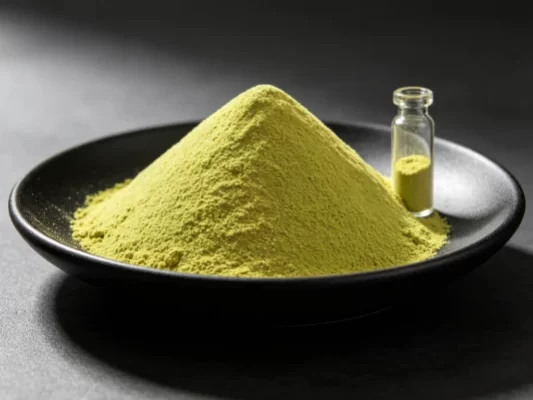
What Is Quercetin Dihydrate 95%?
Quercetin Dihydrate is the hydrated crystalline form of quercetin, one of the most abundant dietary flavonoids. The dihydrate form is the most stable and commonly used grade in supplement manufacturing. We offer both powder and granular forms for different production needs.
Quercetin Dihydrate Powder vs. Granular — Which to Choose?
| Feature | Fine Powder | Granular (20–60 Mesh) |
|---|---|---|
| Particle size | 80–100 mesh | 20–60 mesh |
| Flowability | Moderate | Excellent (free-flowing) |
| Dust | More dust | Low dust |
| Best for | Capsules, powder blends, sachets, liquid formulations | Direct compression tableting, automated capsule filling, high-speed production |
| Dissolution | Faster dissolution | Slightly slower but good |
| Mixing | Easy to blend | Less segregation in blends |
Industrial Applications & Uses
- Dietary supplements: capsules, tablets, softgels, powder blends, gummies
- Functional foods & beverages: fortified drinks, energy bars, antioxidant blends
- Combination formulations: Quercetin+Bromelain, Quercetin+Vitamin C, Quercetin+Zinc immune support blends
- Cosmetics & personal care: antioxidant topical formulations, anti-aging creams
- Animal health: pet supplements, livestock antioxidant additives
- R&D: formulation development, bioavailability enhancement studies
Why Choose Our Quercetin Dihydrate?
- ≥95% HPLC purity — every batch tested, CoA included
- Two forms available — fine powder AND granular (20–60 mesh) for different manufacturing needs
- Plant-derived — from Sophora japonica flower buds, non-GMO
- Large-scale capacity — reliable bulk supply
- Competitive bulk pricing — direct from factory
- Certifications — ISO 9001, Halal, Kosher
- Flexible packaging — 1kg foil bag, 5kg, 10kg, 25kg fiber drum
- Customization — custom mesh size, purity grades (95%/98%), private label, pre-blends
Frequently Asked Questions
Q: What is the CAS number for Quercetin Dihydrate?
A: 6151-25-3. (Note: anhydrous quercetin is CAS 117-39-5.)
Q: What is the difference between powder and granular?
A: Powder is finer (80–100 mesh) for capsules and blends; granular is larger (20–60 mesh), free-flowing, ideal for direct compression tableting and automated filling.
Q: Is quercetin dihydrate water soluble?
A: Practically insoluble in cold water, slightly soluble in hot water. Soluble in ethanol and DMSO. For liquid formulations, consider quercetin phytosome or glycoside forms.
Q: What is the botanical source?
A: Sophora japonica (Japanese pagoda tree) flower buds.