
Palmitoyl Tripeptide-5 (SYN-COLL) — TGF-β Activating Collagen-Boosting Signal Peptide
Palmitoyl Tripeptide-5 (INCI), trade-named SYN-COLL, is a synthetic lipotripeptide with the sequence Pal-Lys-Val-Lys (Pal-KVK), molecular formula C₄₀H₇₅N₇O₁₀, and a molecular weight of approximately 822 Da (CAS 623172-56-5). Developed by Pentapharm (now dsm-firmenich), SYN-COLL is recognized as the first TGF-β boosting peptide on the cosmetic market — it is designed to mimic a functional motif of thrombospondin-1 (TSP-1), an extracellular matrix glycoprotein that activates latent transforming growth factor-beta (TGF-β), the master regulator of collagen synthesis and tissue repair.
Palmitoyl Tripeptide-5 enhances skin penetration and improves peptide stability by protecting against enzymatic degradation. It showed significant improvements in wrinkle depth, skin elasticity, dermal density, and skin thickness. Our Palmitoyl Tripeptide-5 is manufactured by solid-phase peptide synthesis followed by palmitoylation to ≥98% purity (HPLC) and supplied as a white to off-white powder. As a leading bulk peptide supplier, we provide full CoA documentation, custom purities and concentrations, and competitive pricing for premium skincare brands and cosmetic contract manufacturers worldwide.
Technical Specifications
| Parameter | Specification |
|---|---|
| INCI Name | Palmitoyl Tripeptide-5 |
| Trade Name | SYN-COLL® |
| CAS Number | 623172-56-5 |
| Sequence | Pal-Lys-Val-Lys (Pal-KVK) |
| Molecular Formula | C₄₀H₇₅N₇O₁₀ |
| Molecular Weight | ~822 Da |
| Purity (HPLC) | ≥ 98% |
| Identity | LC-MS, amino acid analysis |
| Appearance | White to off-white powder |
| Solubility | Soluble in water/glycerin (gentle warming may help); slightly soluble in ethanol |
| pH Stability | 5.0 – 7.0 |
| Temperature | Add at ≤40°C; avoid prolonged heat >60°C |
| Grade Options | Cosmetic grade, Research grade, High-purity ≥98% |
| Storage | 2–8°C, dry, sealed, protected from light |
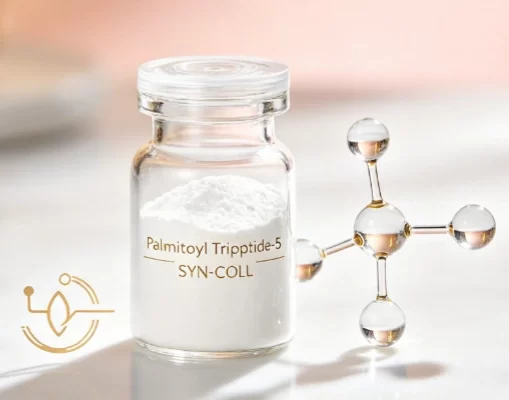
What Is Palmitoyl Tripeptide-5 (SYN-COLL)?
Palmitoyl Tripeptide-5 is a synthetic, N-palmitoylated tripeptide — the original “TGF-β booster” cosmetic peptide.
Chemical & physical properties:
- Sequence: Pal-Lys-Val-Lys (Pal-KVK) — palmitic acid attached to the N-terminal lysine
- CAS: 623172-56-5
- Molecular formula: C₄₀H₇₅N₇O₁₀
- Molecular weight: ~822 Da
- Appearance: White to off-white powder
- Solubility: Soluble in water (with gentle warming) and glycerin; slightly soluble in ethanol; the palmitoyl group makes it more lipophilic than non-palmitoylated peptides
- pH stability: Stable at pH 5.0–7.0
- Purity: ≥98% (HPLC), confirmed by LC-MS
Palmitoyl Tripeptide-5 (SYN-COLL) Application
- Anti-aging & anti-wrinkle serums (face, neck, eye)
- Firming & lifting creams (face, neck, décolleté, body)
- Eye creams & eye serums (fine lines, elasticity, under-eye firming)
- Photodamage repair & anti-aging moisturizers
- Skin thickening & density treatments (thin, mature skin)
- Brightening & even-toning products (tyrosinase inhibition — preliminary)
- Post-procedure recovery (collagen rebuilding after lasers/peels/microneedling)
- Men’s anti-aging products
- Multi-peptide anti-aging formulations (combined with Matrixyl, GHK-Cu, Argireline, etc.)
Palmitoyl Tripeptide-5 (SYN-COLL) Frequently Asked Questions
What does “Palmitoyl” mean? Why is it important?
“Palmitoyl” refers to a palmitic acid (C16 saturated fatty acid) molecule attached to the N-terminus of the peptide. This modification is critical for two reasons:
- Skin penetration enhancement: The stratum corneum (outer skin layer) is lipid-rich. Water-soluble peptides without palmitoylation often cannot cross this barrier and remain on the skin surface, never reaching the dermal fibroblasts where collagen is produced. The palmitoyl group increases lipophilicity, enabling the peptide to penetrate the stratum corneum and reach the viable epidermis/dermis.
- Stability improvement: The N-terminal palmitoyl group protects the peptide from aminopeptidase degradation in the skin, increasing its half-life and biological activity.
This is why palmitoylated peptides (SYN-COLL, Matrixyl/Palmitoyl Pentapeptide-4, Palmitoyl Tripeptide-38) are among the most effective and widely used cosmetic collagen peptides. A peptide without the palmitoyl group (just KVK) would have minimal skin penetration and efficacy.
What is the difference between Palmitoyl Tripeptide-5 and Palmitoyl Tripeptide-1/3/8?
These are different peptides with different sequences, mechanisms, and effects. The number after “Tripeptide” indicates the specific peptide structure:
| INCI Name | Sequence | Mechanism | Primary Benefit |
|---|---|---|---|
| Palmitoyl Tripeptide-5 (SYN-COLL) | Pal-KVK | TSP-1 mimic → TGF-β activation | Collagen I/III synthesis, MMP inhibition |
| Palmitoyl Tripeptide-1 (Pal-GHK) | Pal-GHK | Signal peptide (similar to GHK) | Collagen stimulation, wound healing |
| Palmitoyl Tripeptide-3 | Variable | Varies by supplier | Often generic/mislabeled |
| Palmitoyl Tripeptide-8 | Pal-EHK | Anti-inflammatory (neurotransmitter inhibitor) | Redness, sensitive skin, soothing |
What is TGF-β and why is it important for skin?
Transforming growth factor-beta (TGF-β) is a cytokine (signaling protein) that is the most potent known stimulator of collagen synthesis in fibroblasts. It plays a central role in:
- Collagen synthesis: Upregulates gene expression for type I, III, and IV collagen, elastin, fibronectin, and GAGs
- Tissue repair & wound healing: Essential for the proliferative phase of wound healing (fibroblast proliferation, collagen deposition, angiogenesis)
- Extracellular matrix remodeling: Regulates the balance between collagen synthesis and degradation
- Cell proliferation & differentiation: Influences fibroblast, keratinocyte, and immune cell behavior
In skin aging, TGF-β signaling declines with age and is reduced by UV exposure (photodamage), contributing to collagen loss and skin thinning. By activating latent TGF-β, SYN-COLL boosts this natural collagen-stimulating pathway — making it one of the most direct and potent collagen-stimulating mechanisms available in cosmetic peptides.