
Methacrylated Hyaluronic Acid Powder — Photo-Crosslinkable MeHA / HAMA
Our methacrylated hyaluronic acid powder (MeHA, also known as HAMA or HA-MA) is a photo-crosslinkable biopolymer produced by grafting methacrylate groups onto the hyaluronic acid backbone. With a precisely controlled degree of substitution (DS) ranging from 10% to 60% and customizable molecular weight from 10 kDa to 2 MDa, our MeHA powder enables rapid UV or visible-light crosslinking into hydrogels with tunable mechanical properties, degradation rates, and swelling behavior. Manufactured under strict quality control and characterized by 1H NMR, FTIR, and SEC-MALS, this high-purity methacrylated HA is ideal for 3D bioprinting, tissue engineering scaffolds, drug delivery systems, and wound healing applications. As a reliable bulk supplier and manufacturer, we support researchers and biotech companies worldwide with custom DS grades, competitive pricing, and full technical documentation.
| Synonyms | HAMA, HAMA Lyophilizate, Methacrylated Hyaluronic Acid, Hyaluronic Acid Methacrylate, MeHA |
| Sterility | Sterile |
| Degree of methacrylation | 10-60% |
| Shelf life | Minimum of 6 months from date of receipt |
| CAS Number | 9067-32-7 |
| Storage conditions | Light sensitive, moisture sensitive |
| Form | Lyophilizate |
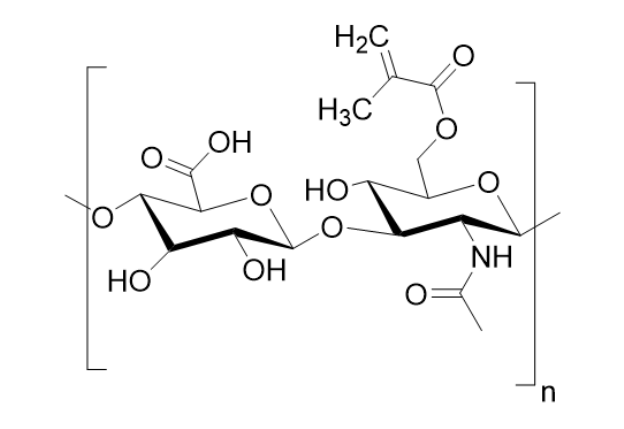
What Is Methacrylated Hyaluronic Acid (MeHA / HAMA)?
Methacrylated Hyaluronic Acid (MeHA) is a chemically modified derivative of hyaluronic acid (HA), where methacrylate groups are introduced to the HA backbone. It typically appears as a white to off-white powder or solid. The molecular formula varies based on the degree of methacrylation, but the base HA has the formula (C14H21NO11)n. MeHA is known for forming hydrogels when exposed to UV light or a cross-linking agent, with tunable mechanical properties and degradation rates. It is widely used in biomedical applications such as tissue engineering, drug delivery, and 3D bioprinting.
Methacrylated hyaluronic acid, commonly abbreviated as MeHA or HAMA (Hyaluronic Acid Methacrylate), is a chemically modified derivative of hyaluronic acid in which methacrylate functional groups are covalently attached to the HA backbone — typically at the hydroxyl positions via reaction with glycidyl methacrylate (GM), or at the carboxyl positions via methacrylic anhydride (MA).
The introduction of methacrylate pendant groups renders the polymer photo-crosslinkable: in the presence of a photoinitiator (e.g., Irgacure 2959, LAP), UV or visible light triggers free-radical polymerization of the methacrylate double bonds, forming a covalently crosslinked hydrogel network within seconds to minutes.
Because the underlying HA backbone retains its native biocompatibility, biodegradability (via hyaluronidase), and cell-binding domains (CD44, RHAMM), MeHA hydrogels are among the most widely used bioinks and tissue engineering matrices in regenerative medicine research.
Key Specifications — Degree of Substitution & Molecular Weight
The two most critical parameters for MeHA are the **degree of substitution (DS)** and the **molecular weight (MW)**. Both directly control hydrogel gelation kinetics, crosslink density, mechanical stiffness, swelling ratio, and degradation rate.
| Grade | Molecular Weight (Da) | Degree of Substitution | Typical Use |
|---|---|---|---|
| Low MW / Low DS | 10,000 – 50,000 | 10 – 25% | Injectable hydrogels, drug delivery, soft tissue fillers |
| Medium MW / Medium DS | 100,000 – 300,000 | 20 – 40% | 3D bioprinting bioinks, general tissue engineering |
| High MW / High DS | 500,000 – 2,000,000 | 30 – 60% | Load-bearing scaffolds, cartilage engineering, high-strength hydrogels |
Applications — 3D Bioprinting, Hydrogels & Tissue Engineering
Our methacrylated hyaluronic acid powder is a versatile building block across the biomedical and biomaterials fields:
3D Bioprinting & Bioinks
- MeHA is a core component of photocrosslinkable bioinks for extrusion-based and digital light processing (DLP) 3D bioprinting.
- Tunable viscosity and rapid gelation enable high-resolution printing of cell-laden constructs with excellent shape fidelity.
- Commonly blended with GelMA (gelatin methacrylate), PEGDA, or alginate to optimize printability and biological performance.
Tissue Engineering Scaffolds
- Cartilage tissue engineering: MeHA hydrogels support chondrocyte phenotype and glycosaminoglycan deposition; high-MW, high-DS grades provide mechanical support for load-bearing cartilage.
- Bone tissue engineering: MeHA composites with hydroxyapatite, bioactive glass, or osteoconductive additives promote osteogenic differentiation.
- Neural tissue engineering: Low-concentration MeHA hydrogels support neurite outgrowth and stem cell differentiation.
- Skin & wound healing: MeHA-based dressings maintain a moist wound environment and support fibroblast and keratinocyte migration.
Drug Delivery & Controlled Release
- Photocrosslinked MeHA hydrogels serve as depots for sustained release of proteins, growth factors (e.g., BMP-2, VEGF), peptides, and small-molecule drugs.
- Degradation rate (controlled by DS and MW) can be matched to desired release kinetics — from days to several weeks.
- Injectable in situ crosslinking formulations enable minimally invasive delivery.
Other Applications
- Cosmetic & aesthetic formulations: Raw material for crosslinked HA dermal filler development (requires additional purification and sterilization).
- Microfluidics & organ-on-a-chip: MeHA hydrogels as extracellular matrix mimics in microfluidic devices.
- Adhesion prevention: Photocrosslinked MeHA barrier films for post-surgical applications.
Frequently Asked Questions (FAQ) Hyaluronic Acid Methacrylated (MeHA / HAMA)?
Q: What is the difference between MeHA and HAMA? A: They are the same product. MeHA = Methacrylated Hyaluronic Acid; HAMA = Hyaluronic Acid Methacrylate. Both refer to HA functionalized with methacrylate groups. Some literature also uses HA-MA or HAGM (HA glycidyl methacrylate).
Q: What degree of substitution should I choose? A: For most 3D bioprinting and tissue engineering applications, a DS of 20–40% is a good starting point. Lower DS (10–20%) gives softer, faster-degrading gels suitable for drug delivery; higher DS (40–60%) gives stiffer, more durable gels for load-bearing or long-term scaffolds. We can provide a sample kit with multiple DS grades for screening.
Q: Is your MeHA suitable for in vivo / clinical use? A: Our standard grade is research-grade (not for human clinical use). We offer GMP-grade MeHA produced in certified facilities for clinical and medical device applications. Please contact us to discuss GMP requirements.
Hyaluronic acid methacrylate Powder Research Reference
3D bioprinting of methacrylated hyaluronic acid (MeHA) hydrogel with intrinsic osteogenicity
- In this study, we modified the naturally occurring extracellular matrix glycosaminoglycan hyaluronic acid (HA), in order to yield photo-crosslinkable hydrogels with increased mechanical stiffness and long-term stability, and with minimal decrease in cytocompatibility. Application of these tailor-made methacrylated hyaluronic acid (MeHA) gels for bone tissue engineering and 3D bioprinting was the subject of investigation.