
Spherical Niobium Powder (99.9% Pure) — Plasma-Spheroidized for LPBF, EBM & DED Additive Manufacturing
High-purity Spherical Niobium Powder, commonly known as Niobium Spheres, comes with standard particle size ranges including 15-45 μm and 45-106 μm. Produced via plasma spheroidization, it maintains an extremely low oxygen level and outstanding flowability, making it an ideal raw material for powder metallurgy, metal injection molding, electron beam melting and other additive manufacturing processes, as well as sophisticated biomedical applications.
Princeton Powder is a leading supplier of Plasma-Spheroidized Niobium Powder worldwide. We provide bulk wholesale and custom-sized spherical niobium powder with reliable quality, supporting long-term cooperation for manufacturers engaged in 3D printing, metal injection molding and aerospace production. Niobium powders including Niobium Carbide Powder, Niobium Oxide Nb2O5 Ceramic Powder, and Niobium Nitride NbN Powder are for sale in bulk.
Formula | Niobium Nb |
CAS Number | 7440-03-1 |
Purity | 99.9% min |
Synonyms | Nb spherical particles, niobium Spherical particles, niobium spherical powders, niobium metal spherical powder |
Particle Sizes | 325 mesh, 15-45 um, 53-106 um or be customized |
Appearance | Black grey powder |
Melting Point | 2468°C |
Boiling Point: | 4742°C |
Apparent Density | >4.5 g/cm3 |
Tap Density | >5.5 g/cm3 |
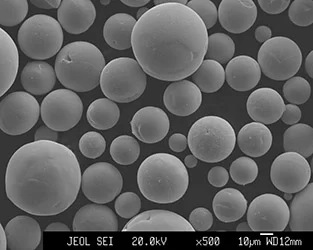
Product Overview
Spherical niobium powder (CAS 7440-03-1, 99.9% min purity) is a plasma-spheroidized refractory metal powder engineered for laser powder bed fusion (LPBF), electron beam melting (EBM), and directed energy deposition (DED) additive manufacturing. Niobium is the lightest refractory metal at 8.57 g/cm³ — roughly half the density of tantalum — offering an exceptional combination of high-temperature performance, room-temperature ductility, biocompatibility, and superconductivity at 9.2 K. With a melting point of 2,477°C and outstanding corrosion resistance, niobium and its alloys (C-103, FS-85, Cb752) are used in aerospace propulsion, medical implants, superconducting RF cavities, and chemical processing equipment. Princeton Powder supplies Nb powder in 15-45µm (standard LPBF) and 45-106µm (EBM/DED) with custom PSD available.
Why Niobium for AM?
| Property | Niobium (Nb) | Tantalum (Ta) | Ti-6Al-4V | Advantage |
|---|---|---|---|---|
| Density | 8.57 g/cm³ | 16.65 g/cm³ | 4.43 g/cm³ | Lightest refractory — best strength/weight for aerospace |
| Melting Point | 2,477°C | 3,017°C | 1,660°C | Far exceeds nickel superalloys (~1,400°C) |
| Ductility | Highly ductile (~25% EL) | Ductile | ~10% EL | Best room-temperature formability among refractories |
| Superconducting | Yes — Tc 9.2 K | No | No | Unique for MRI magnets, RF cavities, particle accelerators |
| Biocompatibility | Excellent (ISO 10993) | Excellent | Good | Nb₂O₅ passive layer — non-cytotoxic, osteogenic |
| Cost | $90–480/kg | $500–1,500+/kg | $50–150/kg | Significantly more economical than Ta for non-medical AM |
Chemical Composition & Specifications
| Element | Specification (wt%) | Test Method |
|---|---|---|
| Niobium (Nb) | ≥99.9% (3N) | GDMS / ICP-OES |
| Tantalum (Ta) | <0.1% | GDMS |
| Oxygen (O) | <600 ppm (LPBF), <300 ppm on request | LECO Inert Gas Fusion |
| Nitrogen (N) | <100 ppm | LECO |
| Iron (Fe) | <0.01% | ICP-OES |
| Carbon (C) | <0.01% | Combustion |
Particle Size Distribution & Flow Characteristics
| PSD Range | AM Process | D10 | D50 | D90 | Apparent Density | Hall Flow |
|---|---|---|---|---|---|---|
| 15-45 µm | LPBF / SLM | ≥15 µm | 28-32 µm | ≤45 µm | >4.5 g/cm³ | <15 s/50g |
| 45-106 µm | EBM / DED | ≥45 µm | 65-75 µm | ≤106 µm | >5.0 g/cm³ | <12 s/50g |
| 15-53 µm | LPBF (alternative) | ≥15 µm | 30-35 µm | ≤53 µm | >4.5 g/cm³ | <15 s/50g |
Production Method: Plasma spheroidization — achieves >95% sphericity with minimal satellites and hollow particles. Each lot: laser diffraction PSD (Malvern), SEM morphology, Hall flowmeter, apparent/tap density. Standards: ASTM B392 (Niobium and Niobium Alloy Bar, Rod, and Wire — composition reference), ASTM F2886 (Surgical Implants — Nb alloy chemical requirements).
Material & Performance Properties
| Property | Pure Nb (LPBF As-Built) | Nb C-103 Alloy | Significance for AM |
|---|---|---|---|
| Density | 8.57 g/cm³ | 8.86 g/cm³ | Lightest refractory — ideal for aerospace weight reduction |
| Melting Point | 2,477°C | ~2,350°C | ~1,000°C above nickel superalloy limits |
| Yield Strength (YS) | 426-550 MPa | ~462 MPa | AM YS exceeds conventional wrought due to dislocation substructure |
| Ultimate Tensile Strength (UTS) | 506-630 MPa | ~557 MPa | Stronger than cast/rolled equivalents |
| Elongation | 25-26% (low O) | 20-22% | Excellent ductility — unique among refractory metals |
| Elastic Modulus | 105 GPa | ~110 GPa | Closer to bone (~18 GPa when porous) than Ti or CoCr |
| Thermal Conductivity | 53.7 W/(m·K) | — | Good thermal management for high-temp components |
| Superconducting Tc | 9.2 K | — | Essential for RF cavities and MRI magnets |
| Corrosion Resistance | Excellent — stable Nb₂O₅ passive layer. Resistant to most acids except HF. | ||
Oxygen Control — The Critical AM Parameter
Oxygen is the single most critical quality parameter for AM-grade niobium. Liu et al. (2023, Materials Science & Engineering A) demonstrated that when oxygen content increases from 0.05 wt% to 0.23 wt%, LPBF niobium elongation to fracture drops from 26% to less than 2% — a catastrophic embrittlement. Princeton Powder controls oxygen to <600 ppm standard, <300 ppm on request via plasma spheroidization in inert atmosphere with LECO verification per lot. For superconducting applications requiring maximum RRR (Residual Resistivity Ratio), <300 ppm O is recommended.
Biocompatibility — Nb₂O₅ Passive Layer
Niobium is one of the most biocompatible metals — its stable niobium pentoxide (Nb₂O₅) surface layer is bioinert, promotes osteoblast adhesion without fibrous encapsulation, and exhibits low cytotoxicity in ISO 10993 testing. Nb-based biomaterials promote calcification by increasing alkaline phosphatase activity and demonstrate excellent MRI compatibility — a critical advantage for implant patients requiring post-operative imaging. LPBF-printed porous Nb structures achieve elastic moduli closely matching cancellous bone, eliminating stress shielding.
Applications
Aerospace & Defense — EBM/LPBF High-Temperature Components
Niobium alloys — particularly C-103 (Nb-10Hf-1Ti), FS-85 (Nb-28Ta-10W-1Zr), and Cb752 (Nb-10W-2.5Zr) — are the materials of choice for AM-printed rocket engine nozzles, satellite thrusters, hypersonic leading edges, and thermal protection systems. Nb alloys retain mechanical stability above 1,000°C where nickel superalloys approach their limits. FS-85 exhibits UTS of ~220 MPa at 1,500°C. AM enables complex internal cooling channels impossible with conventional fabrication. NASA Glenn Research Center has validated FS-85 and Cb752 for additively manufactured propulsion components — AM-processed material consistently outperforms cast/rolled equivalents in both strength and creep resistance due to stable subgrain dislocation networks.
Medical Implants — LPBF Patient-Specific Orthopedics
Niobium's excellent biocompatibility, low elastic modulus, and MRI compatibility make it a premier material for AM-printed spinal fusion cages, acetabular cups, and craniofacial reconstruction plates. Nb spinal cages have demonstrated 99.8% post-HIP density with no cytotoxic response and corrosion rates significantly below titanium benchmarks. AMtrinsic® biomedical-grade Nb powders are used for Ti-Nb-Ta and Ti-Nb-Ta-Zr alloys optimized for elasticity-strength-ductility balance. LPBF-printed porous Nb structures achieve bone-matching modulus — eliminating the stress shielding that causes implant loosening in Ti-6Al-4V implants. ISO 10993 biocompatibility data available.
Superconducting & Scientific Devices — RF Cavities & MRI Magnets
Pure niobium's superconducting critical temperature of 9.2 K makes it the irreplaceable material for superconducting RF (SRF) cavities in particle accelerators (Fermilab, CERN, SLAC), MRI magnets, and quantum computing research. LPBF enables complex cavity geometries that improve Q₀ quality factors and accelerating gradients. For SRF applications, ultra-low oxygen (<300 ppm) PREP (Plasma Rotating Electrode Process) powder with sphericity ≥0.97 and 15-45µm PSD is specified. Post-build electropolishing achieves the surface finish requirements for GHz-range operation. Niobium's combination of superconducting properties and AM processability is unique — no other refractory metal offers this capability.
Frequently Asked Questions
Why use niobium instead of tantalum for AM components?
Niobium is the lightest refractory metal at 8.57 g/cm³ — roughly half the density of tantalum (16.65 g/cm³) — offering superior strength-to-weight ratio for aerospace applications. Nb is also significantly more economical ($90–480/kg vs $500–1,500+/kg for Ta) and is uniquely superconducting at 9.2 K — essential for SRF cavities and MRI magnets. Nb is more ductile at room temperature (25% vs ~10% elongation). Choose Nb when weight, cost, or superconductivity are priorities; choose Ta when maximum density, radiopacity, or ultimate corrosion resistance are required.
What particle size for LPBF niobium?
15-45µm is the standard LPBF/SLM range — achieving >99% relative density at energy density of ~146 J/mm³ (Liu et al., 2023). D10 ≥15µm ensures consistent powder spreading; D90 ≤45µm enables fine layer thicknesses (30-50µm). For EBM, 45-106µm is recommended due to larger beam diameter and elevated build chamber temperature. Custom PSD available on request.
Is niobium powder biocompatible for medical implants?
Yes — niobium is one of the most biocompatible metals. Its stable Nb₂O₅ surface oxide is bioinert, promotes osteoblast adhesion without fibrous encapsulation, and demonstrates low cytotoxicity in ISO 10993 testing. Nb spinal cages (LPBF, post-HIP) achieve 99.8% density with no cytotoxic response and corrosion rates significantly below titanium benchmarks. Nb-based biomaterials promote calcification by increasing alkaline phosphatase activity. Princeton Powder provides ISO 10993 biocompatibility support documentation for FDA 510(k) and CE Mark submissions.
How does oxygen affect niobium AM mechanical properties?
Oxygen is the single most critical quality parameter for AM-grade niobium. Research by Liu et al. (2023, Materials Science & Engineering A) showed that when oxygen content increases from 0.05 wt% to 0.23 wt%, elongation to fracture drops from 26% to less than 2% — catastrophic embrittlement regardless of energy density. Princeton Powder controls oxygen to <600 ppm standard (<300 ppm on request) via plasma spheroidization under inert atmosphere. LECO oxygen analysis is provided with every lot. For superconducting applications, <300 ppm O is critical for maintaining maximum RRR.
What niobium alloys are available for AM?
Princeton Powder supplies pure Nb, C-103 (Nb-10Hf-1Ti), FS-85 (Nb-28Ta-10W-1Zr), Cb752 (Nb-10W-2.5Zr), and Nb-1Zr. C-103 is the most widely used aerospace alloy (YS ~462 MPa, UTS ~557 MPa in AM). FS-85 offers higher strength (YS ~659 MPa, UTS ~747 MPa) with lower ductility (6-7%). NASA Glenn's research confirms AM FS-85 and Cb752 outperform cast/rolled equivalents in both strength and creep resistance. Custom alloy gas atomization available — contact technical team.
What is the price of niobium powder for AM?
Market pricing (2025): $90–180/kg for 99.9% purity; $260–480/kg for 99.99% purity. Pricing varies with PSD precision, oxygen specification, and order volume. Niobium is significantly more economical than tantalum ($500–1,500+/kg) — making it the cost-effective refractory metal choice for aerospace and industrial AM where superconductivity is not required. Contact Princeton Powder with your target PSD, purity, and annual volume for a formal quotation. R&D samples (100 g minimum) available for process qualification.
Research & Technical References
The following peer-reviewed research demonstrates niobium's performance in laser powder bed fusion additive manufacturing. Princeton Powder spherical niobium powder meets or exceeds the material specifications used in these studies.
Additive Manufacturing of Pure Niobium by Laser Powder Bed Fusion: Microstructure, Mechanical Behavior and Oxygen Assisted Embrittlement
Materials Science & Engineering A, 2023 — Liu et al. achieved 99.7% relative density at 146 J/mm³ energy density with LPBF pure Nb. Yield strength of 550 MPa, UTS of 630 MPa, and elongation of 26% at low oxygen (0.05 wt%). Critical finding: when oxygen content increased to 0.23 wt%, elongation dropped to <2% — confirming that oxygen control is the single most critical quality parameter for AM-grade niobium powder. Fine grain size (~70 μm) and high dislocation density were identified as the primary strengthening mechanisms. Practical takeaway: Specifying <600 ppm oxygen (with <300 ppm for critical applications) is essential for achieving ductile as-printed niobium components. Every lot should include LECO oxygen analysis — this is not negotiable for structural applications.
Assessing the Factors Underlying the High Yield Strength of Laser Powder Bed Fusion Processed Niobium
Materials Science & Engineering A, 2024 — Chesetti et al. quantified the strengthening contributions in LPBF niobium (YS 490 MPa, UTS 609 MPa, 9% EL). Atom probe tomography confirmed solid solution strengthening from oxygen and nitrogen interstitials was of the same order of magnitude as strengthening from dislocations and sub-boundaries — explaining why AM Nb is stronger than wrought Nb. The computed overall YS of 506 MPa closely matched the experimental 490 MPa. Practical takeaway: The oxygen specification is a trade-off: too high causes embrittlement, but controlled interstitial content contributes meaningful strength. Princeton Powder's <600 ppm O specification balances strength enhancement with ductility retention — validated by this research.
Bio-functional Niobium-Based Metallic Biomaterials: Exploring Their Physicomechanical Properties, Biological Significance, and Implant Applications
Acta Biomaterialia, 2024 — Liu, Zhao et al. provided a comprehensive two-decade review of Nb-based biomaterials. Nb₂O₅ surface oxide promotes osteoblast adhesion and alkaline phosphatase activity without fibrous encapsulation. Nb spinal cages achieved 99.8% post-HIP density with no cytotoxic response. Practical takeaway: When marketing Nb powder for medical AM, ISO 10993 biocompatibility data and the osteogenic properties of Nb₂O₅ should be highlighted — these are the clinical differentiators that medical device R&D teams evaluate when selecting between Nb, Ta, and Ti-6Al-4V for implant applications.
Contact our technical team for the full reference list and to discuss how Princeton Powder spherical niobium powder can meet your specific AM application requirements.