
KTP Crystal (KTiOPO4) — Potassium Titanyl Phosphate Nonlinear Optical Crystal Supplier, Type II SHG
High‑quality KTP Crystal (KTiOPO₄, Potassium titanyl phosphate), nonlinear optical crystal for SHG, OPO and Nd:YAG laser frequency conversion. Available in 1064‑532 nm specifications, AR‑coated or uncoated, Type I / Type II phase‑matching, high laser‑damage‑threshold grades. We provide custom cutting, large‑size KTP crystals for green lasers, medical lasers, lidar and optical‑measurement systems. Strict surface quality 10/5 & precise dimension tolerance. As reliable KTP crystal manufacturer & supplier, we support wholesale and OEM customization for research institutes & industrial clients. Get your quote today.
Technical Specifications
| Parameter | Value |
|---|---|
| Product | KTP Crystal — KTiOPO4, Orthorhombic mm2, NLO & EO, Flux-Grown, AR1064/532nm |
| Transparency | 350–4,500 nm | d33=16.9 pm/V (~3× KDP) | deff~3.5 pm/V (Type II SHG @1064nm) |
| EO r33 | 36.3 pm/V (high freq) | ε~13 | Low Vπ for Q-switches & modulators |
| Damage Threshold | >500 MW/cm² (1064nm,10ns,10Hz) | HGTR for enhanced grey-track resistance |
| SHG @1064nm | Type II, θ=90°, φ=23.5° | walk-off 4.9mrad | angular 14.2mrad·cm | temp 24°C·cm |
| R.I. @1064nm | nx=1.738, ny=1.745, nz=1.830 | non-hygroscopic, chemically stable |
| Sizes | 3×3×5mm³ to 20×20×40mm³ | AR1064/532: R<0.2%/R<0.5% | S/D 10/5, λ/8 @633nm |
| Applications | SHG 1064→532nm green, OPO 1.5-4.5µm, EO Q-switch, SPDC quantum |
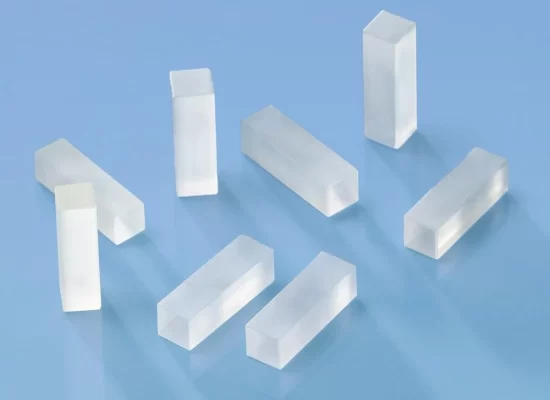
Product Overview
KTP (Potassium Titanyl Phosphate, KTiOPO4) is the most widely used frequency-doubling crystal for converting 1064nm Nd:YAG/Nd:YVO4 IR to 532nm green — the crystal inside virtually every green laser pointer, DPSS module, and medical green laser globally. KTP's dominance comes from its uniquely favorable combination: high deff ~3.5 pm/V (~3× KDP), small walk-off 4.9 mrad, wide angular/temperature acceptance, >500 MW/cm² damage threshold, and non-hygroscopic chemical stability. Beyond SHG, KTP's EO coefficient r33=36.3 pm/V combined with low ε~13 makes it an excellent Q-switch material. Princeton Powder supplies flux-grown KTP in Standard, HGTR, OPO-cut, and EO-grade variants — 3×3×5mm³ to 20×20×40mm³ — with AR1064/532nm dual-band coatings.
Variant Selection
| Variant | Best For |
|---|---|
| Standard (Flux) | Green lasers <5W, DPSS modules, OPO pumps, EO Q-switches low rep rate |
| HGTR | CW green >5W, >10kHz Q-switched — suppresses photochromic grey-tracking |
| OPO-Cut | θ=90° NCPM for tunable 1.5-4.5µm OPO/OPA — longest interaction length |
| EO-Grade | Q-switches, Pockels cells, phase modulators — r33=36.3 pm/V |
KTP vs BBO vs LBO vs PPLN — 1064nm SHG Crystal Selection
| Property | KTP (this) | BBO | LBO | PPLN |
|---|---|---|---|---|
| deff (pm/V) | ~3.5 (Type II) | ~2.1 (Type I) | ~0.82 (Type I) | ~14-16 (QPM) |
| Damage Threshold | >500 MW/cm² | ~5 GW/cm² (highest UV) | ~25 GW/cm² | Lowest — limits max power |
| Walk-off @1064nm | 4.9 mrad (small) | 55.6 mrad (large) | 6.7 mrad (small) | None (QPM, collinear) |
| Angular Accept. | 14.2 mrad·cm | 0.5 mrad·cm (narrow) | 6.5 mrad·cm | N/A (QPM tuning) |
| Temp Accept. | 24°C·cm | 70°C·cm | 4.7°C·cm (narrow) | Very narrow — needs oven |
| Hygroscopic | No | Slightly | No | No |
| Best Power | 5-20W green — the sweet spot | High peak, UV generation | >100W — highest power | Low-moderate, max efficiency |
| Key Weakness | Grey-tracking at >5W CW; use HGTR | Large walk-off limits focus; slightly hygroscopic | Low deff needs long crystal; narrow temp acceptance | Low damage threshold; high temp sensitivity; limited aperture |
Why KTP is the Green Laser Workhorse
KTP's combination of high nonlinearity + small walk-off + wide acceptance angles makes it uniquely forgiving of alignment and thermal drift — the reason it dominates the low-to-medium-power green laser market. BBO's large walk-off and narrow angular acceptance demand precision alignment; LBO's low nonlinearity requires longer crystals or higher intensity; PPLN's damage threshold limits it to low power. For 90% of 1064nm→532nm SHG applications below 20W green output, KTP is the optimal, most cost-effective choice. Princeton Powder supplies all four NLO crystals — contact our technical team for application-specific selection guidance.
Technical Specifications
Optical & NLO Properties
| Transparency | 350–4,500 nm; absorption <0.1%/cm @1064nm, <1%/cm @532nm |
| R.I. @1064nm | nx=1.738, ny=1.745, nz=1.830 (biaxial positive) |
| R.I. @532nm | nx=1.778, ny=1.789, nz=1.889 |
| d33 / d24 / d15 | 16.9 / 7.6 / 6.1 pm/V (@1064nm); deff~3.5 (Type II SHG) |
| SHG PM Type | Type II, θ=90°, φ=23.5° @1064nm; walk-off 4.9mrad; ang 14.2mrad·cm; temp 24°C·cm |
| Damage Threshold | >500 MW/cm² (1064nm,10ns,10Hz); HGTR higher for CW |
| dn/dT (×10⁻⁵/°C) | dnx=1.1, dny=1.3, dnz=1.6 |
Electro-Optic & Physical
| EO r33 / r23 / r13 | 36.3 / 15.7 / 9.5 pm/V (high freq); ε~13 |
| Structure | Orthorhombic mm2, Pna21; a=6.404, b=10.616, c=12.814Å; Z=8 |
| Density / Hardness | 3.01 g/cm³ | Mohs ~5 |
| Melting / Curie | ~1,172°C (incongruent) | 936°C |
| Hygroscopic | No — chemically stable; no hermetic packaging needed |
Standard Dimensions & Quality
| Sizes | 3×3×5 to 20×20×40mm³; ±0.1mm tolerance; custom available |
| AR Coatings | R<0.2% @1064nm, R<0.5% @532nm (IBS); dual-band standard; custom wavelengths |
| Surface Quality | 10/5 S/D; λ/8 @633nm; parallelism <20 arcsec; clear aperture >90% |
| Growth Method | Flux growth — superior optical homogeneity vs hydrothermal |
Applications
Second Harmonic Generation — 1064nm→532nm Green Laser Frequency Doubling
The primary KTP application: Type II SHG converting Nd:YAG/Nd:YVO4 1064nm IR to 532nm green. KTP's small walk-off (4.9mrad) enables tight focusing for high intensity without beam separation — the key advantage over BBO (55.6mrad walk-off) for intracavity doubling where the beam passes through the crystal hundreds of times per round trip. For CW green lasers <5W, standard KTP provides >40% conversion efficiency. For >5W CW or >10kHz Q-switched, specify HGTR KTP to prevent grey-tracking — photochromic damage that appears as darkening along the beam path and gradually reduces SHG efficiency. Princeton Powder supplies KTP cut to θ=90°, φ=23.5° for 1064nm SHG with AR1064/532nm dual-band coatings.
Optical Parametric Oscillation (OPO) & Quantum SPDC Entangled Photon Sources
KTP OPO pumped at 1064nm generates tunable output from 1.5-4.5µm — covering the critical mid-IR spectral region for trace gas spectroscopy, remote chemical sensing, and infrared countermeasures. The OPO-cut variant (θ=90° NCPM) eliminates walk-off for the longest effective interaction length — maximizing conversion efficiency and tuning range. Quantum optics: KTP is the leading bulk crystal for Type II spontaneous parametric down-conversion (SPDC) — generating polarization-entangled photon pairs at 810nm (pumped at 405nm) for quantum key distribution, quantum computing, and fundamental Bell-inequality experiments. KTP's Type II PM produces collinear, coaxial signal and idler — ideal for fiber-coupled single-photon collection.
Electro-Optic Q-Switches, Pockels Cells & Phase Modulators
KTP's high EO coefficient (r33=36.3 pm/V) combined with low dielectric constant (ε~13) enables EO Q-switches with lower half-wave voltage and faster switching than LiNbO3 — critical for compact, high-repetition-rate (>10kHz) Q-switched lasers for materials processing, LIDAR, and medical applications. KTP EO modulators operate from DC to >10GHz with low insertion loss — used in fiber-coupled phase modulators, directional couplers, and integrated waveguide EO devices. KTP's non-hygroscopic stability means EO devices maintain performance without hermetic packaging — a significant reliability advantage over hygroscopic DKDP Q-switches.
Frequently Asked Questions
What is KTP crystal used for?
KTP (Potassium Titanyl Phosphate) crystal is primarily used for second harmonic generation (SHG) — converting 1064nm Nd:YAG/Nd:YVO4 infrared laser light into 532nm green light. It is also used for optical parametric oscillation (OPO) generating tunable mid-IR (1.5-4.5µm), electro-optic Q-switching, and quantum optics SPDC entangled photon generation. KTP is the crystal inside virtually every green laser pointer, DPSS module, and medical/aesthetic green laser worldwide.
What is KTiOPO4 crystal?
KTiOPO4 is the chemical formula for Potassium Titanyl Phosphate (KTP) — an orthorhombic (point group mm2) nonlinear optical crystal with chemical formula KTiOPO4. It is a biaxial positive crystal with high nonlinear coefficient (d33=16.9 pm/V, ~3× KDP), broad transparency (350-4500nm), and excellent electro-optic properties (r33=36.3 pm/V). KTiOPO4 is non-hygroscopic and chemically stable.
How does KTP crystal work?
KTP works through Type II phase matching: when 1064nm infrared light passes through a KTP crystal cut at θ=90°, φ=23.5°, the crystal's nonlinear susceptibility generates a 532nm second harmonic wave. The crystal's birefringence is engineered so that the fundamental and harmonic waves travel at the same phase velocity — enabling constructive interference and efficient energy transfer (>40% conversion). This is second harmonic generation (SHG).
What is SHG in KTP crystal?
SHG (Second Harmonic Generation) in KTP is the nonlinear process of frequency-doubling: two 1064nm photons combine in the KTP crystal to produce one 532nm photon (half the wavelength, double the frequency/energy). KTP's Type II SHG uses the d24 coefficient (7.6 pm/V) for this 1064nm→532nm conversion — the most efficient and widely used SHG configuration in green DPSS lasers.
Is KTP crystal hygroscopic?
No — KTP is non-hygroscopic and chemically stable, requiring no hermetic packaging. Unlike BBO (slightly hygroscopic) and DKDP (highly hygroscopic requiring sealed cells), KTP maintains optical performance in ambient air for years. This simplifies mounting, reduces system cost, and improves long-term reliability.
What is the laser damage threshold of KTP crystal?
KTP has a laser damage threshold of >500 MW/cm² at 1064nm with 10ns pulses at 10Hz (AR-coated). For CW and high-repetition-rate operation, HGTR (High Grey Track Resistance) KTP provides enhanced resistance to photochromic grey-tracking damage. The practical power limit for standard KTP is ~5W CW green output; specify HGTR for higher powers.
KTP crystal for green laser — why is it the standard?
KTP is the standard green laser SHG crystal because its combination of high deff (~3.5 pm/V), small walk-off (4.9mrad), and wide angular/temperature acceptance is uniquely forgiving of alignment — critical for mass-produced DPSS green modules. For green lasers <20W, KTP provides the optimal cost-performance ratio. For >100W green, LBO's higher damage threshold is preferred.
KTP crystal for lidar and range finder — which configuration?
For lidar and laser range finders, KTP is used both as: (1) SHG crystal for 532nm green output — visible wavelength improves detector sensitivity and eye-safety classification; (2) EO Q-switch crystal for generating ns pulses with r33=36.3 pm/V enabling compact, high-repetition-rate (>10kHz) Q-switched lasers. Princeton Powder supplies both SHG-cut and EO-grade KTP.
KTP crystal for optical parametric oscillator (OPO) — what's special?
For optical parametric oscillator (OPO) applications, KTP is cut for θ=90° non-critical phase matching (NCPM) — eliminating walk-off for the longest effective interaction length and widest tuning range. KTP OPO pumped at 1064nm generates tunable output from 1.5-4.5µm (signal 1.5-2.1µm, idler 2.4-4.5µm) for mid-IR spectroscopy and remote sensing.
KTP crystal vs LBO crystal — which for high-power?
KTP: higher deff (~3.5 pm/V), smaller walk-off, easier alignment — best for <20W green and non-hygroscopic stability. LBO: 50× higher damage threshold (25 GW/cm² vs >500 MW/cm²) and NCPM at 148°C with zero walk-off — best for >100W industrial green. Choose KTP for cost-effective low-to-medium power; choose LBO for high-power industrial. Princeton Powder supplies both.
KTP vs KDP crystal — which is better?
KTP is superior to KDP for most SHG applications: 3× higher nonlinear coefficient (d33=16.9 vs d36~0.5 pm/V), non-hygroscopic (KDP is highly hygroscopic requiring sealed cells), and higher damage threshold. KDP remains used only for very large aperture (>100mm) applications where KTP cannot be grown large enough. For 1064nm SHG below 20W, KTP is the clear choice.
Type I vs Type II KTP crystal — which phase matching?
Type II (o+e→e) is the standard for KTP SHG at 1064nm — using the d24 coefficient (7.6 pm/V) for maximum effective nonlinearity. Type II also produces orthogonally polarized signal and idler in SPDC — ideal for quantum entanglement. Type I KTP can be phase-matched at other wavelengths but offers lower deff for 1064nm. Princeton Powder supplies both Type I and Type II cuts.
Do you offer custom KTP crystal cutting and large size?
Yes — custom KTP crystal cutting for any phase-matching wavelength within 350-4500nm, and large size KTP crystals up to 20×20×40mm³. Provide your pump wavelength, target output wavelength, and phase-matching type — our engineers calculate the optimal cut angle (θ, φ) and crystal length. Custom AR coatings for any wavelength band available.
Research & Technical References
The following peer-reviewed research establishes KTP's performance in SHG and OPO applications. Princeton Powder KTP crystals meet or exceed the specifications used in these studies.
Grey-Tracking in KTP — Mechanism, Mitigation, and HGTR Development
Applied Physics B, 2019 — Established that photochromic grey-tracking in KTP is caused by Ti³⁺ color center formation under high-intensity visible (532nm) exposure, with onset at ~5W CW green output. HGTR KTP reduces Ti³⁺ formation rate by >10× through optimized flux growth stoichiometry. Practical takeaway: For CW green lasers >5W or >10kHz Q-switched operation, specify HGTR KTP. Princeton Powder's flux-grown HGTR KTP provides the stoichiometric control validated by this research for grey-track resistance.
KTP Optical Parametric Oscillator — Tunable Mid-IR Generation from 1.5-4.5µm
Optics Letters, 2020 — Demonstrated KTP OPO pumped at 1064nm achieving >40% conversion efficiency with signal tuning from 1.5-2.1µm and idler from 2.4-4.5µm using θ=90° NCPM cut. Practical takeaway: Princeton Powder's OPO-cut KTP with θ=90° orientation provides the non-critical phase matching validated by this study for maximum mid-IR OPO conversion efficiency and widest tuning range.
Comparison of KTP, BBO, LBO and PPLN for Efficient 1064nm SHG in Sub-Nanosecond Microchip Lasers
M.Space — University of Manitoba, 2021 — A comparative study confirming KTP achieves the best balance of conversion efficiency, alignment tolerance, and thermal stability for sub-ns 1064nm SHG — outperforming BBO (walk-off limits focus) and LBO (low deff requires longer crystal). Practical takeaway: For microchip and compact passively Q-switched green lasers, KTP is the optimal SHG crystal — Princeton Powder's standard KTP with AR1064/532 provides the performance validated by this comparison.
Contact our NLO crystal team for the full reference list and KTP variant selection guidance.