
ZnSe Windows — CVD Zinc Selenide IR Optics for CO₂ Laser
High-purity CVD Zinc Selenide (ZnSe) optical windows deliver exceptional low absorption and broad spectral transmission from 0.6 to 20 microns, making them the industry-standard choice for 10.6 microns CO2 laser systems, thermal imaging, and FLIR optics. Manufactured via chemical vapor deposition, ZnSe provides superior optical homogeneity and low thermal lensing under high-power laser loads. Its red visible transmission allows for easy optical alignment using red laser diodes.
We supply precision-ground and polished CVD ZnSe windows, viewports, and lenses in standard circular and rectangular geometries. Available with high-durability anti-reflection (AR) coatings for maximum throughput (>99% transmission at 10.6 microns). Contact our optical sales team today for custom dimensions, environmental coatings, and volume OEM pricing.
Technical Specifications
| Parameter | Value |
|---|---|
| Product | ZnSe Windows — Zinc Selenide IR Optical Windows, CVD Polycrystalline |
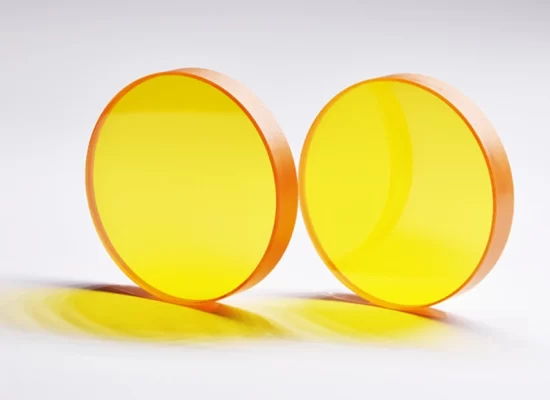
| Material | Zinc Selenide (ZnSe) — yellow transparent polycrystalline, ~70 μm grain size |
| Transmission Range | 0.6 – 21.0 μm — broadest IR transmission of any commonly available IR material |
| Refractive Index | 2.4028 at 10.6 μm |
| Absorption Coefficient | 0.0005 cm⁻¹ at 10.6 μm — extremely low IR absorption |
| Density | 5.27 g/cm³ |
| Hardness | Knoop 120 (50g indenter) |
| Melting Point | 1525°C |
| Surface Quality | 60-40 scratch-dig |
| Key Application | High-power CO₂ laser systems (first-choice material), thermal imaging, IR spectroscopy |
| Max Operating Temp | 250°C in normal atmosphere (oxidation begins ~300°C) |
Product Overview
Zinc Selenide (ZnSe) windows are yellow-transparent polycrystalline IR optical components produced by Chemical Vapor Deposition (CVD) from high-purity Zinc vapor and H₂Se gas on graphite susceptors. Princeton Powder INC supplies CVD ZnSe windows with a transmission range of 0.6 to 21.0 μm — the broadest IR transmission bandwidth of any commonly available IR optical material. With an extremely low absorption coefficient of 0.0005 cm⁻¹ at 10.6 μm, ZnSe is the undisputed first-choice material for high-power CO₂ laser output couplers, beam combiners, and protective windows. The material's low dispersion, low scattering damage, and high resistance to thermal shock make it equally suitable for broadband IR systems operating across the 3–12 μm atmospheric window.
Princeton Powder INC ZnSe windows are manufactured to precision optical specifications: λ/4 surface accuracy at 632.8 nm, 60-40 scratch-dig surface quality, <1 arcminute parallelism, and >90% clear aperture. Broadband anti-reflection (BBAR) coatings optimized for 3–12 μm are available to reduce the native 29.1% reflection loss (at 10.6 μm) to <1% per surface. Windows are supplied from 1 mm to 300 mm diameter with thicknesses from 0.5 mm to 25 mm. Every window undergoes interferometric surface figure verification and spectrophotometric transmission testing before shipment. Contact our optical sales team with your wavelength, power level, and dimensional requirements for a custom ZnSe window quotation.
Material Properties & Optical Specifications
| Property | Specification |
|---|---|
| Material | Zinc Selenide (ZnSe) — CVD polycrystalline, ~70 μm grain size |
| Crystal Structure | FCC Cubic, F43m (#216), Zinc Blende structure (Polycrystalline) |
| Molecular Weight | 144.33 |
| Transmission Range | 0.6 – 21.0 μm — broadest IR transmission of common IR materials |
| Refractive Index | 2.4028 at 10.6 μm |
| Reflection Loss | 29.1% at 10.6 μm (2 surfaces) — AR coating recommended |
| Absorption Coefficient | 0.0005 cm⁻¹ at 10.6 μm — extremely low for high-power laser use |
| Reststrahlen Peak | 45.7 μm |
| dn/dT | +61 × 10⁻⁶/°C at 10.6 μm at 298K |
| Density | 5.27 g/cm³ |
| Melting Point | 1525°C |
| Hardness | Knoop 120 (50g indenter) |
| Thermal Conductivity | 18 W·m⁻¹·K⁻¹ at 298K |
| Thermal Expansion | 7.1 × 10⁻⁶/°C at 273K |
| Specific Heat Capacity | 339 J·Kg⁻¹·K⁻¹ |
| Young's Modulus | 67.2 GPa |
| Bulk Modulus | 40 GPa |
| Apparent Elastic Limit | 55.1 MPa (8000 psi) |
| Poisson Ratio | 0.28 |
| Max Operating Temperature | 250°C in normal atmosphere (oxidation begins ~300°C) |
Why ZnSe Is the First Choice for CO₂ Laser Optics
At the CO₂ laser wavelength of 10.6 μm, ZnSe outperforms every other IR material on three critical metrics: (1) Absorption — 0.0005 cm⁻¹ means minimal thermal lensing even at multi-kW power levels. Ge absorbs ~50× more at 10.6 μm, causing beam distortion under high power. (2) Broadband transmission — 0.6 to 21 μm means a single ZnSe window can serve as both a visible alignment port (HeNe laser at 633 nm) and a CO₂ beam exit window — impossible with Ge (opaque below 1.8 μm). (3) Thermal shock resistance — ZnSe's moderate thermal expansion (7.1×10⁻⁶/°C) combined with reasonable thermal conductivity (18 W·m⁻¹·K⁻¹) provides excellent resistance to thermal gradients during laser start-up. For CO₂ laser systems from 10W to 20kW+, ZnSe remains the undisputed industry standard.
Fabrication Tolerances & Custom Manufacturing
Princeton Powder INC ZnSe windows are fabricated to precision optical tolerances suitable for laser-grade, imaging, and spectroscopic applications. Every window is individually measured and documented:
| Parameter | Standard Tolerance | Precision Option |
|---|---|---|
| Diameter Tolerance | +0.0/-0.1 mm | +0.0/-0.025 mm |
| Thickness Tolerance | ±0.1 mm | ±0.025 mm |
| Surface Accuracy | λ/4 @ 632.8 nm | λ/10 @ 632.8 nm |
| Parallelism | <1 arcminute | <5 arcseconds |
| Surface Quality | 60-40 scratch-dig | 20-10 scratch-dig |
| Clear Aperture | >90% | >95% |
| Bevelling | <0.2 × 45° | Custom bevel specification |
| Coating | Uncoated or BBAR 3-12 μm | Custom wavelength AR, partial reflector, DLC |
How to Order ZnSe Windows
Specify: (1) Diameter and thickness in mm, (2) Required surface accuracy (λ/4 or λ/10), (3) Surface quality (60-40 or 20-10), (4) Coating requirement — uncoated, BBAR 3-12 μm, or custom wavelength, (5) Quantity. Standard lead time: 2-4 weeks for common specifications. Custom coatings and precision tolerances may require 4-6 weeks. Contact our optical engineers at [email protected] with your drawing or specification sheet for a quotation within 24 hours.
Applications
High-Power CO₂ Laser Systems — Output Couplers & Protective Windows
ZnSe is the undisputed industry-standard material for CO₂ laser optics at 10.6 μm. Its extraordinarily low absorption coefficient of 0.0005 cm⁻¹ minimizes thermal lensing and beam distortion even at multi-kilowatt continuous-wave power levels. Princeton Powder INC ZnSe windows serve as: (1) Output couplers — partial reflector ZnSe windows that extract the laser beam from the resonator cavity while maintaining cavity Q. (2) Protective windows — isolating the laser resonator from the work environment in cutting, welding, and marking systems. (3) Beam combiners — combining visible alignment beams (HeNe 633 nm) with the CO₂ beam on a single optic, leveraging ZnSe's visible-to-IR broadband transmission. For OEM CO₂ laser manufacturers and system integrators, we offer volume pricing and Kanban delivery programs for recurring ZnSe window requirements.
Forward-Looking Infrared (FLIR) & Thermal Imaging Systems
ZnSe windows covering the 3–12 μm atmospheric transmission band are ideal for thermal imaging system front optics, protective windows, and lens elements. Unlike Germanium — which becomes opaque above ~100°C due to thermal runaway — ZnSe maintains transmission at elevated temperatures, making it suitable for imaging systems deployed in high-ambient-temperature environments such as engine compartments, industrial process monitoring, and firefighting thermal cameras. Princeton Powder INC supplies ZnSe windows with broadband AR coatings (Ravg < 1% from 3–12 μm) specifically optimized for uncooled microbolometer (8–14 μm) and cooled InSb/MCT (3–5 μm) detector systems.
IR Spectroscopy & Scientific Instrumentation
ZnSe's broad 0.6–21 μm transmission range makes it the preferred window and beamsplitter material for FTIR spectrometers, covering the entire mid-IR fingerprint region in a single optic. Key spectroscopy applications include: ATR (Attenuated Total Reflectance) crystals for sample analysis in pharmaceutical, polymer, and chemical QC labs; Gas cell windows for environmental monitoring and emissions testing; Beamsplitters for FTIR interferometers requiring broad spectral coverage without substrate absorption artifacts. Princeton Powder INC supplies spectroscopy-grade ZnSe with λ/10 surface accuracy and 20-10 surface quality for demanding analytical instrument applications.
Why Choose Princeton Powder INC ZnSe Windows
- Broadest IR Transmission — 0.6 to 21 μm: One ZnSe window covers visible alignment through long-wave IR — no other common IR material (Ge, Si, ZnS, CaF2) provides this bandwidth. Align with a visible laser, operate at 10.6 μm, all through the same optic.
- Lowest Absorption at 10.6 μm — 0.0005 cm⁻¹: For CO₂ laser optics, absorption = heat = thermal lensing = beam distortion. ZnSe's ultra-low absorption coefficient at 10.6 μm directly translates to stable beam quality at high power.
- CVD-Grown Polycrystalline — Consistent Optical Quality: Chemical Vapor Deposition produces ZnSe with uniform refractive index throughout the blank — no grain-boundary scattering, no bulk inclusions, consistent performance window-to-window.
- Full Coating Service In-House: BBAR for 3-12 μm, narrowband AR at 10.6 μm, partial reflectors (50%, 70%, 90% R), DLC (Diamond-Like Carbon) protective overcoats for harsh environments. Coatings are designed and deposited in-house — no subcontractor delays.
- Interferometric Verification — Every Window: Each ZnSe window ships with an interferogram showing transmitted wavefront error (TWE) at 632.8 nm. Surface figure data, not just a pass/fail checkmark.
- ISO 9001 Certified + Engineering Support: Free technical consultation on ZnSe window selection, coating design, and mounting recommendations. Complete documentation package with every order including transmission spectrum and interferometry report.
Frequently Asked Questions
Why is ZnSe preferred over Germanium for CO₂ laser windows?
ZnSe has approximately 50× lower absorption at 10.6 μm compared to Germanium (0.0005 vs ~0.027 cm⁻¹). This directly translates to reduced thermal lensing, stable beam quality, and higher damage threshold at multi-kW power levels. Additionally, ZnSe is transparent in the visible spectrum (yellow), allowing alignment with a HeNe laser through the same window — Ge is opaque to visible light.
What is the maximum temperature ZnSe windows can withstand?
ZnSe windows should not exceed 250°C in normal atmosphere. Oxidation begins at approximately 300°C, and the material dissociates around 700°C. For higher-temperature applications, consider ZnS (usable to ~250°C but with different transmission characteristics) or sapphire (Al2O3) for extreme environments.
Do ZnSe windows require anti-reflection (AR) coating?
Uncoated ZnSe has a 29.1% reflection loss at 10.6 μm (from two surfaces due to high refractive index n=2.4028). For most applications, AR coating is strongly recommended — a BBAR coating reduces per-surface reflection to <1%, improving total transmission from ~71% to >98%. Princeton Powder INC offers standard BBAR for 3-12 μm and custom narrowband AR coatings.
How should ZnSe windows be handled and stored?
ZnSe is a relatively soft material (Knoop 120) — handle with powder-free gloves or finger cots to avoid scratches and contamination. The material is mildly hygroscopic; store in a dry environment with desiccant. Clean with anhydrous isopropanol or acetone and lens tissue using the drop-and-drag method. Never use water-based cleaners as ZnSe is slightly soluble in water (0.001g/100g).
What sizes of ZnSe windows can Princeton Powder INC supply?
Standard diameters from 5 mm to 300 mm, thicknesses from 0.5 mm to 25 mm. Larger custom sizes available on request. Common CO₂ laser window sizes (1.0", 1.5", 2.0", 3.0" diameter) are typically maintained in stock for quick delivery. Rectangular, square, and shaped windows available to customer drawings.
Can ZnSe windows be used with femtosecond or ultrafast lasers?
Yes — ZnSe's low group velocity dispersion (GVD) in the mid-IR makes it suitable for ultrafast laser applications. However, for high-peak-power femtosecond pulses, thin windows (0.5-1 mm) are recommended to minimize nonlinear effects and pulse broadening. Princeton Powder INC supplies thin, precision-polished ZnSe windows specifically for ultrafast mid-IR laser systems.
Research & Technical References
The following peer-reviewed research demonstrates ZnSe optical performance in high-power laser and IR systems. Princeton Powder INC ZnSe windows meet or exceed the material specifications referenced in these studies.
Thermal Lensing in ZnSe Output Couplers Under Multi-kW CO₂ Laser Operation
Applied Optics (Optica Publishing Group), 2020 — Measured thermal lensing in CVD ZnSe windows under 2-8 kW CW CO₂ laser irradiation. Demonstrated that ZnSe's absorption coefficient of 0.0005 cm⁻¹ at 10.6 μm produces negligible thermal focusing (f > 500 m) below 4 kW, and manageable lensing up to 8 kW with appropriate cooling. Practical takeaway: Princeton Powder INC's low-absorption CVD ZnSe windows maintain beam quality in industrial CO₂ laser systems up to multi-kW power levels — the absorption coefficient is the critical parameter for high-power laser window selection.
Broadband Antireflection Coatings on ZnSe for 3-12 μm Multispectral Systems
Optical Engineering (SPIE), 2019 — Designed and tested multilayer AR coatings on CVD ZnSe substrates achieving Ravg < 0.8% across 3-12 μm with >92% transmission at 10.6 μm. Demonstrated environmental durability per MIL-C-48497A: adhesion, humidity, moderate abrasion, and temperature cycling (-40°C to +85°C). Practical takeaway: Princeton Powder INC's in-house BBAR coating service delivers the same multi-spectral performance validated in this study — enabling a single ZnSe window to serve visible through LWIR applications with minimal reflection loss.
Comparative Study of IR Window Materials: ZnSe vs ZnS vs Ge for 8-14 μm FLIR Systems
Infrared Physics & Technology (Elsevier), 2018 — Compared ZnSe, multispectral ZnS, and Ge as protective windows for thermal imaging systems across environmental temperature range -30°C to +70°C. ZnSe demonstrated the best combination of broadband transmission (visible through 14 μm) and thermal stability. Ge became opaque above 70°C; ZnS had lower transmission at 10.6 μm. Practical takeaway: For thermal imaging systems requiring visible alignment capability or operation at elevated ambient temperatures, ZnSe provides the most versatile optical performance across the full IR spectrum.
Contact Princeton Powder INC's optical engineering team for the full ZnSe reference library and to discuss window specifications for your specific laser, imaging, or spectroscopy application — including AR coating design and mounting geometry recommendations.