
KTN (KTa1-xNbxO3) Single Crystal Electro-Optic Substrates
High-purity KTN (KTa1-xNbxO3, Potassium Tantalate Niobate) single crystal substrates deliver exceptional quadratic electro-optic performance for next-generation optical devices. Renowned for possessing one of the highest Kerr constants among ferroelectric perovskites, KTN crystals enable ultrafast optical beam deflectors, high-speed phase modulators, and tunable laser systems with minimal driving voltages.
Optimized for advanced photonics research and thin-film epitaxy, KTN substrates feature low dielectric loss, superior optical homogeneity, and excellent structural stability near its Curie temperature. We supply premium-grade KTN single crystals in standard (100), (110), and (111) orientations with atomic-level surface polishing (Ra < 0.5 nm). Contact our technical sales team for custom Ta/Nb ratio tuning, specific dimensions, and OEM volume pricing.
Technical Specifications
| Parameter | Value |
|---|---|
| Product | KTN — KTa1-xNbxO3, Potassium Tantalate Niobate Solid Solution, Cubic Perovskite |
| Lattice Constant | a ≈ 3.989-4.0 Å (Nb-content dependent) |
| Curie Temperature | ~20-30°C (x≈0.37, near-RT); tunable by Nb composition x |
| EO r33 (linear) | >600 pm/V — ~20× LiNbO3 (31 pm/V); largest EO coefficient of any known crystal |
| Kerr Effect | One of the largest quadratic EO (Kerr) coefficients known — maximized near Tc |
| Half-Wave Voltage Vπ | ~500V→50V over 5-95°C range (Cu:KTN) — extremely low |
| R.I. / Transmission | n≈2.23-2.234 | 400–4,000 nm |
| Key Feature | Vπ~50V enables CMOS-compatible EO drive — eliminating kilovolt amplifiers |
| Primary Applications | Ultra-low-voltage EO modulators, solid-state beam deflectors, Q-switches, holographic storage |
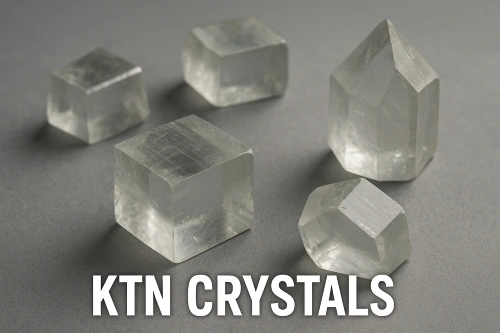
Product Overview
KTN (KTa1-xNbxO3) exhibits the largest electro-optic effect of any known crystal — r33>600 pm/V (~20× LiNbO3) and a giant quadratic (Kerr) coefficient maximized near the composition-tunable Curie point (~20-30°C for x≈0.37). The practical consequence: half-wave voltages as low as ~50V — enabling compact, CMOS-drivable EO modulators and solid-state beam scanners. Princeton Powder supplies KTN with custom Nb composition to tune Tc, in (100), (110), (111) orientations.
Technical Specifications
| Parameter | Specification |
|---|---|
| Composition | KTa1-xNbxO3; x=0.35-0.45 (Tc from -20°C to +80°C) |
| Crystal Structure | Cubic perovskite Pm3m (above Tc); tetragonal/orthorhombic (below Tc) |
| Density / Melting Pt | 7.015 g/cm³ | ~1,350°C (incongruent) |
| Curie Temperature | 20-30°C (x≈0.37); 52°C (Cu:KTN x≈0.43) |
| EO r33 (linear) | >600 pm/V — ~20× LiNbO3 |
| Kerr Effect | Giant quadratic EO — maximized near Tc; Δn>10⁻² at modest E-fields |
| Vπ (Half-Wave) | ~500V→50V over 5-95°C (Cu:KTN) |
| Coercive Field | 250 V/mm |
| R.I. / Transmission | n≈2.23; 400–4,000 nm |
| Thermal Conductivity | 0.17 W/m·K @300K |
| Orientations / Sizes | (100)(110)(111) ±0.5°; 5×5-15×15mm²; 0.5mm thick; SSP/DSP Ra<10Å |
Applications
Ultra-Low-Voltage EO Modulators
KTN's Vπ~50V — 10-100× lower than LN — enables fiber-coupled EO modulators driven directly by RF amplifiers without voltage step-up transformers.
Solid-State Beam Deflectors
KTN Kerr deflectors achieve >±10° scanning at kHz speeds — replacing galvanometer mirrors in lidar, OCT, and free-space optical communication.
Compact Q-Switches
Vπ~50-100V Pockels cells enable battery-powered Q-switched lasers for handheld lidar and medical lasers — no bulky HV supplies.
FAQ
Why does KTN need temperature stabilization?
Kerr coefficient diverges as T→Tc — giving extraordinary EO performance but amplifying temperature sensitivity. Typical: ±0.1°C for quantitative Kerr; ±0.5°C for switching/modulation.
What Nb composition x for my Curie temperature?
x≈0.37 → Tc~20-30°C (near-RT, max Kerr). x≈0.40 → Tc~40-50°C (better stability). Higher x → higher Tc, ferroelectric (linear EO). Contact our technical team for optimization.
KTN vs LiNbO3 for EO?
KTN: Vπ~20× lower, needs ±0.1°C control, more expensive. LN: mature, cheaper, no thermal management. Choose KTN when drive voltage is primary constraint.