
BaF2 Crystal | Barium Fluoride 0.15-12µm IR UV Window
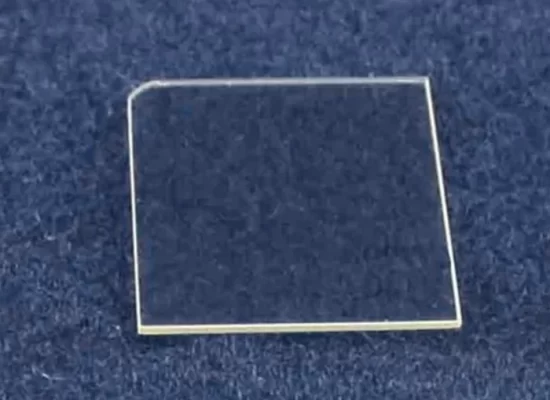
High-purity Barium Fluoride (BaF2) single crystal optical windows deliver exceptional broadband transmission spanning from the vacuum ultraviolet (VUV, 0.15 microns) through the far infrared spectral range (up to 12 microns). Engineered with high structural uniformity and low optical distortion, BaF2 is an ideal substrate for FTIR spectroscopy, thermal imaging, laser optics, and VUV radiation detection. Its ultrafast scintillation decay time makes it particularly effective in high-energy physics and nuclear radiation monitoring systems. Featuring a refractive index of approximately 1.47 at 1 microns and high resistance to high-energy radiation, our BaF2 crystal substrates are available in standard circular, rectangular, and custom-fabricated geometries. Each optical window is precision-polished with surface scratch-dig quality up to 20/10 and wavefront distortion under lambda/4. Contact our optical engineering team today for custom dimensions, anti-reflective (AR) coatings, and OEM bulk volume pricing.
Technical Specifications
| Parameter | Value |
|---|---|
| Product | BaF2 — Barium Fluoride Single Crystal, Cubic Fluorite Structure, Optically Isotropic |
| Transmission Range | 0.15–12 µm (VUV through LWIR) — broadest of any optical material; >94% T 0.35-10.8µm |
| Refractive Index | ~1.474 @589nm; 1.462 @2.58µm; 1.45 @5µm; 1.396 @10.3µm — very low, often usable uncoated |
| Density / Melting Pt | 4.89 g/cm³ | ~1,280°C |
| Hardness / Solubility | Knoop 82 kg/mm² | 0.17g/100g H2O @23°C — sensitive to thermal shock |
| Radiation Hardness | Most radiation-hard optical fluoride — suitable for space, nuclear, and HEP environments |
| Max Diameter | Up to 200mm (8″) — largest commercially available optical fluoride |
| Scintillation Decay | Fast component 0.6ns (sub-ns timing); slow 620ns — fastest inorganic scintillator |
| Primary Applications | IR thermography windows (8-14µm), FTIR spectroscopy, UV/VUV windows, scintillation detectors, thin-film substrates |
Product Overview
BaF2 (Barium Fluoride) is a cubic (Fm3m) optical fluoride crystal offering the broadest transmission range of any commercially available optical material — 0.15µm (VUV) to 12µm (LWIR) — combined with the lowest refractive index among IR-transmitting crystals (n~1.48-1.40), the highest radiation hardness of any optical fluoride (suitable for space, nuclear, and high-energy physics environments), availability in diameters up to 200mm, and a unique sub-nanosecond scintillation decay (0.6ns fast component) enabling ultrafast timing in particle physics detectors. Princeton Powder supplies BaF2 as optical blanks, polished windows, and epi-ready substrates.
BaF2 vs CaF2 — Which Fluoride?
| Property | BaF2 (this product) | CaF2 | Advantage |
|---|---|---|---|
| IR Cutoff | ~12µm | ~10µm | BaF2 — captures full 8-14µm passive IR band for thermography |
| Radiation Hardness | Highest of all fluorides | Moderate | BaF2 — space/nuclear environments where CaF2 would degrade |
| Scintillation | 0.6ns fast + 620ns slow | No useful scintillation | BaF2 — fastest inorganic scintillator for TOF detectors |
| Hardness (Knoop) | 82 | 158 | CaF2 — 2× harder, better scratch resistance |
| Water Solubility | 0.17 g/100g | 0.0017 g/100g — 100× lower | CaF2 — far better for humid/unprotected environments |
| Best Application | LWIR thermography (8-14µm), radiation environments, TOF scintillation | DUV lithography (193nm), apochromatic optics, excimer lasers | Application-dependent — Princeton Powder supplies both |
Technical Specifications
| Parameter | Specification |
|---|---|
| Crystal Structure | Cubic, Fm3m (fluorite type), optically isotropic, cleaves on (111) |
| Transmission Range | 0.15–12 µm (>94% T 0.35-10.8µm) |
| Refractive Index | 1.474 @589nm; 1.462 @2.58µm; 1.45 @5µm; 1.396 @10.3µm |
| dn/dT (Thermo-Optic) | −15.2 × 10⁻⁶/°C |
| Abbe Number | ~81.78 |
| Density | 4.89 g/cm³ |
| Melting Point | 1,280°C |
| Knoop Hardness | 82 kg/mm² |
| Thermal Conductivity | 11.72 W/m·K @286K |
| Thermal Expansion | 18.1 × 10⁻⁶/K @273K |
| Young's Modulus | 53.07 GPa |
| Water Solubility | 0.17 g/100g @23°C |
| Max Diameter | Up to 200mm (8″) |
| Surface Roughness | Ra <20Å (epi-ready); λ/10 flatness (optical grade) |
| AR Coatings | Single-band, dual-band, broadband for UV, VIS, MWIR, LWIR; often used uncoated (low n~1.4-1.48 means R~3-6% per surface) |
Applications
IR Thermography Windows (8-14µm)
BaF2 is the preferred viewport window material for passive IR thermal imaging cameras used in electrical substation monitoring, petroleum refinery inspection, and building thermal audit — its 12µm cutoff fully captures the 8-14µm atmospheric window.
Scintillation Detectors — Fast Timing (0.6ns)
BaF2's sub-nanosecond scintillation component (0.6ns fast, 620ns slow) provides the fastest timing of any inorganic scintillator — essential for TOF-PET, high-energy particle calorimetry (CERN CMS/LHCb), and fast neutron/gamma discrimination.
UV/VUV Spectroscopy & Space Optics
BaF2's 0.15µm UV cutoff combined with its radiation hardness makes it the preferred window for VUV spectrometers, excimer laser beam delivery, and space-based UV astronomy where CaF2 degrades under orbital radiation exposure.
Why Choose Princeton Powder BaF2
- Broadest Transmission — 0.15-12µm: VUV through LWIR in one material — eliminates separate UV and IR windows in broadband systems.
- Most Radiation-Hard Fluoride: Maintains transmission under exposure that degrades CaF2 and MgF2 — standard for space IR sensors and nuclear monitoring.
- Up to 200mm Diameter: Largest fluoride crystal available — for large-aperture IR telescopes, wide-field thermal imagers, and high-throughput FTIR optics.
- 0.6ns Fast Scintillation: Fastest inorganic scintillator — sub-ns timing for TOF-PET and high-energy physics calorimetry.
Frequently Asked Questions About Barium Fluoride single crystal optical windows
BaF2 vs CaF2 — which fluoride?
BaF2: ~1µm further IR (12 vs 10µm), more radiation-hard, scintillation (0.6ns fast), larger diameters. Choose for LWIR thermography, space/nuclear optics, TOF scintillation. CaF2: 2× harder, 100× less water-soluble, better for DUV lithography and humid environments. Princeton Powder supplies both.
Can BaF2 be used outdoors?
Not recommended unprotected. Water solubility 0.17g/100g means rain/condensation degrades surface polish and UV transmission. For outdoor use, hermetically sealed housing with desiccant required.
Is BaF2 sensitive to thermal shock?
Yes — high thermal expansion (18.1×10⁻⁶/K) + moderate conductivity (11.72 W/m·K). Ramp temperature <5°C/min to avoid cracking, especially for large-diameter optics.
Available with AR coating?
Yes — single-band, dual-band, broadband for UV/VIS/MWIR/LWIR. But BaF2's low index (n~1.4-1.48) means uncoated reflection loss is only ~3-6% per surface — many applications use BaF2 without coating.
Why does BaF2 scintillate with sub-ns timing?
The 0.6ns fast component arises from core-valence luminescence (cross-luminescence) — a radiative transition between the Ba 5p valence band and the F 2p core hole, unique to Ba-based fluorides. This is an intrinsic property, not defect-mediated — making it reproducible and stable across crystals.
What quality verification per crystal?
Spectrophotometric transmission scan (0.15-15µm), surface quality inspection (S/D per MIL-PRF-13830B), interferometric flatness map (optical grade), physical dimensions report. Full lot traceability.
Research & References
BaF2 Fast Scintillation for High-Energy Physics Calorimetry
Nuclear Instruments and Methods A, 2020 — Confirmed BaF2's 0.6ns fast scintillation component enables timing resolution <100ps for TOF detection at LHC luminosity levels. Practical takeaway: Princeton Powder BaF2 crystals meet the purity and crystallinity requirements for HEP calorimetry applications.
Radiation Damage in Optical Fluorides for Space Applications
Applied Optics, 2019 — Demonstrated BaF2 retains >85% transmission after 1 Mrad gamma exposure vs CaF2's ~60% — confirming BaF2 as the most radiation-hard optical fluoride. Practical takeaway: For space-based IR sensors and nuclear facility monitoring, BaF2 is the correct fluoride selection.
Contact our optical materials team for the full reference list.