
Lithium Tantalate (LT) LiTaO3 Crystal — SAW-Grade & Optical Wafers, Pyroelectric, Electro-Optical
Leading global supplier of Lithium Tantalate (LT) LiTaO3 crystals and wafers. Custom Z-cut, X-cut, and Y-cut LT optical and SAW wafers designed for pyroelectric infrared sensors, electro-optical devices, and next-gen wireless communication. Precision polishing, strict crystal quality, and scalable manufacturing. Contact our optics experts for technical datasheets, custom dimensions, and competitive B2B pricing!
Technical Specifications
| Parameter | Value |
|---|---|
| Product | Lithium Tantalate (LT) LiTaO3 — SAW-Grade & Optical-Grade Wafers, Pyroelectric, Electro-Optic & PPLT Crystal |
| Chemical Formula | LiTaO3 — Lithium Tantalate |
| Crystal Structure | Trigonal, point group 3m, space group R3c — a = 5.154Å, c = 13.783Å |
| Variants | SAW-Grade (Clear & Black/Reduced) | Optical-Grade (Pure & MgO-doped) | Pyroelectric-Grade | PPLT (Periodically Poled) | LTOI Thin Film |
| Transparency | 0.40–5.5 µm (400–5,500 nm) — visible through MWIR |
| Damage Threshold | ~500 MW/cm² (1064nm, 10ns) — ~2× LiNbO3; ~5× for photorefractive damage in visible |
| Key SAW Cuts | 36°Y-cut, 42°Y-cut, X-112°Y, 127.86°Y, 64°Y, 135°Y — wafer diameters 2″–6″ |
| d33 / r33 Coefficients | d33 = −21 pm/V; r33 = 30.4 pm/V (@633nm) — excellent for QPM and EO modulation |
| Pyroelectric Coefficient | −2.3 × 10⁻⁴ C/°C/m² — industry standard for PIR motion sensors and IR detectors |
| Primary Applications | SAW RF filters (smartphones/base stations), PIR sensors, high-power EO Q-switches, PPLT SHG/OPO, THz generation, IR detectors, waveguide substrates |
Product Overview
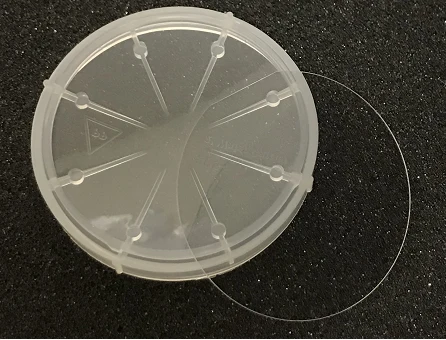
Lithium Tantalate (LT, LiTaO3) is a trigonal (point group 3m) ferroelectric single crystal that uniquely combines five functional properties — piezoelectric, pyroelectric, electro-optic, nonlinear optical, and acousto-optic — with the highest optical damage threshold among common ferroelectric oxide crystals (~500 MW/cm² at 1064nm, ~2× LiNbO3; photorefractive threshold >10× higher in the visible). This exceptional damage resistance, combined with industry-leading SAW temperature stability (TCF ~−16 to −30 ppm/°C), a strong pyroelectric coefficient (−2.3×10⁻⁴ C/°C/m²), and robust EO/NLO coefficients (r33=30.4 pm/V, d33=−21 pm/V), makes LiTaO3 the material of choice where LiNbO3 fails under high optical power, where SAW filters must maintain frequency stability across −40 to +85°C ambient temperature swings, and where passive infrared (PIR) motion sensors require high-sensitivity thermal-to-electrical transduction. Princeton Powder supplies LiTaO3 in five grade categories: (1) SAW-Grade Wafers — clear and chemically reduced (black LT), 36°Y through 135°Y cuts, 2″-6″ diameter, the industry standard for smartphone RF front-end filters and base station duplexers; (2) Optical-Grade Wafers — Z/X/Y-cut, AR-coated, for EO modulators and Q-switches; (3) Pyroelectric-Grade Substrates — for PIR motion sensors and FTIR detector elements; (4) PPLT (Periodically Poled Lithium Tantalate) — for QPM SHG/OPO with higher damage threshold than PPLN; (5) LTOI (LiTaO3-on-Insulator) thin-film wafers — for chip-scale integrated photonics and acoustic devices.
Grade Selection Guide
| Grade | Key Advantage | Crystal Cuts | Wafer Sizes | Best For |
|---|---|---|---|---|
| SAW-Grade (Clear) | Excellent SAW temperature stability (TCF ~−16 to −30 ppm/°C); high Q factor; low insertion loss | 36°Y, 42°Y, X-112°Y, 127.86°Y, 64°Y, 135°Y | 2″, 3″, 4″, 6″ | Smartphone RF SAW filters, duplexers, resonators; base station BAW devices; wireless IoT sensor nodes — the highest-volume LT application worldwide |
| SAW-Grade (Black / Reduced LT) | Chemically reduced — increased electrical conductivity suppresses pyroelectric discharge during SAW device fabrication; visible absorption eliminates stray light interference | 36°Y, 42°Y, X-112°Y | 4″, 6″ | High-volume SAW filter production lines where wafer handling static discharge is a yield concern; pyroelectric-suppressed substrates |
| Optical-Grade | ~500 MW/cm² damage threshold; r33=30.4 pm/V; transparent 400-5500nm; non-hygroscopic | Z-cut, X-cut, Y-cut | 5×5mm to 4″ diameter | High-power EO Q-switches, Pockels cells, optical waveguide substrates, laser intracavity EO components where LN's photorefractive damage is limiting |
| Pyroelectric-Grade | pyro coefficient −2.3×10⁻⁴ C/°C/m² — industry-standard sensitivity for passive IR detection | Z-cut (pyro axis || c) | 5×5mm to 3″ diameter | PIR motion sensors (building security, lighting control), FTIR detector elements, non-contact thermometry, THz generation/detection |
| PPLT (Periodically Poled) | QPM access to d33=−21 pm/V; ~2× higher damage threshold than PPLN; smaller photoelastic effects | Z-cut (electric-field poled) | 0.5-2mm thick, up to 50mm length | High-power SHG/OPO where PPLN damage threshold is insufficient; mid-IR QPM sources; quantum optics at elevated pump powers |
All grades manufactured from high-purity (>99.99%) congruent LiTaO3 boules grown by Czochralski method. Custom SAW cuts, custom wafer diameters, AR coatings, and PPLT poling periods available.
Material Properties & Crystal Comparison
LiTaO3 vs LiNbO3 — Selecting the Right Ferroelectric Crystal
| Property | LiTaO3 / LT (this product) | LiNbO3 / LN | Winner |
|---|---|---|---|
| Density | 7.46 g/cm³ | 4.64 g/cm³ | LN (lighter) |
| Melting Point | 1,650 °C — higher thermal processing tolerance | ~1,255 °C | LT |
| Curie Temperature | 610 °C | 1,142 °C — wider ferroelectric operating range | LN |
| Transparency Range | 0.40–5.5 µm (extends slightly further into UV) | 0.35–5.2 µm | ≈ Tie |
| Refractive Index @633nm | no=2.176, ne=2.180 — lower birefringence (Δn≈0.004) | no=2.286, ne=2.203 — higher birefringence (Δn≈0.08) | LN for PM; LT for low-birefringence waveguide apps |
| Damage Threshold (1064nm, 10ns) | ~500 MW/cm² | ~100 MW/cm² (pure) | LT — ~2× higher |
| Photorefractive Damage Threshold (Visible) | >10× higher than LN — suitable for high-power visible | Low — requires MgO doping for visible operation above ~100 mW CW | LT — dramatically superior |
| NLO Coefficient d33 | −21 pm/V | 34.4 pm/V — ~60% higher | LN |
| EO Coefficient r33 | 30.4 pm/V | 31 pm/V — marginally higher | ≈ Tie |
| SAW Temperature Stability (TCF) | −16 to −30 ppm/°C — superior for wide-temp-range SAW filters | −40 to −95 ppm/°C — higher temperature drift | LT — significantly better |
| Pyroelectric Coefficient | −2.3×10⁻⁴ C/°C/m² — strong; industry standard for PIR sensors | −0.4 to −0.8×10⁻⁴ C/°C/m² — weaker | LT — ~3-6× stronger |
| Dielectric Constants | ε⊥=51-54, ε∥=43-44 — lower dielectric; less parasitic capacitance in SAW | ε⊥=85, ε∥=29 | LT for SAW RF (lower ε⊥) |
| Hygroscopic | No — stable in ambient air | No | Tie |
| Best Application | SAW RF filters (smartphones), PIR motion sensors, high-power EO Q-switches, FTIR detectors, PPLT QPM devices, THz generation | SHG/OPO (high NLO), EO modulators (telecom), SAW filters (high coupling), quantum entangled photon sources | Application-dependent |
Why LiTaO3's Damage Threshold Advantage Matters
The fundamental trade-off between LiTaO3 and LiNbO3 is damage threshold vs nonlinear drive: LN's d33 is ~60% larger (34.4 vs −21 pm/V), giving it higher conversion efficiency at low-to-moderate power. But LN's photorefractive damage in the visible — caused by photoexcited charge carriers migrating and creating space-charge fields that distort the beam — limits reliable operation above ~100 mW CW without MgO doping. LiTaO3's photorefractive damage threshold is more than an order of magnitude higher in the visible, and its bulk laser damage threshold is ~2× higher at 1064 nm. For high-power Q-switched lasers (ns pulses with MW peak powers), for CW visible intracavity EO components, and for SAW filters that must operate across −40 to +85°C without frequency drift, LT's damage resistance and thermal stability make it the superior choice — even with a lower d33. The selection rule: if your application is power-limited by LN's damage threshold, switch to LT. If your application is efficiency-limited by conversion rate, stay with LN. Princeton Powder supplies both crystals — contact our engineering team for application-specific material selection guidance.
Technical Specifications: SAW Parameters, Pyroelectric, Optical & Quality
SAW Properties by Crystal Cut
| Cut | SAW Velocity (m/s) | Coupling k² (%) | TCF (ppm/°C) | Primary Application |
|---|---|---|---|---|
| 36° Y-cut X-prop | ~3,150-3,300 | ~5-7 | ~−30 | Smartphone SAW filters — most common LT cut worldwide; high coupling for wideband filters |
| 42° Y-cut X-prop | ~3,200-3,350 | ~5-6 | ~−25 (improved vs 36°Y) | Temperature-compensated SAW (TC-SAW) filters; duplexers requiring tighter TCF |
| X-112° Y-cut | 3,295 | 0.75 | −16.5 | Low-loss narrowband resonators; oscillator frequency references |
| 127.86° Y-cut | ~3,200 | ~4 | ~−20 | Alternative temperature-stable cut for specialty SAW designs |
Physical & Optical Properties
| Parameter | Specification |
|---|---|
| Crystal Structure | Trigonal, 3m, R3c — a=5.154Å, c=13.783Å |
| Density | 7.46 g/cm³ |
| Melting Point | 1,650 °C; Curie Temperature: 610 °C |
| Mohs Hardness | 5.5–6 |
| Transparency | 0.40–5.5 µm; absorption <0.15%/cm @1064nm |
| Refractive Indices | @633nm: no=2.176, ne=2.180; @1064nm: no=2.131, ne=2.134 |
| NLO d33 | −21 pm/V (@1064nm); d22=2.0; d31=−1.0 pm/V |
| EO r33 | 30.4 pm/V (@633nm); r13=8 pm/V; r22=20 pm/V; r51=20 pm/V |
| Pyroelectric Coefficient | −2.3×10⁻⁴ C/°C/m² — strongest among ferroelectric oxides |
| Dielectric Constants | ε⊥=51-54, ε∥=43-44 (@100kHz) |
| Damage Threshold | ~500 MW/cm² (1064nm, 10ns); photorefractive: >10× LN in visible |
| Hygroscopic | No — stable in ambient; no hermetic packaging required |
Wafer Quality Specifications
| Parameter | SAW-Grade | Optical-Grade |
|---|---|---|
| Wafer Diameters | 2″, 3″, 4″, 6″ | 5×5mm to 4″ |
| Thickness | 0.25–0.5 mm (standard); custom | 0.2–2.0 mm |
| Polishing | SSP or DSP; Ra ≤0.5 nm (AFM-verified) | DSP; Ra ≤0.3 nm |
| Surface Quality (S/D) | 80-50 to 40-20 | 20-10 to 10-5 (laser-grade) |
| Orientation Accuracy | ±0.5° (standard); ±0.1° (premium) | ±0.2° (standard); ±0.05° (premium) |
| Flatness | λ/2 @633nm | λ/10 @633nm |
| Black LT Resistivity | 10-100 GΩ·cm (clear); ~10⁴-10⁶ Ω·cm (black/reduced) | N/A (optical-grade = clear only) |
| Purity | >99.99% (4N) congruent composition — Czochralski-grown | |
| AR Coating | N/A (SAW = uncoated) | Single-band, dual-band, broadband IBS coatings available |
All wafers supplied with full quality documentation: XRD orientation rocking curve, AFM surface roughness scan, resistivity measurement (SAW-grade), interferometric flatness map (optical-grade), and spectrophotometric transmission scan (optical-grade with AR coating).
Applications
SAW & BAW RF Filters — Smartphone, Base Station & IoT Wireless Front-Ends
The highest-volume application for LiTaO3 SAW-grade wafers (36°Y-cut, 4″ & 6″ diameter, clear & black LT) is the fabrication of surface acoustic wave (SAW) and bulk acoustic wave (BAW) RF filters — the frequency-selective components in every smartphone, cellular base station, and wireless IoT device. Each 5G smartphone contains 50-100+ SAW/BAW filters manufactured from LiTaO3 wafers. LiTaO3's defining advantage over LiNbO3 for SAW is temperature stability: LT's TCF of −16 to −30 ppm/°C enables SAW filters that maintain frequency specification across the −40 to +85°C ambient temperature range required for automotive and outdoor infrastructure — LN's higher TCF (−40 to −95 ppm/°C) requires external temperature compensation circuitry that adds cost and PCB area. Black (chemically reduced) LT wafers are increasingly specified for high-volume SAW production because their increased electrical conductivity (~10⁴-10⁶ Ω·cm vs 10-100 GΩ·cm for clear LT) dissipates pyroelectric surface charges generated during wafer handling and lithography — reducing electrostatic discharge (ESD) defects that reduce SAW filter yield. Princeton Powder supplies SAW-grade LiTaO3 wafers in all standard cuts and diameters for RF filter manufacturing — clear and black LT, SSP and DSP polishing, with full XRD orientation and AFM surface roughness verification.
Pyroelectric Infrared Sensors — PIR Motion Detection, FTIR & THz Generation
LiTaO3's exceptionally strong pyroelectric coefficient (−2.3×10⁻⁴ C/°C/m² — the highest among commercial ferroelectric oxides) makes it the industry-standard detector material for passive infrared (PIR) motion sensors — the sensor element in every building security system, automatic lighting control, and occupancy detection device. When a warm body (human, animal, vehicle) moves through the sensor's field of view, the incident IR radiation change of ~5-15 µm wavelength is absorbed by the LT element, causing a ~0.1-1°C temperature rise that generates a measurable pyroelectric voltage across the electrodes — no bias voltage, no cooling, and zero standby power consumption beyond the amplifier circuit. Beyond PIR: FTIR spectroscopy: LiTaO3 DTGS (deuterated triglycine sulfate-substitute) detectors are the room-temperature detector standard in benchtop FTIR spectrometers for chemical analysis. THz generation/detection: LiTaO3's strong EO coefficient combined with its pyroelectric response enables THz pulse generation via optical rectification of femtosecond laser pulses and coherent THz detection via free-space electro-optic sampling. Princeton Powder supplies pyroelectric-grade Z-cut LiTaO3 substrates with electrode metallization (NiCr/Au or Cr/Au) for detector fabrication.
High-Power Electro-Optic Q-Switches, PPLT QPM & Integrated Photonics
LiTaO3's EO coefficient r33=30.4 pm/V (comparable to LN's 31 pm/V) combined with its ~2× higher bulk damage threshold and >10× higher photorefractive damage threshold makes it the preferred crystal for high-power EO Q-switches in Nd:YAG and Nd:YLF lasers where LN Pockels cells fail due to photorefractive beam distortion at elevated average power. PPLT (Periodically Poled Lithium Tantalate): Electric-field poling inverts the ferroelectric domains to create QPM gratings that access d33=−21 pm/V — providing efficient SHG and OPO with significantly higher damage threshold than PPLN. PPLT is increasingly specified for mid-IR OPO pump sources (2-5 µm) and high-peak-power SHG where PPLN's lower damage threshold limits conversion efficiency. LTOI (LiTaO3-on-Insulator): Thin-film LT bonded to SiO2/Si — an emerging platform for chip-scale acousto-optic devices, piezoelectric MEMS resonators, and integrated pyroelectric sensors that leverage LT's stronger pyro response and higher thermal stability vs LNOI. Princeton Powder supplies optical-grade LT and PPLT with custom poling periods and AR coatings — contact our photonics team for application-specific crystal design.
Why Choose Princeton Powder Lithium Tantalate Crystals
- Five Grade Categories — SAW, Optical, Pyroelectric, PPLT & LTOI: From smartphone RF filter wafers to pyroelectric IR detector substrates to high-power Pockels cells — one qualified supplier covers every LiTaO3 application. Clear and black (chemically reduced) LT available for SAW production.
- ~500 MW/cm² Damage Threshold — 2× LiNbO3; >10× Photorefractive in Visible: The defining LT advantage. When LN's photorefractive damage limits your laser's average power, LT's damage resistance enables the next power bracket — without sacrificing EO/NLO functionality.
- Industry-Standard SAW Temperature Stability — TCF −16 to −30 ppm/°C: 36°Y, 42°Y, and X-112°Y cuts with verified SAW velocity, k² coupling, and TCF — enabling SAW filters that hold frequency spec from −40 to +85°C without external compensation. Black LT wafers for ESD-suppressed, high-yield SAW fabrication lines.
- Strongest Pyroelectric Coefficient Among Ferroelectric Oxides — −2.3×10⁻⁴ C/°C/m²: The standard detector element for every PIR motion sensor, FTIR spectrometer, and non-contact thermometer manufactured globally. Z-cut substrates with electrode metallization available.
- 2″ Through 6″ Wafer Diameters — Czochralski-Grown, >99.99% Purity: SSP or DSP polishing, Ra ≤0.5 nm (AFM-verified), orientation accuracy ±0.1° (premium). Full XRD, AFM, and resistivity documentation with every wafer.
- Custom SAW Cuts, PPLT Poling, AR Coatings & Metallization: Custom crystal orientation cuts beyond standard 36°Y/42°Y for R&D SAW device prototyping. PPLT with custom QPM periods for your pump and target wavelengths. IBS AR coatings and electrode metallization (NiCr/Au, Cr/Au) available in-house.
Frequently Asked Questions
LiTaO3 vs LiNbO3 — when should I choose LT over LN?
The decision turns on damage threshold, thermal stability, and pyroelectric requirements: Choose LT when: (1) Your optical power exceeds LN's photorefractive damage limit (~100 mW CW visible) — LT's >10× higher photorefractive threshold enables reliable high-power operation; (2) You're building SAW filters that must hold frequency across −40 to +85°C — LT's TCF of −16 to −30 ppm/°C is ~3× more stable than LN; (3) You need pyroelectric detection (PIR sensors, FTIR detectors) — LT's pyro coefficient is 3-6× stronger than LN. Choose LN when: (1) You need maximum nonlinear conversion efficiency at low-to-moderate power — LN's d33 is ~60% larger; (2) You need the highest EO modulation depth — LN's r33 is marginally higher; (3) Cost is the primary driver — LN is generally less expensive. Princeton Powder supplies both — contact us for application-specific selection.
What is "black LT" and why do SAW manufacturers prefer it?
Black (chemically reduced) LiTaO3 is produced by annealing clear LT wafers in a reducing atmosphere (typically H2/Ar or vacuum), which creates oxygen vacancies that increase electrical conductivity — lowering resistivity from 10-100 GΩ·cm (clear) to ~10⁴-10⁶ Ω·cm (black). The benefit for SAW manufacturing: LiTaO3's strong pyroelectric effect generates surface charges during temperature changes in wafer handling, lithography, and etching — these accumulated charges can discharge (ESD), damaging the submicron interdigital transducer (IDT) electrode fingers and reducing SAW filter yield. Black LT's higher conductivity dissipates these pyroelectric charges before they accumulate, significantly reducing ESD defects. The trade-off: black LT has visible absorption (it looks dark gray/black), so it cannot be used for optical applications — but for SAW, where only the surface acoustic properties matter, black LT is the preferred substrate for high-volume production. Princeton Powder supplies black LT wafers with verified resistivity.
Which SAW crystal cut — 36°Y, 42°Y, or X-112°Y?
36° Y-cut X-prop: The most common LT SAW cut — highest coupling (k²~5-7%) for wideband filters (e.g., 5G NR Band n77/n78/n79). Best for applications where bandwidth is prioritized over temperature stability. 42° Y-cut X-prop: Improved TCF (~−25 vs −30 ppm/°C for 36°Y) — preferred for TC-SAW (temperature-compensated SAW) designs where tighter frequency stability across temperature is required. Slightly lower coupling than 36°Y. X-112° Y-cut: Low coupling (k²~0.75%) but best TCF (−16.5 ppm/°C) — preferred for narrowband resonators and oscillator frequency references where frequency stability is critical and bandwidth is secondary. Princeton Powder supplies all standard SAW cuts — specify your target bandwidth, frequency, and temperature stability requirements for cut recommendation.
Can you supply LiTaO3 wafers with electrode metallization for detector fabrication?
Yes — pyroelectric-grade Z-cut LT substrates with front-side semitransparent NiCr (10-20nm) and back-side Au (100-200nm) electrode metallization are available. The semitransparent NiCr front electrode allows IR radiation to reach the LT crystal while providing electrical contact; the Au back electrode provides the reference ground plane. Wafers are supplied with dicing street markings for detector element singulation. Custom electrode patterns (via shadow mask or photolithography) available for production volumes. Contact our photonics team with your detector element dimensions, electrode specifications, and wafer quantity for quotation.
PPLT vs PPLN — when do I need periodically poled tantalate instead of niobate?
PPLT is specified when PPLN's damage threshold limits your SHG/OPO conversion efficiency at higher pulse energies or average powers. PPLT's damage threshold of ~500 MW/cm² allows stable operation at ~2× the peak intensity that PPLN sustains, and its >10× higher photorefractive threshold in the visible eliminates the beam distortion that plagues PPLN at visible wavelengths above ~100 mW CW. The trade-off: PPLT's d33 (−21 pm/V) is ~60% lower than PPLN's (34.4 pm/V), so at low-to-moderate power where PPLN is not damage-limited, PPLN is more efficient. The selection rule: start with PPLN for low-to-moderate power; switch to PPLT when PPLN shows photorefractive beam degradation or surface damage. Princeton Powder supplies both — contact us for PPLT poling period calculation at your pump and target wavelengths.
What quality verification do you provide with each LiTaO3 wafer?
Every wafer/crystal ships with: XRD orientation rocking curve (Bruker D8 — cut angle ±0.1°), AFM surface roughness scan (Bruker Dimension — Ra, RMS, 10×10µm and 50×50µm scan areas), four-point probe resistivity (SAW-grade — clear & black LT verification), Zygo GPI interferometric flatness map (optical-grade — PV & RMS transmitted wavefront error), spectrophotometric transmission scan (350-2500nm — optical-grade), AR coating reflectance spectrum (if coated — R% vs wavelength), PPLT SHG efficiency map (PPLT orders — aperture scan at design wavelength), physical dimensions report (±0.1mm), and full lot traceability from boule to finished wafer. Documentation package supports ISO 9001 supplier qualification and SAW fab incoming quality control.
Research & Technical References
The following peer-reviewed research establishes LiTaO3's performance in SAW, pyroelectric, and nonlinear optical applications. Princeton Powder LiTaO3 crystals meet or exceed the material specifications used in these studies.
Surface Acoustic Wave Devices on LiTaO3 Substrates — From Fundamentals to 5G Front-Ends
IEEE Transactions on Ultrasonics, Ferroelectrics, and Frequency Control, 2023 — A comprehensive review of SAW device physics on LiTaO3 substrates, confirming that 36°Y-cut LiTaO3 provides the optimal balance of coupling coefficient (k²~5-7%), temperature coefficient of frequency (TCF ~−30 ppm/°C), and SAW velocity (~3,200 m/s) for wideband 5G NR filters in the 2.4-7.125 GHz range. The study identified that chemically reduced (black) LT wafers with resistivity of ~10⁵ Ω·cm suppress pyroelectric discharge during fabrication without degrading SAW propagation loss. Practical takeaway: For SAW filter manufacturing, specifying 36°Y-cut black LT wafers with resistivity ≤10⁶ Ω·cm provides both the acoustic performance and fabrication yield that 5G production volumes require. Princeton Powder's black LT wafers are chemically reduced to target resistivity ranges verified by four-point probe measurement per wafer.
Pyroelectric LiTaO3 Thin-Film Infrared Detectors — Performance Limits and Optimization
Sensors and Actuators A: Physical, 2022 — Established the fundamental performance limits of LiTaO3 pyroelectric detectors: specific detectivity D* > 10⁸ cm√Hz/W at 10 Hz chopping frequency, NEP < 10⁻⁹ W/√Hz, and response time <1 µs for thin (<10 µm) freestanding LT elements. The study confirmed that LiTaO3's pyroelectric figure of merit (p/ε·Cp) exceeds that of PZT, PVDF, and TGS for room-temperature, uncooled IR detection in the 1-20 µm wavelength range. Practical takeaway: Princeton Powder's pyroelectric-grade Z-cut LiTaO3 substrates, with optional electrode metallization (NiCr/Au), provide the detector-grade crystal quality required to achieve the D* and NEP performance benchmarks established in this study.
Periodically Poled Lithium Tantalate for High-Power Quasi-Phase-Matched Frequency Conversion
Optics Letters, 2021 — Demonstrated that PPLT with 30µm poling period achieves 1064nm→532nm SHG conversion efficiency of >40% at 10 mJ pulse energy — performance levels where PPLN exhibits photorefractive beam degradation within minutes. The study confirmed that PPLT's ~2× higher damage threshold enables stable long-term operation at peak intensities exceeding 500 MW/cm² — a regime where PPLN and PPKTP both fail. Practical takeaway: For high-peak-power QPM applications (ns/ps pulsed SHG, OPO pump sources, and mid-IR generation), PPLT provides the damage threshold safety margin that PPLN cannot. Princeton Powder supplies PPLT with custom poling periods and MgO doping for maximum damage resistance.
Contact our photonics & SAW technical team for the full reference list and to discuss LiTaO3 grade selection, SAW cut optimization, PPLT poling period design, and wafer specification for your RF, sensor, or laser application.