
Superelastic Nitinol Straight Wire (ASTM F2063) — Medical Grades, Guidewires, Stents & Orthodontic Applications
High-quality ASTM F2063 medical grade Superelastic Nitinol Straight Wire is specifically engineered for high-precision medical devices and minimally invasive applications. Available in a wide diameter range from 0.05mm to 5.0mm, it perfectly meets strict dimensional requirements from micro-catheters to orthopedic implants. This premium wire leverages two key metallurgical features: Superelasticity (SE) for extreme flexibility, kink resistance, and continuous stress delivery, and Shape Memory Alloy (SMA) properties for precise temperature-triggered shape recovery, high fatigue resistance, and exceptional biocompatibility. Consequently, it serves as an ideal material for critical medical guidewires, self-expanding vascular stents, and orthodontic archwires. We offer customizable transition temperatures, various surface finishes, and precise drawing services under strict ISO 13485 quality control standards to satisfy demanding medical device designs worldwide.
Technical Specifications
| Parameter | Value |
|---|---|
| Product | Superelastic Nitinol Straight Wire — Nickel-Titanium (NiTi) Shape Memory Alloy, Round Cross-Section, ASTM F2063 |
| Material | Nitinol (NiTi) — near-equiatomic nickel-titanium shape memory alloy, 54.5–57.0 wt% Ni, balance Ti per ASTM F2063 |
| Grades Available | TiNi-SS (Medical SE, Af 33±3°C) | Nitinol #1 (SE, Af +10 to +18°C) | Nitinol #2 (SE, Af 0 to +18°C) | TN3/TNC (Low-Temp SE, Af -5 to -30°C) | SM495 (SMA, Af +20 to +40°C) | SM502 (SMA, Af +45 to +90°C) |
| Diameter Range | 0.025mm–7.0mm (0.001″–0.275″) — wire; >5.0mm available as rod |
| AF Temperature | −30°C to +120°C — fully customizable via alloy composition + heat treatment; ±5°C standard tolerance (tighter on request) |
| Surface Finishes | Black oxide, light oxide, pickled/cleaned, etched, polished/bright, electropolished (EMP) — medical implant-grade |
| Packaging | Straight lengths (1m, 2m, 3m) | Spools (100m, 500m, 1000m) | Coils — vacuum-sealed with desiccant |
| Key Properties | Superelastic strain recovery 8-10% | Kink-resistant | Biocompatible (ISO 10993) | Fatigue life >10⁷ cycles | Elastic modulus 75-83 GPa (austenite) / 28-41 GPa (martensite) |
| Applications | Guidewire cores, self-expanding stents, orthodontic archwires, catheter reinforcement, surgical instruments, bone staples, aerospace actuators |
| Standards | ASTM F2063 (Medical Implant-Grade Wrought NiTi) | ASTM F2004 (DSC Transformation Temperature) | ISO 9001:2015 | ISO 13485:2016 |
Product Overview
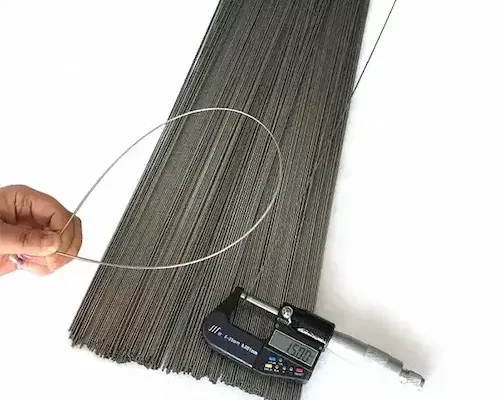
Superelastic Nitinol straight wire (ASTM F2063) is a precision-drawn nickel-titanium (NiTi) shape memory alloy wire with a round cross-section, engineered for applications demanding kink resistance, 8-10% recoverable superelastic strain, and excellent biocompatibility. As the most widely used form of Nitinol in medical devices, straight wire serves as the core material for guidewires, the precursor for self-expanding stent fabrication, orthodontic archwires, and countless minimally invasive surgical instruments. Princeton Powder supplies Nitinol straight wire in six grade families: TiNi-SS (medical SE, Af 33±3°C — the standard for body-temperature implantable devices), Nitinol #1 (SE, Af +10 to +18°C), Nitinol #2 (SE, Af 0 to +18°C), TN3/TNC (low-temp SE, Af -5 to -30°C), SM495 (SMA, Af +20 to +40°C), and SM502 (SMA, Af +45 to +90°C) — with diameters from 0.025mm (0.001") to 7.0mm (0.275"). The alloy's defining advantage over stainless steel, cobalt-chrome, and titanium is its reversible martensitic phase transformation: Nitinol recovers 8-10% strain — 16× the elastic limit of 316L stainless steel (<0.5%) — making it the irreplaceable material for kink-resistant guidewires and self-expanding implants.
Grade Selection Guide
| Grade | Type | Active Af | Behavior at 37°C | Key Characteristic | Best For |
|---|---|---|---|---|---|
| TiNi-SS | Medical SE | 33°C ± 3°C | Fully superelastic | ASTM F2063 body-temp standard — the most specified Nitinol grade for implantable medical devices | Guidewire cores, self-expanding stents, heart valve frames, vascular implants — the medical SE standard worldwide |
| Nitinol #1 | Superelastic | +10 to +18°C | Fully superelastic | 8-10% recoverable strain, kink-resistant, UTS ~1,241 MPa (annealed), elongation >10% | Orthodontic archwires, endoscopic instruments, consumer products (eyeglass frames) |
| Nitinol #2 | Superelastic | 0 to +18°C | Fully superelastic | Wider Af window — superelastic at lower ambient temperatures than #1 | Room-temperature actuators, industrial springs, outdoor equipment |
| TN3 / TNC | Low-Temp SE | −5 to −30°C | Fully superelastic | Superelastic at cryogenic and sub-zero temperatures — unique capability | Cryogenic actuators, aerospace deployment mechanisms, Arctic/marine equipment |
| SM495 | Shape Memory | +20 to +40°C | Activates (transforms) | Ti-Ni-01 per ASTM F2063 — martensitic at room temp, activates near body temp | Orthopedic bone staples, thermal actuators, vascular closure devices |
| SM502 | Shape Memory | +45 to +90°C | Shape memory (stable) | Ti-Ni-02 per ASTM F2063 — higher activation for industrial thermal controls | Fire safety actuators, industrial over-temperature protection, aerospace deployment |
All Nitinol straight wire is manufactured to ASTM F2063 (medical implant-grade wrought nickel-titanium shape memory alloys). Every lot is DSC-verified per ASTM F2004 with Af tolerance of ±5°C standard. Tighter tolerances (±3°C) available for critical medical applications. Contact our technical team with your target diameter, Af temperature, surface finish, and packaging format for quotation.
Material Properties & Performance
Nitinol vs Conventional Medical Metals — Why Superelasticity Matters
| Property | Nitinol (Austenite) | 316L Stainless Steel | CoCr Alloy (L605) | Advantage |
|---|---|---|---|---|
| Recoverable Elastic Strain | 8–10% | <0.5% | <0.5% | 16×+ greater than SS/CoCr — the defining advantage for kink-resistant guidewires and self-expanding stents |
| Elastic Modulus (Austenite) | 75–83 GPa | 193 GPa | 233–243 GPa | ~60% lower stiffness — better compliance with vascular/orthopedic biomechanics, reduced stress shielding |
| Elastic Modulus (Martensite) | 28–41 GPa | N/A | N/A | Ultra-low stiffness when deformed — enables easy crimping of stents into delivery catheters |
| Loading Plateau Stress | ~480–650 MPa | N/A (yields) | N/A (yields) | Constant-force delivery over entire strain range — predictable device performance |
| Ultimate Tensile Strength | ~1,241 MPa (180 ksi — annealed) | ~585 MPa (annealed) | ~1,000 MPa (annealed) | Comparable or superior strength despite lower modulus |
| Density | 6.45 g/cm³ | 8.0 g/cm³ | 9.1 g/cm³ | Lighter — weight savings in implantable and aerospace devices |
| Fatigue Life | >10⁷ cycles (EMP) | 10⁵–10⁶ cycles | 10⁵–10⁶ cycles | 10-100× longer — critical for cardiovascular implants (400M+ cycles over 10-year implant life) |
| Corrosion Resistance | Superior to 316L SS — TiO₂ passive layer, stable at pH 5.2 | Good — Cr₂O₃ passive layer, susceptible to pitting in chloride | Excellent — Cr₂O₃ passive layer | Stable in acidic conditions where 316L SS shows increased Ni release |
| Biocompatibility | ISO 10993 compliant — decades of clinical implant use | ISO 10993 compliant | ISO 10993 compliant | Well-tolerated; electropolishing minimizes Ni ion release to negligible levels |
| Kink Resistance | Excellent — superelastic recovery from extreme bending | Poor — permanent kink beyond yield point | Poor — permanent kink beyond yield point | The single most important property for guidewire and catheter navigation |
How Superelasticity Enables Medical Device Functionality
Nitinol's superelasticity arises from a reversible, diffusionless solid-state phase transformation between austenite (B2 cubic, high-temperature phase) and stress-induced martensite (B19′ monoclinic). Above the austenite finish temperature (Af), Nitinol is fully austenitic. Applied stress induces a local transformation to martensite — accommodating up to 10% strain without dislocation motion or permanent deformation. When stress is removed, the martensite spontaneously reverts to austenite, and the wire returns to its original straight configuration. This is the mechanism behind kink resistance: while a stainless steel wire bent beyond 0.5% strain permanently yields and kinks, a Nitinol wire undergoes the same 8% bend via reversible phase transformation and springs back. The practical implication for medical devices is profound: a Nitinol guidewire can navigate tortuous vascular anatomy — the aortic arch, carotid siphon, coronary vessels — and emerge straight at the target site, whereas a stainless steel wire would kink at the first tight curve and become unusable. Af temperature control is the most critical quality parameter: a 0.1 at.% shift in nickel content changes Af by approximately 10°C. Princeton Powder specifies by Af (not just grade name), provides DSC verification (ASTM F2004) with every lot, and maintains ±5°C standard tolerance.
Diameters, AF Temperature, Surface Finishes & Packaging
Straight Wire Diameters
| Category | Diameter Range | Tolerance | Typical Application |
|---|---|---|---|
| Ultra-Fine | 0.025–0.10 mm (0.001"–0.004") | ±0.0005 mm | Neurovascular guidewires, micro-catheter reinforcement, micro-springs |
| Fine | 0.10–0.50 mm (0.004"–0.020") | ±0.002 mm | Coronary guidewire cores, stone retrieval baskets, dental root canal files |
| Standard Medical | 0.50–2.0 mm (0.020"–0.080") | ±0.005 mm | Orthodontic archwires, peripheral guidewires, endoscopic snares, bone staples |
| Large | 2.0–5.0 mm (0.080"–0.200") | ±0.01 mm | Stent tubing precursor, orthopedic fixation rods, industrial actuators |
| Rod | 5.0–7.0 mm (0.200"–0.275") | ±0.02 mm | Aerospace deployment mechanisms, large industrial actuators, structural SMA components |
Custom diameters available within 0.025–7.0mm range. Specify target diameter and tolerance class when requesting quotation.
AF (Austenite Finish) Temperature — Fully Customizable
The Af temperature is the single most important Nitinol specification — it determines superelastic vs shape memory behavior at the use temperature. Specify by Af, not just grade name. Princeton Powder provides DSC verification (ASTM F2004) with every lot.
| Af Range | Grade | At 20-25°C (Room Temp) | At 37°C (Body Temp) | Typical Medical Application |
|---|---|---|---|---|
| −5 to −30°C | TN3 / TNC | Fully superelastic | Fully superelastic | Cryogenic surgical tools, low-temp storage devices |
| 0 to +10°C | Nitinol #2 | Fully superelastic | Fully superelastic | Room-temp devices, consumer products |
| +10 to +18°C | Nitinol #1 | Superelastic (some Af above room temp may be partially martensitic) | Fully superelastic | Orthodontic archwires, endoscopic instruments |
| 33°C ± 3°C | TiNi-SS | Partially martensitic (soft, deformable) | Fully superelastic | Guidewire cores, self-expanding stents, heart valve frames — body-temp implant standard |
| +20 to +40°C | SM495 | Shape memory (deformable) | May activate near body temp | Orthopedic bone staples, body-temp actuators |
| +45 to +90°C | SM502 | Shape memory (deformable) | Shape memory (stable) | Industrial thermal controls, fire safety, aerospace deployment |
Surface Finishes
| Finish | Appearance | Characteristics | Medical Use |
|---|---|---|---|
| Black Oxide (BO) | Shiny black to blue-black | Default diamond-drawn surface | Non-implant industrial, springs |
| Light Oxide (LO) | Gold to brown | Thinner oxide layer than BO | Consumer products, eyeglass frames |
| Pickled / Cleaned | Matte, oxide-free | Chemical oxide removal + light metal removal | Intermediate processing; pre-coating surface prep |
| Polished / Bright | Mirror-like (SS appearance) | Mechanically polished — reduced friction, improved corrosion resistance | Surgical instruments, orthodontic archwires (cost-effective vs EMP) |
| Electropolished (EMP) | Bright, microscopically smooth | Electrolytic polishing — removes micro-cracks, minimizes Ni leaching, maximizes fatigue life | Cardiovascular guidewires, stents, neurovascular devices — medical implant standard |
Packaging Options
| Format | Standard Quantities | Best For |
|---|---|---|
| Straight Lengths | 1m, 2m, 3m (cut to order) | Guidewire core production, stent precursor, R&D prototyping |
| Spools | 100m, 500m, 1000m | High-volume orthodontic archwire production, continuous manufacturing processes |
| Coils | Custom length | Bulk wire for further processing, spring winding, stent braiding |
All packaging: Vacuum-sealed with desiccant for moisture protection. Each unit labeled with heat number, Af temperature, grade, diameter, surface finish, and ASTM F2063 compliance statement. Full lot traceability from ingot to finished wire.
Applications
Guidewires, Self-Expanding Stents & Catheter Reinforcement
The largest-volume medical application for superelastic Nitinol straight wire (TiNi-SS, Af 33±3°C, electropolished) is as the core material for minimally invasive cardiovascular and peripheral devices. Guidewire cores: A Nitinol core wire (typically 0.10–0.89mm Ø) is the structural backbone of every modern guidewire. Its kink resistance — 16× the elastic strain capacity of stainless steel — enables navigation through the aortic arch, carotid siphon, and tortuous coronary vessels without permanent deformation. Self-expanding stents: Nitinol tubing — drawn from straight wire rod precursor — is laser-cut into stent patterns, crimped into delivery catheters, and deployed at body temperature where superelastic recovery gently scaffolds the vessel. Nitinol's lower elastic modulus (75-83 GPa vs 193 GPa for SS) better matches vascular biomechanics, reducing vessel straightening and restenosis rates. Catheter reinforcement: Fine Nitinol straight wire (0.025–0.10mm Ø) is braided or coiled into catheter shafts to provide kink-resistant torque transmission without increasing shaft diameter. Princeton Powder TiNi-SS straight wire with electropolished surface and ISO 13485 certification meets the full documentation requirements for FDA 510(k) and CE Mark cardiovascular device submissions.
Orthodontic Archwires & Dental Endodontic Instruments
Nitinol straight wire transformed orthodontics. Superelastic archwires (typically Nitinol #1, Af +10 to +18°C, 0.30–0.50mm Ø) deliver near-constant, gentle force over weeks of tooth movement — at 35° activation, Nitinol stiffness is only 43% of stainless steel. This constant low-force delivery reduces patient discomfort, minimizes root resorption risk, and extends adjustment intervals compared to stainless steel wires which produce steep, rapidly decaying forces. Rectangular archwires (flat profile) are also stocked — see our flat wire product page. Endodontic root canal files: Ultra-fine Nitinol straight wire (0.20–0.40mm Ø) is machined into rotary endodontic files that follow curved root canals without ledging or perforation — the kink resistance that makes guidewires work also makes rotary files safe. Princeton Powder supplies Nitinol #1 straight wire in spools (100m–1000m) for high-volume orthodontic archwire and endodontic file production.
Orthopedic Implants, Surgical Instruments & Aerospace Actuators
Orthopedic bone staples (SM495, Af +20 to +40°C, 1.0–2.0mm Ø): The most common orthopedic Nitinol application — implanted in the soft martensitic state below body temperature, bone staples activate upon reaching 37°C, applying constant compressive force across the osteotomy or fracture site to promote healing. Shape memory effect eliminates the need for mechanical compression screws or external fixation. Surgical instruments: Arthroscopic graspers, laparoscopic retractors, and endoscopic snares use Nitinol straight wire for kink-resistant actuation in constrained anatomical spaces — a single instrument can articulate through multiple curves and return straight. Aerospace actuators: SM502 grade (Af +45 to +90°C) straight wire actuators deploy satellite solar panels and thermal control louvers — activated passively by the temperature change between spacecraft shadow and sunlight, requiring zero electrical power and zero mechanical complexity. Nitinol's unique combination of biocompatibility, kink resistance, shape memory, and fatigue life makes it the material of choice for mission-critical devices where failure is not an option — from the human body to Earth orbit.
Frequently Asked Questions
Why can't stainless steel replace Nitinol in guidewires or self-expanding stents?
Because stainless steel can only elastically recover <0.5% strain before permanent yielding — Nitinol recovers 8-10% (16×+ greater). A 316L stainless steel guidewire navigating a tight vascular curve would permanently kink at the first bend and become unusable. A Nitinol guidewire undergoes the same bend via reversible phase transformation and springs back straight. For stents: a stainless steel stent crimped into a delivery catheter would stay crimped — it has no self-expansion mechanism. A Nitinol stent uses superelastic recovery to self-expand against the vessel wall upon deployment. This is not a "better/worse" comparison — for self-expanding devices, Nitinol is the only material that works.
What Af temperature should I specify for medical implant applications?
For body-temperature (37°C) superelastic implantable devices — guidewires, stents, heart valve frames, vascular implants — specify TiNi-SS grade with Af 33°C ± 3°C per ASTM F2063. At this Af, the wire is partially martensitic (soft) at room temperature for easy handling and loading into delivery systems, and fully austenitic (superelastic) at body temperature for device functionality. For orthodontic archwires used at mouth temperature (~35°C), Nitinol #1 (Af +10 to +18°C) is the standard. Always specify Af range — not just grade name. Princeton Powder provides DSC verification with every lot.
What surface finish is required for implantable Nitinol medical devices?
Electropolished (EMP) is the medical implant standard — and for good reason: (1) it removes surface micro-cracks from the wire drawing process that act as fatigue crack initiation sites, dramatically extending fatigue life; (2) it minimizes nickel ion release for ISO 10993 biocompatibility; (3) it provides the lowest-friction surface for smooth device delivery through catheters and sheaths. Polished/Bright is a cost-effective alternative for non-implantable surgical instruments. Princeton Powder provides surface roughness (Ra) reports with every polished and electropolished order.
What diameters are available and how are tolerances controlled?
0.025mm (0.001") to 7.0mm (0.275"). Ultra-fine wire (0.025–0.10mm) for neurovascular and micro-catheter applications — ±0.0005mm tolerance. Fine wire (0.10–0.50mm) for coronary guidewire cores — ±0.002mm. Standard medical (0.50–2.0mm) for orthodontic archwires and peripheral guidewires — ±0.005mm. Large diameters (2.0–7.0mm) and rods available for industrial actuators and stent tubing precursor. Custom diameters within range — specify target Ø and tolerance class.
Nitinol straight wire vs flat wire — which should I choose?
The choice depends on your application's mechanical requirements: Straight wire (round cross-section) provides isotropic bending — equal stiffness in all directions. This is ideal for guidewire cores (which must bend uniformly in any plane), stent struts (drawn from round wire), and coil springs. Flat wire (rectangular cross-section) provides directional stiffness — stiff in the width direction for pushability and torque transmission, flexible in the thickness direction for navigating curves. This is ideal for orthodontic archwires needing broader tooth contact and stone retrieval baskets needing wider stone engagement. Princeton Powder supplies both — straight wire and flat wire — from the same ISO 13485-certified facility. See our Nitinol flat wire product page for rectangular profile specifications.
What documentation do you provide for FDA 510(k) and CE Mark medical device submissions?
Every medical-grade Nitinol straight wire order includes: ASTM F2063 chemical composition certificate (GDMS/ICP-OES with impurity limits), ASTM F2004 DSC thermogram showing Af/As/Ms/Mf with ±5°C verification, dimensional inspection report (diameter + tolerance + roundness), surface roughness (Ra) report for polished/EMP finishes, ISO 9001:2015 + ISO 13485:2016 certificates, full lot traceability from ingot to finished wire, and ISO 10993 biocompatibility support data. Contact our regulatory support team for device-specific documentation requirements or supplier qualification audits.
Research & Technical References
The following peer-reviewed research demonstrates Nitinol's performance in medical device applications. Princeton Powder superelastic Nitinol straight wire meets or exceeds the ASTM F2063 material specifications referenced in these studies.
Nitinol Shape Memory Alloy (NiTi SMA): Materials and Applications in Medical Devices — A Comprehensive Review
SAGE Journals — Proceedings of the Institution of Mechanical Engineers, Part H: Journal of Engineering in Medicine, 2026 — Gholizadeh & Sivarasu provided the most comprehensive and current review of Nitinol in medical devices, covering materials science, processing, and clinical applications. Key findings: Nitinol's 8–10% recoverable strain — 16×+ that of 316L stainless steel and CoCr alloys — is the defining property enabling kink-resistant guidewires, self-expanding stents, and constant-force orthodontic archwires. The review confirmed that proper electropolishing and passivation reduce nickel ion release to clinically negligible levels, and that ASTM F2063 + ISO 13485 quality systems are the regulatory standard for Nitinol medical device raw materials. Practical takeaway: When specifying Nitinol straight wire for implantable medical devices, three specifications are non-negotiable: (1) ASTM F2063 chemistry certification, (2) DSC-verified Af temperature ±5°C per ASTM F2004, and (3) electropolished surface finish with Ra verification — exactly what Princeton Powder provides with every medical-grade shipment.
Super-Elastic Alloys with Gigapascal Plateau Strengths: Advancing Medical and Space Applications
Fort Wayne Metals Research, 2025–2026 — This industry research demonstrated that advanced ternary Nitinol formulations (NiTiNbY) achieve upper plateau stresses of 1,100 MPa — a 65%+ increase over standard binary Nitinol — while maintaining full superelastic recovery. Unloading plateau stresses doubled versus conventional Nitinol, enabling thinner wire diameters with equal or greater force delivery for next-generation neurovascular guidewires and structural heart devices. Practical takeaway: While standard binary Nitinol #1 and TiNi-SS remain the workhorse materials for the vast majority of medical devices, Princeton Powder's custom Af and diameter capabilities support advanced ternary alloy development programs — contact our R&D team to discuss custom composition Nitinol straight wire for high-strength medical or aerospace applications.
Mechanical and Corrosion Behaviour of Superelastic Additively Manufactured Nitinol for Biomedical Applications
Procedia CIRP, 2024 — Guarise et al. demonstrated that electropolishing is essential for achieving both adequate superelastic fatigue performance and corrosion resistance in Nitinol for biomedical use. Surface micro-cracks from the wire drawing process act as fatigue initiation sites — electropolishing removes these defects, extending fatigue life to >10⁷ cycles at physiologically relevant strain levels. Ni₄Ti₃ precipitate formation during heat treatment was linked to both functional superelasticity and reduced nickel ion release. Practical takeaway: Specifying electropolished (EMP) surface finish is not cosmetic — it is a mechanical performance requirement for implantable medical devices. Princeton Powder's in-house electropolishing with Ra reporting per lot directly addresses the fatigue life and biocompatibility requirements identified in this research.
Contact our technical team for the full reference list and to discuss Nitinol straight wire grade selection, Af specification, and surface finish requirements for your specific medical device, aerospace, or industrial application.