
Nitinol Flat Wire — ASTM F2063, SE & SMA Grades, 0.05-2mm Thicknes
High-grade Nitinol flat wire manufactured in strict compliance with ASTM F2063 standards for medical and precision engineering applications. Available in Superelastic (SE) and Shape Memory Alloy (SMA) grades, this nickel-titanium flat wire ranges from 0.05mm to 2mm in thickness, featuring exceptional elasticity, precise transformation temperatures, and superior corrosion resistance. Perfectly engineered for medical devices, stents, guide wires, actuators, and aerospace components. As a trusted global powder and advanced alloy supplier, Princeton Powder delivers custom dimensions, tailored surface finishes, and strict quality control with full mill test certification. Contact Princeton Powder today for wholesale pricing, custom OEM solutions, or to request a quick quote on premium ASTM F2063 Nitinol flat wire.
Technical Specifications
| Parameter | Value |
|---|---|
| Product | Nitinol Flat Wire — Nickel-Titanium (NiTi) Shape Memory & Superelastic Alloy, ASTM F2063 |
| Material | Nitinol (NiTi) — near-equiatomic nickel-titanium shape memory alloy, 54.5–57.0 wt% Ni, balance Ti |
| Grades Available | Nitinol #1 (Superelastic, Af +10 to +18°C) | Nitinol #2 (SE, Af 0 to +18°C) | Nitinol 60 (Wear-resistant) | SM495–SM502 (Shape Memory) |
| Thickness | 0.05–2.0 mm (custom within range) |
| Width | 0.3–10 mm (custom within range) |
| Width/Thickness Ratio | Drawn: 1:1 to 5:1 | Rolled: 3:1 to 10:1 |
| AF Temperature | −20°C to +100°C — fully customizable via alloy composition + heat treatment |
| Surface Finishes | Black oxide, light oxide, dark oxide, pickled, etched, polished/bright (mirror), electropolished |
| Key Properties | Superelastic strain recovery 8-10% | Shape memory effect | Kink-resistant | Biocompatible (ISO 10993) | Fatigue life >10⁷ cycles |
| Applications | Medical stents & guidewires, orthodontic archwires, orthopedic bone staples, aerospace actuators, eyeglass frames, precision springs |
| Standards | ASTM F2063 (Medical Implant-Grade Wrought NiTi) | ISO 9001:2015 | ISO 13485:2016 |
Product Overview
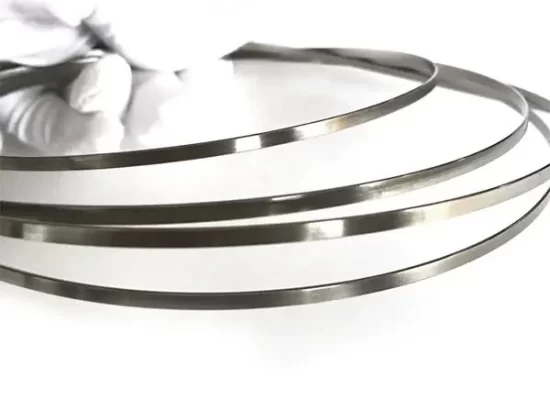
Nitinol flat wire (ASTM F2063) is a precision-rolled or drawn nickel-titanium (NiTi) shape memory alloy with a rectangular cross-section, engineered for applications demanding superelastic strain recovery (8-10%), shape memory effect, kink resistance, and biocompatibility. The flat profile provides higher contact area, directional mechanical properties, and a slim cross-section for space-constrained designs compared to round wire. Princeton Powder supplies Nitinol flat wire in four grade families: Nitinol #1 (superelastic, Af +10 to +18°C), Nitinol #2 (SE, Af 0 to +18°C), Nitinol 60 (wear-resistant, ~60 wt% Ni), and SM495–SM502 (shape memory, Af 20-90°C) — with thickness from 0.05mm to 2.0mm and width from 0.3mm to 10mm. The alloy's defining advantage is its reversible martensitic phase transformation — triggered by stress (superelasticity) or temperature (shape memory) — enabling device functionality impossible with conventional metals like stainless steel or titanium.
Grade Selection Guide
| Grade | Type | Active Af | UTS (Annealed) | Elongation | Key Characteristic | Best For |
|---|---|---|---|---|---|---|
| Nitinol #1 | Superelastic (SE) | +10 to +18°C | ~1,241 MPa (180 ksi) | >10% | Extraordinary recoverable strain 8-10%, kink-resistant at body temp | Medical stents, guidewires, orthodontic archwires — the most-used medical SE grade worldwide |
| Nitinol #2 | Superelastic (SE) | 0 to +18°C | ~1,241 MPa | >10% | Wider Af window — superelastic at lower ambient temps | Room-temperature actuators, eyeglass frames, consumer products |
| Nitinol 60 | Wear-Resistant | N/A | Higher hardness | — | ~60 wt% Ni — superior hardness + wear resistance vs standard Nitinol | Bearings, tooling, high-wear industrial components |
| SM495 | Shape Memory (SMA) | +20 to +40°C | ~1,100 MPa | >10% | Ti-Ni-01 per ASTM F2063 — activates near body temperature | Orthopedic bone staples, thermal actuators, vascular closure devices |
| SM502 | Shape Memory (SMA) | +45 to +90°C | ~1,100 MPa | >10% | Ti-Ni-02 per ASTM F2063 — higher activation temperature for industrial use | Aerospace deployment mechanisms, fire safety actuators, industrial thermal controls |
All Nitinol flat wire is manufactured to ASTM F2063 (medical implant-grade wrought nickel-titanium shape memory alloys). Custom Af temperatures, dimensions, and surface finishes available. Contact our technical team with your application requirements for grade recommendation, Af specification guidance, and quotation.
Material Properties & Performance
| Property | Specification | Significance |
|---|---|---|
| Alloy | Nickel-Titanium (NiTi) — 54.5–57.0 wt% Ni, balance Ti | Near-equiatomic composition enables reversible martensitic transformation |
| Density | 6.45 g/cm³ | Lighter than stainless steel (8.0) — weight savings in aerospace & implantable devices |
| Melting Point | ~1,310°C | High-temperature shape setting at 400-500°C — well below melting point |
| Elastic Modulus (Austenite) | 75–83 GPa | Stiffness when fully superelastic — similar to titanium alloys |
| Elastic Modulus (Martensite) | 28–41 GPa | Significantly softer when transformed — enables low-force deformation for shape memory activation |
| Superelastic Strain Recovery | 8–10% fully recoverable | 5×+ greater than stainless steel (<0.5%) — the defining advantage for medical devices |
| Loading Plateau Stress | >483 MPa (70 ksi) | Constant-force delivery over entire strain range — predictable device performance |
| Ultimate Tensile Strength (Ann.) | ~1,241 MPa (180 ksi) | Comparable to high-strength stainless steel |
| Fatigue Life | >10⁷ cycles (properly processed) | Critical for implantable devices — stent, heart valve, and bone staple durability |
| Damping Capacity | ~10× that of standard steel | Vibration absorption for aerospace and industrial applications |
| Corrosion Resistance | Superior to medical-grade stainless steel — TiO₂ passive layer | Stable in chloride environments (human body); resists pitting and crevice corrosion |
| Biocompatibility | ISO 10993 compliant — well-tolerated by human tissue | Decades of clinical use in implantable medical devices |
How Superelasticity Works — The Reversible Martensitic Transformation
Nitinol's superelasticity and shape memory arise from a reversible, diffusionless solid-state phase transformation between austenite (B2 cubic, high-temperature phase) and martensite (B19′ monoclinic, low-temperature phase). Superelasticity: At temperatures above the austenite finish temperature (Af), Nitinol is fully austenitic. Applied stress induces a phase transformation to martensite — accommodating 8-10% strain without dislocation motion. When stress is removed, the martensite spontaneously reverts to austenite, and the material returns to its original shape. Shape Memory: At temperatures below the martensite start (Ms), Nitinol can be easily deformed. Heating above Af triggers the reverse transformation, restoring the original shape. A 0.1 at.% shift in Ni content changes transformation temperatures by ~10°C — which is why Princeton Powder specifies by Af temperature (not just nominal composition) and provides DSC verification with every lot.
Dimensions, AF Temperature & Surface Finishes
Flat Wire Dimensions
| Production Method | Thickness Range | Width Range | W/T Ratio | Thickness Tolerance | Width Tolerance |
|---|---|---|---|---|---|
| Drawn | 0.10–2.0 mm | 0.3–10 mm | 1:1 to 5:1 | ±3% | ±2% |
| Rolled | 0.05–2.0 mm | 0.3–10 mm | 3:1 to 10:1 | ±6% | ±3% |
Common Stock Sizes (Width × Thickness in mm)
0.6×0.2, 0.8×0.2, 1.0×0.2, 1.5×0.2, 3.0×0.5, 4.0×0.5, 5.0×0.5, 0.6×1.8, 0.9×2.0, 1.0×2.5, 1.5×4.0, 3.0×0.7, 4.0×0.7, 5.0×0.8. Custom dimensions available — contact our technical team with your W×T specification.
AF (Austenite Finish) Temperature — Customizable
The Af temperature is the single most important specification for Nitinol — it determines whether the material exhibits superelasticity or shape memory at the use temperature. Specify by Af, not just grade name.
| Af Range | Behavior at Room Temp (20-25°C) | Behavior at Body Temp (37°C) | Typical Application |
|---|---|---|---|
| −20°C to 0°C | Fully superelastic | Fully superelastic | Cryogenic actuators, cold-temperature deployment |
| 0°C to +10°C | Fully superelastic (Nitinol #2 range) | Fully superelastic | Room-temperature superelastic devices, eyeglass frames |
| +10°C to +18°C | Superelastic (Nitinol #1 range) | Fully superelastic | Medical stents, guidewires, orthodontic archwires — the medical SE standard |
| +20°C to +40°C | Shape memory (deformable) | May activate at body temp | Orthopedic bone staples (SM495), body-temperature actuators |
| +45°C to +90°C | Shape memory (deformable) | Shape memory (stable) | Industrial thermal actuators (SM502), fire safety, aerospace deployment |
Af tolerance: ±5°C standard. DSC (Differential Scanning Calorimetry) per ASTM F2004 provided with every lot. Tighter tolerances available for critical medical applications.
Surface Finishes
| Finish | Appearance | Characteristics | Typical Use |
|---|---|---|---|
| Black Oxide (BO) | Shiny black to blue-black | Diamond-drawn surface, default as-drawn finish | Industrial springs, general-purpose |
| Light Oxide (LO) | Gold to brown | Diamond-drawn surface, thinner oxide layer | Consumer products, eyeglass frames |
| Pickled (P) | Matte, slightly rough | Chemical oxide removal + light base metal removal | Applications requiring bare metal surface for subsequent coating |
| Etched (E) | Smooth, oxide-free | Chemical oxide removal, smooth surface retained | Precision instruments, SEM-quality surface |
| Polished / Bright | Mirror-like (stainless steel appearance) | Etched + mechanically or electrolytically polished; lowest friction, best corrosion resistance, minimal Ni leaching | Medical guidewires, stents, orthodontic archwires — the standard for implantable devices |
| Electropolished (EMP) | Bright, microscopically smooth | Electrolytic polishing — removes surface micro-cracks, reduces Ni ion release, maximizes fatigue life | Cardiovascular stents, neurovascular devices — highest fatigue requirement |
Packaging: Spools (100m, 500m, 1000m) or straight lengths (1m, 2m, 3m) — specify your preferred format. Vacuum-sealed with desiccant for moisture protection. Each spool/length labeled with heat number, Af temperature, dimensions, surface finish, and ASTM F2063 compliance.
Applications
Medical Devices — Stents, Guidewires & Orthodontic Archwires
The largest-volume application for superelastic Nitinol flat wire (ASTM F2063, Af +10 to +18°C) is in minimally invasive medical devices where kink resistance, constant-force delivery, and 8-10% recoverable strain are clinical requirements. Self-expanding vascular stents are laser-cut from Nitinol tubing but rely on flat wire for strut precursor forms and braided stent designs. Guidewires use flat-rolled Nitinol cores for torque transmission through tortuous vascular pathways without permanent kinking — something stainless steel guidewires cannot achieve. Orthodontic archwires in rectangular (flat) profiles deliver constant, gentle force over weeks of tooth movement — the superelastic plateau ensures consistent clinical force levels without periodic retightening. Princeton Powder Nitinol #1 flat wire with polished or electropolished surface finish meets the ISO 10993 biocompatibility, ASTM F2063 chemistry, and DSC Af verification (±5°C) requirements for FDA 510(k) and CE Mark medical device submissions.
Orthopedic Implants & Surgical Instruments
Nitinol's shape memory effect combined with biocompatibility makes flat wire the material of choice for orthopedic bone staples — the most common orthopedic Nitinol application. Implanted in the martensitic (deformable) state below body temperature, bone staples activate upon reaching 37°C, applying constant compressive force across the osteotomy or fracture site to promote healing. SM495 grade (Af +20 to +40°C) is specified for this application. Surgical instruments — including arthroscopic graspers, endoscopic snares, stone retrieval baskets, and laparoscopic retractors — use flat Nitinol wire for its kink resistance, torqueability, and ability to navigate constrained anatomical spaces without permanent deformation. Flat wire's rectangular profile provides directional bending stiffness: stiff in the width direction for pushability; flexible in the thickness direction for navigating curves — an advantage round wire cannot replicate.
Aerospace Actuators, Industrial Springs & Consumer Products
Beyond medical, Nitinol flat wire serves demanding applications where its unique functional properties justify the material premium: Aerospace: SM502 grade (Af +45 to +90°C) flat wire actuators deploy satellite solar panels, antenna reflectors, and thermal control louvers — activated passively by the temperature change between spacecraft shadow and sunlight, requiring zero electrical power. Industrial: Nitinol 60 flat wire is used for high-hardness bearings and wear components that outperform hardened tool steels in corrosive environments. Nitinol springs deliver constant force over wide deflection ranges for precision valves and regulators. Consumer: Superelastic Nitinol #2 flat wire (Af 0 to +10°C) is the material inside flexible eyeglass frames that return to shape after bending; foldable phone hinge mechanisms; and high-end fishing wire that resists permanent kinking. Princeton Powder supplies Nitinol flat wire in all grades from a single source — from R&D spool quantities to production volumes.
Frequently Asked Questions
What is the difference between superelastic and shape memory Nitinol flat wire?
Both effects come from the same reversible martensitic phase transformation — the difference is what triggers it. Superelastic Nitinol (e.g., Nitinol #1, Af +10 to +18°C): The material is fully austenitic at use temperature. Applied stress induces a phase transformation to martensite — accommodating 8-10% strain. When stress is removed, the martensite spontaneously reverts, and the material returns to its original shape. Shape Memory Nitinol (e.g., SM495, Af +20 to +40°C): The material is martensitic at use temperature and can be easily deformed. Heating above Af triggers the reverse transformation, restoring the original shape. Choose superelastic when you need instant, stress-driven recovery (stents, guidewires); choose shape memory when you need temperature-triggered actuation (bone staples, thermal actuators).
Why specify by Af temperature instead of just "Nitinol #1" or "Nitinol #2"?
Because a 0.1 at.% shift in nickel content changes transformation temperatures by approximately 10°C — and Af determines whether your device is superelastic, shape memory, or non-functional at the use temperature. Two batches of "Nitinol #1" with Af of +8°C vs +20°C will perform completely differently at body temperature (37°C). Always specify your Af range (e.g., "Af +10 to +18°C") — not just the grade name. Princeton Powder provides DSC verification (ASTM F2004) with every lot so you can confirm Af before processing.
What surface finish should I choose for medical implant applications?
For implantable medical devices (stents, guidewires, orthopedic implants): Electropolished (EMP) is the gold standard — it removes surface micro-cracks that act as fatigue initiation sites, reduces nickel ion release for ISO 10993 biocompatibility, and provides the lowest-friction surface for device delivery through catheters. Polished / Bright is a cost-effective alternative for non-implantable surgical instruments. For non-medical applications, black oxide, pickled, or etched finishes are standard. Princeton Powder provides surface roughness (Ra) reports for all polished and electropolished orders.
What flat wire dimensions are available and how are tolerances controlled?
Thickness 0.05–2.0mm × Width 0.3–10mm. Drawn flat wire (W/T ratio 1:1 to 5:1) offers tighter tolerances (±3% thickness, ±2% width) — preferred for precision medical devices. Rolled flat wire (W/T ratio 3:1 to 10:1) provides wider profiles at ±6%/±3% tolerance. Common stock sizes: 0.6×0.2mm, 1.0×0.2mm, 3.0×0.5mm, 5.0×0.8mm, 0.6×1.8mm, 1.0×2.5mm. Custom W×T dimensions available — specify your target dimensions and tolerance class when requesting quotation.
How does Nitinol flat wire compare to round Nitinol wire?
Flat wire provides directional mechanical properties that round wire cannot: it is stiff in the width direction (for pushability and torque transmission in guidewires) and flexible in the thickness direction (for navigating curves). The flat geometry also provides higher surface contact area — important for orthodontic archwires (broader tooth contact), stone retrieval baskets (wider stone engagement), and electrical contacts. For applications requiring isotropic bending (equal in all directions), round wire is appropriate. For applications requiring directional stiffness, flat wire is superior.
What documentation do you provide for medical device regulatory submissions?
Every medical-grade Nitinol flat wire order includes the complete documentation package required for FDA 510(k) and CE Mark technical files: ASTM F2063 chemical composition certificate (GDMS/ICP-OES), DSC thermogram with Af/As/Ms/Mf temperatures (ASTM F2004), dimensional inspection report with W×T tolerance verification, surface roughness (Ra) report (polished/electropolished finishes), ISO 9001:2015 + ISO 13485:2016 quality system certificates, full lot traceability from ingot to finished spool, and ISO 10993 biocompatibility support documentation. Contact our regulatory support team for device-specific documentation requirements.
Research & Technical References
The following peer-reviewed research demonstrates Nitinol's performance in biomedical and engineering applications. Princeton Powder Nitinol flat wire meets or exceeds the ASTM F2063 material specifications referenced in these studies.
Heat Treatment Protocol for Additively Manufactured Nitinol Shape Memory Alloys in Biomedical Applications
SSRN / Materials Science & Engineering A, 2024 — Tareq et al. achieved the highest superelasticity reported for LPBF-processed NiTi: 6.52% recoverable strain with 96% recovery ratio after 10 cycles. The optimized protocol — solution treatment at 900°C/1hr followed by aging at 450°C/30min — produced ultrafine Ni₄Ti₃ precipitates enabling a two-step martensitic transformation with an intermediate R-phase that stabilizes cyclic performance. Practical takeaway: Princeton Powder's controlled Ni content (54.5–57.0 wt%) and tight Af specification (±5°C DSC-verified) ensure that Nitinol flat wire forms the Ni₄Ti₃ precipitate distribution necessary for stable, high-recovery superelasticity in medical device applications.
Mechanical and Corrosion Behaviour of Superelastic Additively Manufactured Nitinol for Biomedical Applications
Procedia CIRP, 2024 — Guarise et al. investigated the fatigue-corrosion interplay in superelastic Nitinol for biomedical use, demonstrating that proper post-process heat treatment and electropolishing are essential for achieving both adequate superelastic response and corrosion resistance. Ni₄Ti₃ precipitate formation was linked to both functional performance and reduced Ni ion release. Practical takeaway: For implantable medical devices, specifying electropolished (EMP) surface finish is not cosmetic — it directly improves fatigue life by removing surface micro-cracks and reduces Ni ion leaching for ISO 10993 biocompatibility. Princeton Powder offers in-house electropolishing with Ra reporting per lot.
SLM Additive Manufacturing of NiTi Porous Implants: A Review of Constitutive Models, Manufacturing, Heat Treatment, Mechanical, and Biomedical Studies
Metals and Materials International, Vol. 29, 2023 — A comprehensive review confirming that NiTi's biocompatibility, corrosion resistance, and superelasticity make it the premier material for patient-specific porous orthopedic implants. The review highlighted that a 0.1 at.% shift in Ni content changes transformation temperatures by ~10°C — underscoring the criticality of tight composition control for reproducible medical device performance. Practical takeaway: When specifying Nitinol flat wire for medical devices, always specify by Af temperature (not just "Nitinol #1" grade name) and require DSC verification per lot. Princeton Powder's DSC-verified Af (±5°C) and ASTM F2063 chemistry certification provide the lot-to-lot reproducibility that medical device regulatory submissions require.
Contact our technical team for the full reference list and to discuss Nitinol flat wire grade selection, Af specification, and surface finish requirements for your specific medical device, aerospace, or industrial application.