
Cobalt Granules, Pellets & Evaporation Material — High Purity Supplier
Cobalt granules are small, high-purity metallic particles typically used in alloy production, chemical synthesis, and specialized coatings. Cobalt pellets are uniform, compact metallic pieces designed for efficient melting and alloying processes in metallurgy and electronics industries. They exhibit excellent thermal and magnetic properties, making them ideal for battery manufacturing, aerospace alloys, magnetic materials, and superalloy development.
Cobalt products including Cobalt Chromium Tungsten CoCrW Powder, Pure Cobalt Co Powder, CoCrNi powder, and CoCrMo Powder are for sale at a competitive price.
Formula | Cobalt Granules, Cobalt Pellets |
Part Number | CO1121 |
Purity | 99.9% min |
CAS Number | 7440-48-4 |
Sizes | < 10 mm |
Melting Point | 1495 C |
Boiling Point | 2870 C |
Density | 8.4 g/cm 3 |
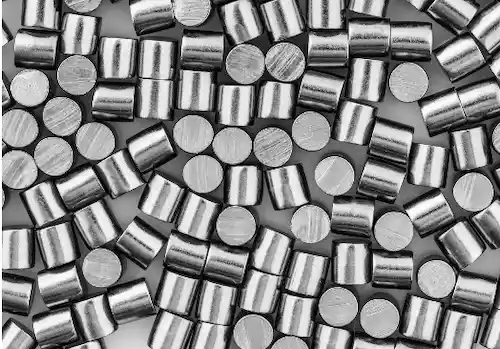
Description of Cobalt Granules, Cobalt Pellets
Cobalt pellets are high-purity metallic materials with excellent magnetic, thermal, and wear-resistant properties. Typically shaped as small, uniform cylinders or spherical pieces, they are designed for precise melting and alloying. These pellets are widely used in the production of superalloys, aerospace components, and magnetic materials, as well as in the synthesis of advanced catalysts. Their consistent shape and size enhance processing efficiency in demanding industrial and research applications.
Manufacturing method of Cobalt Granules, Cobalt Pellets
Cobalt pellets are commonly produced by casting or powder metallurgy techniques. In casting, molten cobalt is poured into molds to form small, uniform pellets, while powder metallurgy involves compressing cobalt powder into pellet shapes under high pressure and sintering them for durability. Both methods ensure consistent size, density, and purity for applications in alloying, electronics, and magnetic material production.
Main properties of Cobalt Granules, Cobalt Pellets
- High Density: Compact structure with consistent weight and size for efficient processing.
- Thermal and Electrical Conductivity: Performs well in thermal and electronic applications.
- Mechanical Strength: Strong and durable, making them suitable for alloying and high-stress environments.
- Particle Size Uniformity: Granules are available in specific sizes, ensuring precision in applications like catalysis or powder metallurgy.
Cobalt Material Specifications
| Property | Specification |
|---|---|
| Material | Cobalt (Co) — High Purity Metal |
| Form | Granules, Pellets, Evaporation Material |
| Purity | 99.8% min (99.9%+ available on request) |
| Density | 8.90 g/cm³ |
| Melting Point | 1,495 °C |
| Key Properties | Ferromagnetic, High Thermal Stability, Corrosion Resistant |
| Primary Applications | Battery Cathode Precursor, Aerospace Superalloys, Magnetic Materials, Evaporation Coating |
| Packaging | Sealed moisture-resistant containers, custom packaging available |
| MOQ | 1 kg (standard grades) |
Why Choose Princeton Powder for Cobalt Materials
- High Purity Cobalt: Our cobalt granules and pellets meet stringent purity specifications for evaporation coating, battery cathode precursor, and superalloy production. Full Certificate of Analysis (COA) with every order.
- Controlled Particle Size: Uniform granule and pellet dimensions ensure consistent melting behavior in e-beam and thermal evaporation processes. Custom size distributions available.
- US-Based Inventory: Domestic stock eliminates long international lead times. Same-day quotes, fast fulfillment.
- ISO 9001:2015 Certified: Rigorous quality management ensures batch-to-batch consistency for production-scale reliability.
- Bulk Supply Capability: From R&D sample quantities to multi-ton production orders — we scale with your needs.
- Technical Support: Application engineers available for material selection, process optimization, and custom specification development.
Applications of Cobalt Granules & Evaporation Materials
Battery & Energy Storage
Cobalt is a critical component in lithium-ion battery cathodes (NMC — Nickel Manganese Cobalt, and LCO — Lithium Cobalt Oxide formulations). High-purity cobalt granules serve as the precursor material for cathode powder synthesis. Princeton Powder supplies cobalt materials with tightly controlled purity and particle specifications to meet battery-grade requirements. The growing demand for EV batteries and grid-scale energy storage makes cobalt one of the most strategically important industrial metals.
Aerospace & Superalloys
Cobalt-based superalloys deliver exceptional high-temperature strength, oxidation resistance, and thermal fatigue resistance — critical properties for turbine blades, combustion chambers, and rocket engine components. Cobalt pellets are the preferred melting stock for vacuum induction melting (VIM) of aerospace-grade superalloys. Our consistent pellet geometry ensures predictable melt characteristics and homogeneous alloy composition.
Magnetic Materials
Cobalt's ferromagnetic properties and high Curie temperature (1,115°C) make it essential for permanent magnet alloys (Alnico), magnetic recording media, and soft magnetic materials. Cobalt granules are used in powder metallurgy routes for producing high-performance magnets used in electric motors, sensors, and actuators.
Frequently Asked Questions About Cobalt Granules & Pellets
What are cobalt granules and pellets used for?
Cobalt granules and pellets are high-purity metallic materials used in evaporation coating, sputtering target manufacturing, battery cathode precursor production, aerospace superalloy development, and magnetic material synthesis. Their excellent thermal stability, ferromagnetic properties, and corrosion resistance make them essential for high-performance industrial applications. Princeton Powder supplies cobalt granules and pellets with consistent particle size and high purity for demanding manufacturing processes.
What purity levels are available for cobalt evaporation materials?
Princeton Powder supplies cobalt granules and pellets at 99.8% minimum purity as standard, with 99.9% and 99.95% (3N5) grades available on request. Every order includes a Certificate of Analysis (COA) documenting the actual purity, particle size distribution, and trace element composition of your specific lot.
What is the difference between cobalt granules and cobalt pellets?
Cobalt granules are smaller, irregular-shaped particles optimized for alloy production, chemical synthesis, and specialized coatings. Cobalt pellets are larger, uniformly compacted pieces designed for efficient melting and alloying processes in metallurgy and electronics industries. Granules offer faster dissolution and higher surface area; pellets provide consistent melting behavior in vacuum and inert-atmosphere furnaces. Princeton Powder supplies both forms — contact us for application-specific guidance.
What is the minimum order quantity (MOQ) for cobalt materials?
Standard MOQ is 1 kg for stock cobalt granule and pellet grades. Custom purity specifications, non-standard particle sizes, or specialized packaging may have higher minimums. We routinely fulfill orders from R&D laboratory quantities to full production volumes. Contact our sales team for a same-day quote.
How are cobalt granules packaged for international shipping?
Cobalt granules and pellets are packaged in sealed, moisture-resistant, oxygen-barrier containers to prevent oxidation during transit. Each shipment includes full export documentation: Commercial Invoice, Packing List, Certificate of Origin, and material COA. We ship globally via DHL, FedEx, and freight forwarders. Standard handling time: 3-7 business days.
Can Princeton Powder provide custom cobalt granule specifications?
Yes. We offer custom particle size distributions, custom purity grades (up to 99.95%+), and custom packaging configurations for OEM and research requirements. Our technical team works directly with your engineering group to develop cobalt materials optimized for your specific evaporation, sputtering, or alloying process. Contact us for a feasibility assessment and quote.
Cobalt Granules, Cobalt Pellets Scholar Articles
Spark Plasma Sintering of Cobalt Powders in Conjunction with High Energy Mechanical Treatment and Nanomodification
Spark plasma sintering (SPS) investigations were carried out on three sets of Co specimens: untreated, high energy mechanically (HEMT) pre-treated, and nanomodified powders. The microstructure, density, and mechanical properties of sintered pellets were investigated as a function of various pre-treatments and sintering temperatures (700–1000 °C). Fine-grained sinters were obtained for pre-treated Co powders; nano-additives tended to inhibit grain growth by reinforcing particles at grain boundaries and limiting grain-boundary movement. High degree of compaction was also achieved with relative densities of sintered Co pellets ranging between 95.2% and 99.6%. A direct co-relation was observed between the mechanical properties and densities of sintered Co pellets. For a comparable sinter quality, sintering temperatures for pre-treated powders were lower by 100 °C as compared to untreated powders. Highest values of bending strength (1997 MPa), microhardness (305 MPa), and relative density (99.6%) were observed for nanomodified HEMT and SPS processed Co pellets, sintered at 700 °C.